Institutional-Grade Research at an Everyday Investor’s Price
Professional-level due diligence delivered in plain English. A screener that does the heavy lifting. Expert portfolio tracking & market commentary. A private community of investors who amplify each other's portfolios. Everything a Canadian self-directed investor needs to take their portfolio to the next level


As Featured In
DIY Investing Shouldn't Feel Like a Second Job
Hours of Research, No Clarity
You're scanning articles, Reddit threads, and brokerage reports trying to piece together whether a stock is actually worth buying. By the time you decide, the opportunity has passed.
Buying on Gut Feel
Without a system and fundamental understanding, most investors end up chasing headlines or tips from coworkers or influencers. You know you should be looking at the fundamentals. You just don't have the tools or the time.
Investing Alone
There's nobody to bounce ideas off of. No one to say "I wouldn't touch that stock" or "this one just reported strong earnings." You're making every decision in a vacuum.
Research, Tools, and Community. All in One Place.
Every report takes over 200+ metrics into consideration, grading stocks across 7 core areas. Having access to the data is one thing. Being able to interpret it to find strong companies is another. 6,000+ companies and growing.
The Bull List is for high-conviction companies we believe have potential. The Foundational List is for rock-solid core holdings to buy and hold forever. Both are continuously updated with quarterly commentary on every single stock.
Dan publishes his personal holdings, every transaction, and his actual returns alongside weekly commentary. You aren’t just getting research; you’re seeing exactly how he invests his own capital. With over 95% of his portfolio allocated to Bull List and Foundational stocks, he truly puts his money where his research is.
Our proprietary grading system analyzes 7000+ stocks on over 140 data points to come up with an institutional-grade screener and research report system. It's what you wished your brokerage screener could do.
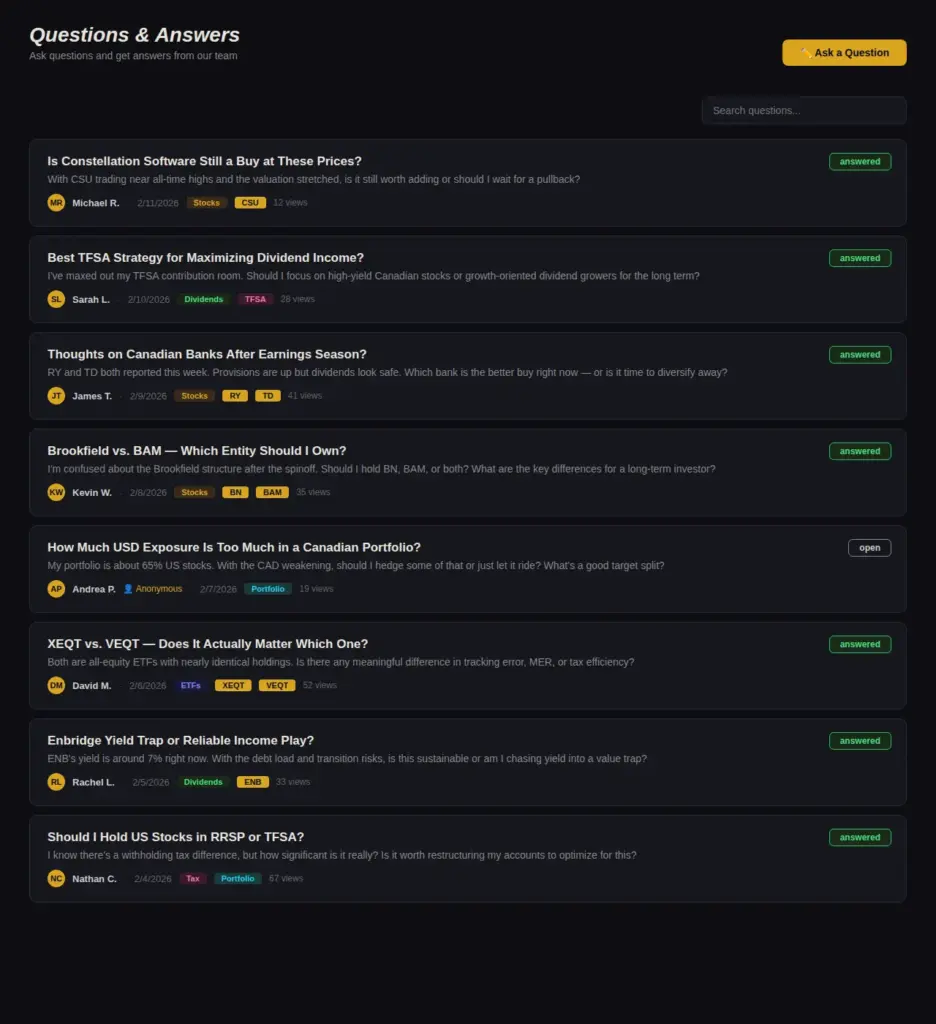
"Is Telus still a buy after it stopped dividend growth?" "Should I hold or sell my bank stocks?" "Do I have too much Canadian exposure?" Ask anything and get a real, thoughtful answer from Dan, typically within 24 hours. It's like having an expert on speed dial.
Add your holdings, track your cash flows, and see where you stand. Portfolio analysis, income tracking, warning signs, and more. Too many platforms make portfolio tracking WAY too complicated. Stocktrades doesn't.
See what the entire Stocktrades community is buying, selling, and watching. Most bought, most sold, most owned, and most watched stocks — collective intelligence in real time.


2,000+ Investors. Zero Noise. All Signals.
The tools are worth the price of admission alone. But ask any member what keeps them subscribed and they'll tell you: it's the people.
Private Discord Server
Real-time stock discussion with 2,000+ Canadian investors. Earnings reactions as they drop. Market open check-ins. "What do you think about this one?" conversations that actually help you decide. It's like having a room full of sharp investors on speed dial.
See What the Community Is Doing
Our Premium Stats dashboard shows the most bought, most sold, most owned, and most watched stocks across all members. It's collective intelligence in real time. See where conviction is building before the crowd catches on. Has the community dumped a stock you own? Ask why. Have buys increased considerably on a stock on your watchlist? Maybe now is the time to pull the trigger.
Dan Is in the Trenches With You
This isn't a service where the founder disappears after you subscribe. Dan is in Discord daily, sharing his thinking on market moves, answering questions personally, and posting trade updates in real time.
"Favourite thing about Stocktrades is the Discord and the positive community that it has become! Any little question is answered thoroughly by Dan, Matt or another knowledgeable member. Excellent job guys!"
"I really do think Stocktrades.ca offers excellent guidance. The other main plus is how accessible Dan and Mat are in the Discord channel. In addition, the feedback from other premium members is great too."
"These people, this service, actively connect with their clients on a daily basis through interactive discussion. Their success is determined by their client's success, rather than based on selling info."
We Don't Just Talk. We Show Receipts.
These are real stocks highlighted to Premium members over the years. Dan's portfolio is public. His transactions are logged. His commentary explains every move. No other Canadian service offers this level of transparency.
Past performance does not guarantee future results. These represent select highlights.
See What's On the Lists Nowstocks highlighted on Premium
Ask Any Question. Get a Real Answer.
Not a canned response. Not a link to an FAQ. You ask a question about your specific situation and get a thoughtful, personalized answer from someone who's been investing for over 16 years.
"Should I still be buying stocks in this market? Are we not due for a correction?"
"What is your number one conviction play on the Canadian markets right now?"
"At current valuations, which Canadian bank stock would you start with?"
What Changes When You Join
Decisions Get Faster
When every stock has a detailed report, a grade, and community sentiment data, you stop agonizing and start acting. Members tell us they cut their research time by 80%, especially with the clarification they get from direct access to Dan.
Market Drops Stop Scaring You
When you understand what you own and why you own it, a red day is an opportunity instead of a panic attack. The community helps you stay grounded when headlines get loud.
Your Portfolio Gets Sharper
Better data, better picks, better allocation. Members regularly tell us Premium pays for itself in the first month simply because of the tools they have access to and the large-scale benefits it has on their portfolio.
Real Members. Real Words. Unedited.
"The premium membership has been well worth it. Easily paid for itself 10x+. I turned subpar results investing on my own to handily beating the TSX with their advice."
"It's like talking to a friend over a beer; relaxed, friendly, excellent information and no high pressure FOMO tactics. At all. Some of the advice has already SAVED me a lot of money."
"I have been a StockTrades Premium member for 2+ years. It has been the best investment I have ever made. The suggestions, backed by well-thought out research made sense, and also made money."
"I have purchased most of your dividend producing stocks, and I am very pleased. My portfolios are growing, and most days all my holdings are positive."
"I made the switch to 100% DIY as a late stage investor and find the premium tools here invaluable. I wish I had these guys behind me ten years ago."
"Dan and the rest of Stocktrades are very dedicated, and the platform is second to none. Being a Premium member is literally like having your very own advisor/analyst available daily."
Less Than a Coffee a Day
30-day money-back guarantee. Cancel anytime. No hidden fees.
- 7,000+ Stock Reports, Updated Daily
- Portfolio Tracker with Analysis
- Stock Screener & 140 Point Grading System
- Dan's Real Portfolio - Transactions & Commentary
- Bull & Foundational List - Top Opportunities Today
- Private Discord + Unlimited Q&A
- See What Over 2000 Members Are Buying & Selling
- Additional Features at NO Additional Cost
30-Day Money-Back Guarantee
Try the full platform for 30 days. If it doesn't change how you invest, we'll refund every penny. No questions, no hassle, no hard feelings.
Common Questions
How does this compare to other Canadian investment services?
Most services sell you a list of picks and disappear. We give you the full research platform, the screener, the community, and direct access to the team. Dan publishes his real portfolio. No other Canadian service offers that level of transparency.
I'm a complete beginner. Will I be lost?
Not at all. Many members started with zero experience. The reports are written to be understood, the Discord community is welcoming to new investors, and the Q&A means you can ask anything without feeling dumb.
What's the Discord community actually like?
It's 2,000+ Canadian investors having real conversations. Earnings reactions, "what do you think of this one?" debates, portfolio gut checks, market news. Dan and the team are in there daily. No spam, no meme stocks, no nonsense.
Do you cover US stocks too?
Yes. While our roots are Canadian, we cover 7,000+ companies including major US markets. The screener, reports, and buy lists all include US stocks that meet our quality bar.
Can I cancel anytime?
Yes. Cancel with a few clicks in your account settings. No phone call, no guilt trip, no hidden fees. We also offer a 30-day money-back guarantee so you can try risk-free.
How often is the content updated?
Stock data refreshes every 15 minutes. Buy lists are updated quarterly with full commentary. New research publications go out weekly. Dan's portfolio transactions are posted in real time. The Discord is active daily.
Your Portfolio Will Thank You
Join 2,000+ Canadians who stopped guessing and started investing with conviction, community, and real data behind every decision.
Get Instant Access 30-day money-back guarantee | Cancel anytime | No hidden fees