

This article was created using the transcript of my Youtube video on ranking the top gold stocks. AI was used to create the article.
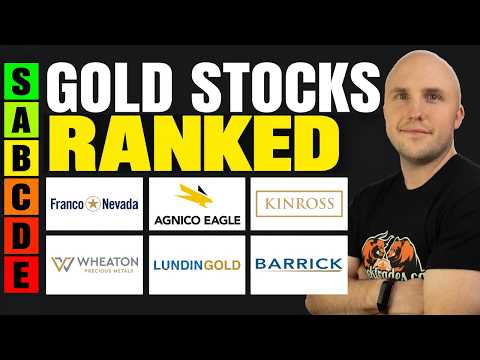
I ranked six of the largest gold companies in Canada from S to E: Agnico Eagle, Barrick Mining, Wheaton Precious Metals, Franco-Nevada, Kinross Gold and Lundin Gold. It’s one stock per tier, so somebody has to land in E. This list mixes two very different businesses. Wheaton and Franco-Nevada are streaming and royalty companies, while the other four are miners, and they carry very different risks. Pay attention to those differences, because they drive most of this ranking.
Why Gold Stocks Are Down
Through 2025 and into 2026, the price of gold went straight up. Weekly closes peaked above US$5,000 an ounce in January, and gold has since broken back below US$4,000. The main reason is that markets now expect US interest rates to go up. Gold pays no interest, so it gets less attractive when rates are higher. It is still historically high, largely because of inflation, but the drop has hit these stocks hard.

Every company on this list is well off its 2026 high. The two streamers fell the least.

Miners vs Streamers: What a Falling Gold Price Does to Margins
A miner’s costs barely move when gold falls, so its profit per ounce falls a lot faster than the gold price. A streaming or royalty company pays very little per ounce, so its margins hold up much better.
Here’s a quick explanation of how the streamers work. In a stream, the company pays a miner cash upfront, and in return it gets to buy part of that mine’s future gold or silver at a low fixed price, usually for the life of the mine. In a royalty, it gets a percentage of what the mine sells, with no share of the operating costs. Most of the miners signing these deals are copper miners, where gold and silver are side products, so selling them in advance is cheap money to build or expand a mine.

This is roughly what each company keeps per ounce (or per gold equivalent ounce for the streamers) at today’s price, and what happens if gold falls to US$2,500. The cost measures aren’t identical between miners and streamers, so read this as how fast margins shrink, not as comparable free cash flow.
| Company | Cost Basis | Margin at US$3,900 Gold | Margin at US$2,500 Gold | Change |
|---|---|---|---|---|
| Franco-Nevada | ~US$330 cash cost | ~US$3,570 | ~US$2,215 | -38% |
| Wheaton | ~US$600 cash cost | ~US$3,300 | ~US$2,020 | -39% |
| Lundin Gold | ~US$1,130 AISC | ~US$2,770 | ~US$1,510 | -45% |
| Agnico Eagle | ~US$1,510 AISC | ~US$2,390 | ~US$1,030 | -57% |
| Barrick | ~US$1,825 AISC | ~US$2,075 | ~US$745 | -64% |
| Kinross | ~US$1,853 AISC | ~US$2,048 | ~US$718 | -65% |
AISC is the all-in sustaining cost: what it costs a miner to produce an ounce of gold, including the spending needed to keep its mines running. This table is why the streamers have held up better, why they’re the more consistent business model, and why the miners are getting hit so hard.
Wheaton Precious Metals (TSX: WPM): B Tier
Wheaton is a 47-person company, and I mean that literally: it has 47 employees. It does not run mines. It pays miners cash upfront and buys part of their future gold and silver at a low fixed price.

It’s about a C$74 billion company, up around 18% over the past year, with a 0.7% dividend yield. Like Franco-Nevada, you won’t get a high yield here. These are low-yield dividend growers where most of the return comes from the share price. Wheaton’s dividend was cut 64% between 2013 and 2015, during a very big gold and silver bear market, and it took about eight years to get back to where it was. I can’t completely blame them for that, but there is a company on this list that didn’t cut.
Its cash cost is about US$568 per gold equivalent ounce, so the margins are very high, as they are for any streamer. The best example of how a stream pays off is Salobo. Wheaton paid Vale US$3.57 billion in stages from 2013 to 2025 for 75% of the gold from its Salobo copper mine in Brazil. Wheaton now pays US$433 an ounce for that gold, and sold it for US$4,452 an ounce in the second quarter of 2026. Salobo was 45% of 2025 revenue, has paid back its cost and keeps producing for about 20 more years. Streamers sign a lot of small and mid-size deals. Some will lose money, but a home run like this one just prints cash.
The problem right now is silver. In 2026 Wheaton paid US$4.3 billion for a silver stream on BHP’s share of the Antamina mine in Peru, the largest stream ever. It was priced when silver averaged about US$88 an ounce. Silver is now around US$49. On current reserves alone, the deal doesn’t earn back its cost even at US$80 silver, so it depends on the mine life getting extended.

The deal also turned Wheaton into a majority silver company. Silver was 52% of revenue in the second quarter of 2026, gold 46%, and cobalt a tiny remainder. To pay for it, Wheaton went from US$1.2 billion of net cash to US$1.9 billion of net debt in six months, on top of about US$2.37 billion it has already committed to other miners. About 77% of its output now comes from Latin America.
Bull case: It keeps most of each ounce even in a gold crash. Salobo has paid back and keeps producing. Overhead is tiny, and there has been very little share dilution since 2016.
Bear case: It’s now about half silver, after a big silver bet made near the top. It has net debt for the first time in years, and most of its output comes from Latin America.
Before this silver deal, Wheaton would have been A tier for me all day. It’s a premier streamer, and I like the streaming model more than the mining model. But in my eyes the BHP deal was a pretty bad one. It won’t bankrupt the company, but it could hurt results if silver keeps falling, and Wheaton kind of needs silver to get back to that US$80 range. Wheaton goes in B tier.
Barrick Mining (TSX: ABX): E Tier
Barrick was probably the most popular gold producer in North America for a very long time, and I owned it about 15 years ago. This is the former king of gold, and it’s shrinking. The company renamed itself from Barrick Gold to Barrick Mining in 2025. It produced 3.26 million ounces of gold in 2025, down from 6.1 million in 2015.

It’s about a C$86 billion company, up 12% over the past year, with a base dividend yield of about 1.9%. It cut its dividend 75% in 2013 and another 60% in 2015, which happened to pretty much every miner in that bear market. The base dividend is still below its 2012 level.
About 49% of its gold comes from Nevada, mostly through Nevada Gold Mines, the world’s largest gold complex. Barrick owns 61.5% and runs it, and Newmont, the biggest gold miner in the world, owns the other 38.5%. The rest comes largely from Africa, the Dominican Republic and South America. Some of those mines are expensive. Loulo-Gounkoto in Mali has all-in sustaining costs of US$2,640 to US$2,900 an ounce, so it wouldn’t take much more of a drop in gold to make it a loss-making mine. Barrick’s company-wide AISC guidance for 2026 is US$1,760 to US$1,950, one of the higher ones on this list. Copper is about 12% of earnings.
Barrick plans to IPO a minority stake in its North American mines. If it had done that with gold near US$5,500, I could see it being a very good proposition. With gold stocks taking a big hit, it may get pushed into 2027. Barrick would keep majority control either way.
It has no gold hedges, so every US$100 move in gold shifts its share of yearly EBITDA by about US$270 million. Net cash is about US$1.2 billion, and Newmont is due to pay it US$1.95 billion in a deal over the Fourmile discovery. Barrick bought back US$1.2 billion of stock in the second quarter of 2026 alone, more than eight times that quarter’s free cash flow. The company clearly sees its shares as cheap.

Bull case: It’s among the cheapest of the six, below 5x EV/EBITDA. Only Kinross is cheaper. It has visible growth with more gold by 2028 and a 30-year copper expansion in Zambia. Splitting out the North American mines could get them a better valuation. Some of the highest-grade gold mines in the world are being dragged down by the costly mines in Africa, and I’d be interested in the North American spinout if it happens.
Bear case: Gold produced per share is down 60% since 2016. About a third of its gold comes from Mali, the DRC, Tanzania and Papua New Guinea, which aren’t the most profitable or the most stable places to operate. And it has a long record of costly mistakes, including US$8.7 billion of write-downs in one quarter in 2013, and then Mali in 2025.

Barrick goes in the basement: E tier. I think it’s the weakest of these six companies, streamer or producer. It’s the second-cheapest stock on the list, and I think it’s second-cheapest for a reason.
Kinross Gold (TSX: K): D Tier
Kinross is a Toronto gold miner with no producing Canadian mine. It’s down 46% from its 2026 high and is getting absolutely wrecked this year. Before the big rise in gold, it was a much smaller company. Now it’s about a C$33 billion company.

Its mines are in Brazil, Mauritania, Nevada, Alaska and Chile. It’s developing Great Bear in Red Lake, Ontario, but first gold there is targeted for late 2029, a long way out. If you buy Kinross today, you’re buying a gold miner with a lot more exposure to riskier countries than most of the others on this list. Only about 34% of its production comes from the United States, with about 30% from Brazil, 25% from Mauritania and the rest from Chile. I think that’s a big part of why it’s down the most. If you want an example of how much this matters, look at First Quantum, which lost its Cobre Panamá mine in 2023 and got crushed.
The dividend yields about 0.8%. Kinross suspended its dividend in 2013, paid nothing from 2014 to 2019, and only started paying again around COVID. All-in sustaining cost guidance for 2026 is US$1,850 to US$1,900 an ounce, the highest of the six.
Two mines in Brazil and Mauritania produce 55% of its gold and about 61% of mine-level profit. The Brazil mine, Paracatu, is so low grade that about 2.5 tonnes of ore hold roughly one gram of gold. It works on sheer scale. The older mines in Nevada and Alaska cost more: Round Mountain in Nevada had a cost of sales of US$2,557 an ounce in the third quarter, the highest in the company. That’s its mine in a safer jurisdiction, running at the highest cost.
2026 has been rough. Kinross cut production guidance, missed third-quarter revenue, raised cost guidance and had two contractor deaths at its Bald Mountain mine in Nevada. Great Bear could produce about 500,000 ounces a year at about US$800 an ounce, which would be much lower-cost production, but I’m not giving it a ton of credit for something that far out.
The balance sheet is solid. It has US$1.9 billion of net cash, investment-grade ratings and no debt due until 2033. It returns 50% of free cash flow and bought back about US$810 million of stock in 2026, which is meaningful for a company this size.

Bull case: It’s the cheapest of the six at about 4x EV/EBITDA, with US$1.9 billion of net cash. It has two low-cost anchor mines, growth from 2028, and Great Bear could be a low-cost Canadian mine in 2029.
Bear case: It has the highest costs of the six, so if gold keeps falling its margins get crushed. Gold produced per share is down 28% since 2016, and several of its mines are short-lived. And it has a bad history of awful deals: about US$7.1 billion for Tasiast in Mauritania in 2010, with billions written off later. In 2022, Russia forced it to sell its mine there for about half the agreed price. And it suspended the dividend in the last gold bear market.
I haven’t been bullish on Kinross through any of this, so it’s firmly in D tier. Honestly, Barrick and Kinross are so close that you could swap them. They’re pretty much interchangeable at the bottom of this list.
Lundin Gold (TSX: LUG): C Tier
Lundin Gold is probably the one a lot of people haven’t heard of. It’s the smallest company on this list, at about C$20 billion, but it’s still one of the largest Canadian gold producers.

It owns one mine, Fruta del Norte in Ecuador, one of the highest-grade gold mines anywhere at about 9 to 10 grams per tonne. Compare that to Kinross’s Paracatu at one gram per 2.5 tonnes. Fruta del Norte makes about 500,000 ounces a year at about US$1,100 an ounce, the lowest cost of any miner on this list. That factored into my ranking quite a bit, but so did the fact that this is a pure play on one mine in one country. This was a very difficult company to rank.

The story of this mine is wild. Kinross bought it for about C$1.2 billion in 2008, walked away over a 70% windfall tax in 2013, and sold it to the Lundins for US$240 million in 2014. That’s another Kinross mistake, and part of why Lundin ends up ranked above it.

Production started in 2020, and from 2022 to 2025 it averaged around 490,000 ounces a year against the 340,000 it had planned. The third quarter of 2026 was a record at about 153,700 ounces. Grade is its edge: less rock to dig and process per ounce means very low costs. Grade is expected to drift lower over time, and it’s studying a mill expansion to hold production around 500,000 ounces a year, but this isn’t a mine that’s about to deteriorate quickly.
It has no financial debt and around US$500 million in cash. Newmont owns about 32% of the company and the Lundin family about 26%. The stock is down about 15% over the past year and shows a 7.2% trailing yield, but the word trailing is key. Only about 2% of that is the fixed dividend. The rest is variable, and it shrinks automatically when gold falls. It paid US$664 million of dividends in 2025, and you’re probably not going to get a 7% yield going forward.
Ecuador takes a big cut: a 5% royalty, 22% income tax, a 12% state profit share, a 3% employee profit share, and a guarantee that the state gets at least half of the project’s cumulative benefits. The country has a lot of negotiating power over a single-mine company, and there may be nothing Lundin can do if it makes the terms more stringent.
Bull case: It’s the lowest-cost miner here thanks to an exceptionally high-grade mine. It has no debt and among the highest payouts in the sector. Reserves keep growing and are planned at US$1,700 gold.
Bear case: One mine, one country. A tax fight with Ecuador has started: in September 2026 the tax authority assessed US$73 million plus up to US$81 million of potential fines for 2023, which Lundin disputes. Tax is the reason Kinross walked away from this mine. We’ve seen with Cobre Panamá that governments sometimes just shut a mine down.
It has a higher-quality mine and much lower costs than both Barrick and Kinross, and I think the risk is worth the potential reward if there’s no turmoil around this mine. Lundin goes in C tier, with the caveat that you need to watch the Ecuador situation closely. It’s a high-quality, very well-run company with a lot of risk that’s out of its control.
Agnico Eagle (TSX: AEM): A Tier
We’re down to the last two, and I don’t think anybody should be surprised which two remain. I own Franco-Nevada. I sold Agnico Eagle way too early. I owned Kirkland Lake for its Detour Lake mine, and when the two merged I didn’t take the time to dig into Agnico, so I sold for a decent profit. That was nowhere close to what I could have made if I had held.

In my opinion, Agnico is the lowest-risk gold miner on this list. About 87% of its gold comes from Canada, and about 98% from Canada, Finland and Australia. A lot of your thesis with a gold miner comes down to where it mines, and new gold investors often don’t keep tabs on that. Its all-in sustaining cost was US$1,529 an ounce for the first nine months of 2026, compared to about US$1,100 for Lundin, but Agnico is very unlikely to get into tax disputes with established countries where it provides a lot of employment.

It’s a C$117 billion company, roughly flat over the past year, with a dividend yield of about 1.1%. It has ten mines, mostly in Canada. Detour Lake in northern Ontario is Canada’s biggest gold mine, about 20% of Agnico’s output, with a mine plan to 2052. It’s a gem of a gold mine, and it’s why Agnico went after Kirkland Lake. It’s low grade and high volume: a tonne of rock holds less than a gram of gold, about the weight of a paperclip, so it works by moving enormous amounts of rock. That means costs are climbing as diesel, labour and tariffs on drill bits go up. Third-quarter AISC was up 24% from a year earlier. It’s not a thesis breaker, but it’s something to watch.
Agnico has grown through mergers: Kirkland Lake in 2022, Yamana’s Canadian mines in 2023, and billions of dollars of deals in Finland in 2026. And look at how fast the balance sheet has improved. It had net debt every year from 2016 to 2024, and now has US$3.4 billion of net cash.

The dividend is US$1.80 a share and has been paid every year since 1983, though it was cut 64% in 2014. Pretty much every miner cut during that bear market. Agnico bought back US$800 million of stock in 2026 and expects to return more than half of its 2026 free cash flow to investors, a lot like the oil companies right now.
Bull case: About 98% of its gold comes from lower-risk countries, by a country mile the most of any miner on this list. With US$3.4 billion of net cash, it can keep growing through a gold slump, either by buying assets that have dropped in price or by buying back its own stock. Reserves are planned at US$1,600 gold, and its growth comes from mines it already owns. It’s well positioned for decades.
Bear case: It’s still a price taker. Its margin per ounce falls about 57% if gold drops to US$2,500. Gold produced per share is down 8% since 2016, because the mergers added more shares than ounces. And it’s priced like the best miner: 7.4x EV/EBITDA against 4 to 5x for Barrick and Kinross. Still, I’d pay 7.4x for Agnico before I’d pay 4 or 5x for either of those two.
If we stripped the streamers off this list, Agnico would be S tier all day. I think it’s the best gold miner in the world. With the streamers on here, it goes in A tier. It’s a premier company, but miners are heavily exposed to the price of gold, and there’s nothing they can do about it.
Franco-Nevada (TSX: FNV): S Tier
This is my favourite company in the sector, one I own, and it’s been featured on Stocktrades Premium since we launched the platform in 2018. I think it’s the best way to get long-term exposure to gold. Miners can make you more over the short term, but I believe the streamers win the long-term battle.

Like Wheaton, it owns royalties and streams, plus oil and gas interests, mostly across the Americas. It gets a cut of production without paying to run the operations. It turned US$1.82 billion of 2025 revenue into about US$1.66 billion of EBITDA with 44 employees, and it has no debt. It has never cut its dividend, and it has raised it 19 years in a row, including through one of the worst gold bear markets we’ve seen.

From 2011 to 2015, Franco-Nevada’s share price rose about 67% while gold fell 35%, Agnico fell 42%, Wheaton fell 44%, Barrick 79% and Kinross 84%. It absolutely crushed it in a horrendous environment for gold.
Its cash cost is about US$347 per gold equivalent ounce, which rolls its gold, silver, oil and gas into one gold-equivalent figure, the same way an oil company reports barrels of oil equivalent. About 71% of revenue is gold and 13% silver. That’s the main difference from Wheaton, which is now a majority silver company. A good royalty example is the 2% it gets of everything Agnico’s Detour Lake mine sells. Franco gets paid off the top line, regardless of operating costs, even if the mine runs at a loss. On the streaming side, it pays upfront, then buys gold or silver at about US$400 an ounce or about 20% of the market price. Its biggest asset now is Candelaria in Chile, about 13% of revenue.
It also made one of the most legendary bets in the space. In the mid-1980s, the founders paid about US$2 million, half their cash at the time, for a royalty on Goldstrike in Nevada. Barrick then found about 50 million ounces of gold under it, and that royalty still paid Franco-Nevada US$22.8 million in 2025.

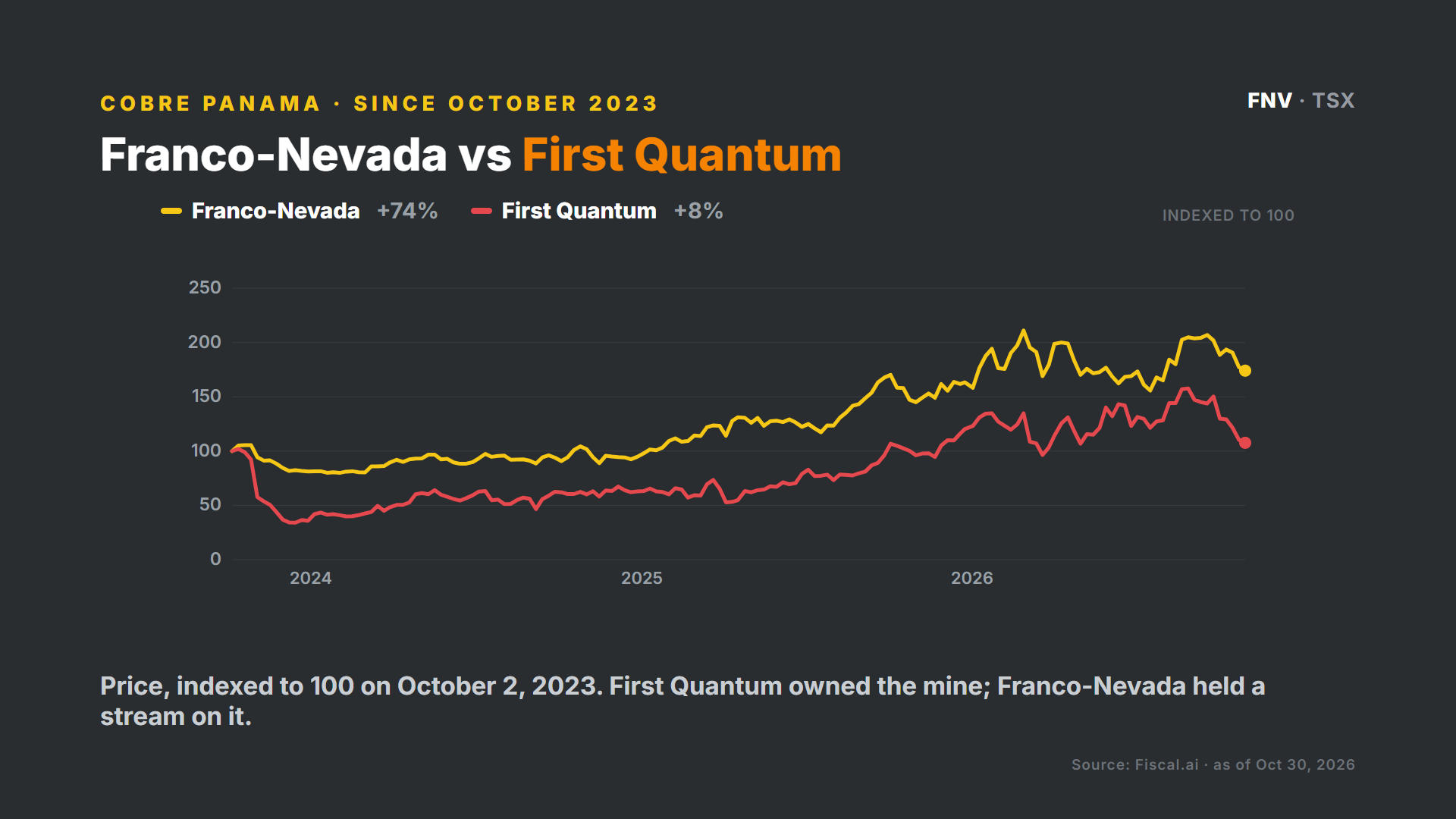
The one deal that really hurt was Cobre Panamá. It was about 20% of revenue until Panama shut it down in 2023, and Franco wrote it down to zero. A Panamanian government commission now recommends negotiating a time-limited deal, but the terms are unknown, and there’s still a lot of debate over whether the mine reopens or stays closed. It shows that a streamer isn’t completely sheltered from a higher-risk jurisdiction. But look at the difference between the company that owned the mine and the company that held a stream on it. First Quantum got crushed. Franco has largely recovered.
Its balance sheet has no debt and about US$1 billion in cash, with about US$4.3 billion of available capital including undrawn credit, so it can do pretty much any deal it wants. The dividend was US$1.70 a share over the past year, about 20% of operating cash flow, and the current rate is US$1.76. It has spent about US$3 billion on new royalties since 2024, many priced near record gold.

Bull case: It has the best margin profile of any company on this list, so it’s the most resilient of the six in a gold crash. No debt, a dividend that has never been cut, and Cobre Panamá on the books at zero. It ripped the Band-Aid off, so any restart is upside.
Bear case: Valuation. It’s the most expensive stock here at about 20x EBITDA with a 0.8% yield. You are paying for quality. Precious metals production per share is down about 12% since 2016, though I imagine there are a lot of deals to be made in the space right now. And there’s political risk: Peru alone was about 21% of 2025 revenue, Panama is unresolved, and there’s a disputed stream in Burkina Faso.
Franco-Nevada goes in S tier. It has the highest margins and, in my opinion, it’s the highest-quality company in the group. It’s the gold star of exposure to the gold industry. Funny enough, a gold star is its logo, which I didn’t make up.
The Final Board

| Stock | Ticker | Type | 1-Year Price | Dividend Yield | Cost per Ounce | Tier |
|---|---|---|---|---|---|---|
| Franco-Nevada | FNV | Royalty and streaming | +19% | 0.8% | ~US$347 cash cost | S |
| Agnico Eagle | AEM | Miner | +1% | 1.1% | US$1,529 AISC | A |
| Wheaton Precious Metals | WPM | Streaming | +18% | 0.7% | ~US$568 cash cost | B |
| Lundin Gold | LUG | Miner, one mine | -15% | ~2% fixed, 7.2% trailing | ~US$1,140 AISC | C |
| Kinross Gold | K | Miner | -16% | 0.8% | US$1,850-1,900 AISC | D |
| Barrick Mining | ABX | Miner, gold and copper | +12% | ~1.9% | US$1,760-1,950 AISC | E |
Franco-Nevada has the highest margins and the highest quality in the group. Agnico Eagle is what I’d call the best gold miner in the world. If Wheaton hadn’t made what I view as a poor silver bet, it would probably be second, because I like the streaming model so much more than the producer model. Lundin has one of the highest-quality mines on this list, but it only has one, and if it gets into trouble there the stock will drop. Kinross and Barrick are the two I’d call poorly run. Kinross has made a lot of bad capital decisions over the years, and a rising gold price lifted both of them. If Barrick spun out its North American mines separately, I’d definitely keep an eye on that, but its international mines are low enough quality that I’m not very interested in the rest.
One last thing. Even the streamers are exposed to the gold price, though much less than the producers. If gold keeps falling, these stocks will keep falling, and there’s nothing they can do about it operationally. If you want to buy and truly hold without looking at it again, I think the streamers are the way to go. The miners benefit more when gold prices are rising fast.
FAQ
What is the best Canadian gold stock to buy?
On this board, Franco-Nevada ranks highest (S tier) for its margins, no debt and 19 straight years of dividend raises without a cut. Agnico Eagle (A tier) is the top-ranked miner, with about 98% of its gold coming from lower-risk countries.
Are gold miners or gold royalty and streaming companies better investments?
Streaming and royalty companies like Franco-Nevada and Wheaton pay a small, mostly fixed cost per ounce, so their margins fall much less when gold drops. In our scenario, their margins shrink about 38% to 39% if gold falls from US$3,900 to US$2,500, compared with 45% to 65% for the miners. Miners tend to gain more when gold rises quickly. Streamers trade at much higher valuations, around 20x EBITDA against 4 to 7.4x for Agnico, Barrick and Kinross.
Why are Canadian gold stocks down in 2026?
Gold fell from weekly closes above US$5,000 in January to below US$4,000, largely because markets now expect US interest rates to rise, and gold pays no interest. Because miners’ costs don’t fall with the gold price, their profits fall faster, which is why Kinross, Lundin and Agnico are down more than the streamers.
Is Lundin Gold’s 7% dividend yield sustainable?
The 7.2% is a trailing yield. Only about 2% is the fixed dividend. The rest is a variable payout tied to free cash flow, which falls automatically when gold falls, so the forward yield is likely to be lower.
Why is Wheaton Precious Metals only B tier?
Its US$4.3 billion silver stream on BHP’s share of Antamina was priced when silver averaged about US$88 an ounce. Silver is now around US$49. The deal made Wheaton a majority silver company and took it from US$1.2 billion of net cash to US$1.9 billion of net debt. Without that deal, it would have been A tier.
Nothing in this article is investment advice. Do your own research before buying any stock.


