
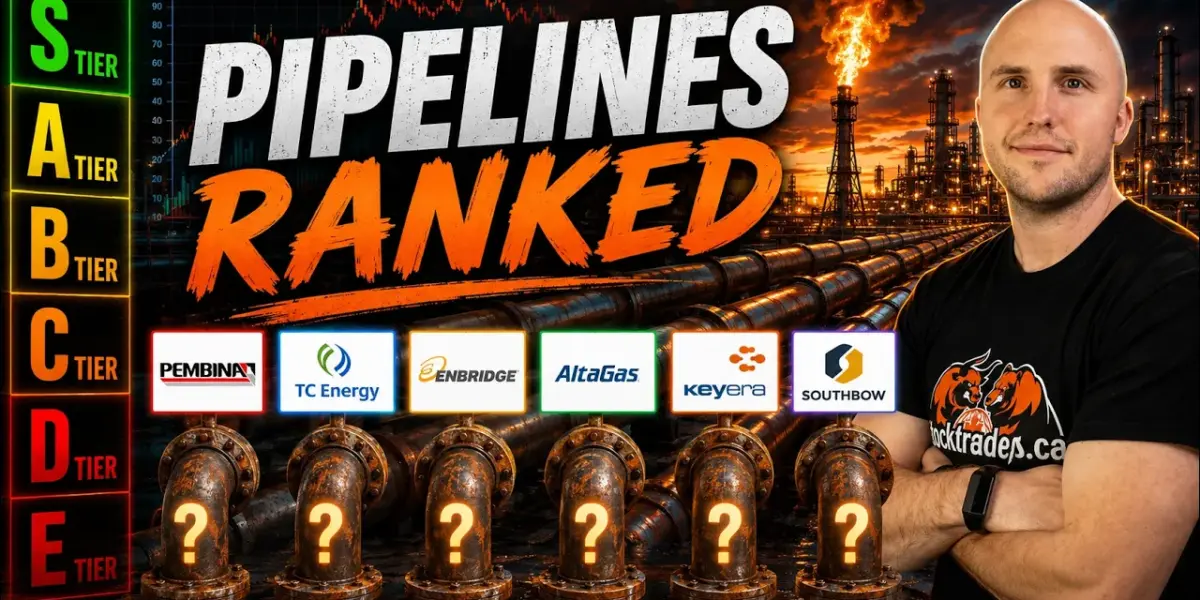
All figures as of August 2026. This is analysis, not personalized advice. This article was generated using a video transcript from the video below, with the assistance of AI.

It’s rare to find a sector that pays huge yields and still crushes the index, but Canadian pipeline stocks have beaten the TSX, the S&P 500 and the Nasdaq in 2026. These are some of the best companies in the country, and they’ve paid income to Canadians for decades. So the question isn’t whether pipelines are high quality. The question is which one deserves your money.
This ranking covers the six big names: Enbridge (ENB), TC Energy (TRP), Pembina (PPL), Keyera (KEY), South Bow (SOBO) and AltaGas (ALA), ranked S tier to E tier, one per slot. Someone has to finish last, and to be clear up front: if I were ranking pure company quality, most of these would crowd into the top tiers. This list weighs yield, valuation, execution, commodity exposure and growth, and forces a decision.
Pipelines 101: the tollbooth model
One concept explains why investors love this sector: take-or-pay contracts. Companies buy space in a pipeline, and if they don’t ship product through it, they pay anyway. Why agree to that? Because capacity is so scarce that if they don’t sign, somebody else will. The result is cash flow that’s largely guaranteed and mostly inflation-protected, with costs passed through to the shipper. The best pipelines run 90%+ of revenue on these contracts or regulated rates: a tollbooth on Canadian energy.
Two valuation notes. First, use EV/EBITDA for pipelines, not P/E; enterprise value captures the debt, and for a pipeline the debt is the story. The group trades roughly between 12 and 16 times. Second, watch the distributable cash flow payout ratio: the healthy zone is roughly 50 to 70%, which leaves room to raise the dividend and fund growth.

E tier: AltaGas (ALA): not really a pipeline
I’ll admit the slight cheat: AltaGas gets bundled with pipelines, but it’s really a hybrid. About 55% of the business is regulated gas utilities in the United States, with midstream and export terminals making up the rest. You’re buying utility rate-base growth plus export terminal growth, wrapped in a structure complex enough to earn a conglomerate discount, with 4.4x leverage on top.
Here’s the irony: AltaGas has been one of the best performers of the whole group, up roughly 140% over the past decade on a total-return basis. So why last? Because this list rewards a long, storied history of consistent operation and management, and AltaGas doesn’t have one; the past is checkered even if the present is strong. Not a bad company. Just the sixth pick out of six, for the investor who came here looking for an actual pipeline.
D tier: South Bow (SOBO): the income vehicle
South Bow is the Keystone pipeline, spun out of TC Energy in October 2024 because TC thought the crude side was chronically undervalued. They were right: the spin-off unlocked a ton of value and the stock has run hard since.
What you get is deliberate: a slow-growing, high-yielding income vehicle. A 5.4% yield on about a 70% distributable cash flow payout, roughly 90% take-or-pay revenue, and one core asset: 4,900 km of pipe moving about 616,000 barrels a day from Hardisty to the US Midwest and Gulf Coast at a 95% operating factor. This thing pumps oil all the time.
The problem is what it can’t do: grow. The other pipelines on this list are guiding to 5 to 7% annual EBITDA growth; South Bow has effectively none, by design. It also carries the most leverage of the group at 4.7x. Expect the 5.4% yield plus maybe 2 to 3% a year of price appreciation, and that’s the whole story. High-quality income vehicle, and if that’s specifically what you want, it arguably moves up a tier. For total-return investors, D.
C tier: Keyera (KEY): the fastest grower, the highest risk
Keyera is the natural gas liquids pure play: it takes raw gas, strips and processes the liquids (propane, butane, condensate), then moves, stores and markets them. The forgotten pipeline for years, and now suddenly interesting: the Plains NGL acquisition in 2026 transformed it from an Alberta-centric player into a national one, stretching all the way to Ontario.
The growth case is the best in the sector: the deal is expected to drive 16% fee-based EBITDA growth into 2027, then 7 to 8% a year through 2029, with mid-teens accretion. Most pipelines on this list aren’t close to that. The balance sheet was the group’s best before the deal (2.2x) and should return to the 2.5 to 3x range by the end of 2027.
The catch is the quality of the cash flow. About 70% of margin is fee-for-service and only 62% of that is take-or-pay, which leaves roughly a quarter of the business commodity-exposed, far more than an Enbridge. And the deal itself carries risk: it’s being investigated, synergy targets have to land, and if it unravels, the growth story goes with it. The fastest-growing pipeline, and the highest-risk one. C tier.
B tier: TC Energy (TRP): the AI play, fully priced
After spinning off South Bow, TC Energy is a pure natural gas and power company, and that makes it the purest play on the two biggest gas tailwinds there are: LNG and AI data centre power demand. Data centres need power now, and before nuclear scales, natural gas fills the gap. If you want the pipeline that benefits most from soaring gas demand, it’s the continent’s biggest gas mover.
The quality is elite: 98% of cash flow rate-regulated or take-or-pay (tied with Enbridge for best on the list), a 25+ year dividend growth streak, and unlike Enbridge, a repaired balance sheet; TC hit its deleveraging targets and can self-fund without dilution.
So why B? One number: 16x EV/EBITDA, the richest valuation of the six, paired with the group’s lowest yield. You are paying up for the AI tailwind after the stock already ran. At 13x, TC would be my S tier pipeline without question. At 16x, the price has eaten the edge. B tier on valuation alone.
A tier: Enbridge (ENB): the premier name, the slowest grower
Enbridge is North America’s largest energy infrastructure company and, since the Dominion acquisition, the continent’s largest natural gas utility. I’d call it the most utility-like pipeline of the six: 98% of cash flow is cost-of-service or take-or-pay, the Mainline moves 3 million barrels a day (roughly 30% of all Canadian crude, an effective monopoly), and it owns the largest interstate gas network on the continent plus a growing renewables arm.
The dividend is the crown: a 31-year growth streak and a mid-5% yield you can set and forget. If I could put two companies in the S tier, Enbridge would be there all day.
What keeps it at A: it’s the slowest grower on the list (EBITDA guidance of just 3 to 5%), the valuation is full after a big run, and leverage sits at the top of its 4.5 to 5x range after the Dominion deal, which is why dividend growth has slowed to about 3% while they work it down. A premier company at a premium price with the least growth. That’s an A, not an S.
S tier: Pembina (PPL): the best pipeline in the country

My number one surprised a lot of people. Pembina is the fully integrated Western Canadian midstream company: gathering, processing, transportation, storage and marketing across the entire Western Canadian Sedimentary Basin. A tollbooth and a processing plant for Alberta and BC oil, gas and NGLs.
The case stacks up line by line. The cleanest balance sheet of the group at 3.8x net debt to EBITDA. The best dividend coverage and the safest yield (4.3%) with genuine room to keep raising faster than Enbridge can. Fee-based revenue of 80 to 90%, with 65 to 70% take-or-pay. Guidance of 5 to 7% fee-based growth through 2030, the longest guidance runway of any pipeline here. And crucially, it’s not hostage to one commodity: crude, natural gas and NGLs all flow through it, so no single market can sink the ship.
The risks are the honest kind: the marketing segment is commodity-exposed and volatile, and peak capital spending on the Kitimat NGL project brings cost-overrun potential. But the risk-reward beats Enbridge and TC, which are growing slower at richer prices. Arguably the best-managed pipeline on the continent, with the most room to run. S tier.
The bottom line
| Tier | Stock | One line |
|---|---|---|
| S | Pembina (PPL) | Best balance sheet, safest yield, most room to grow |
| A | Enbridge (ENB) | The premier name, fully priced, slowest growth |
| B | TC Energy (TRP) | The AI and LNG play, at 16x you’ve paid for it |
| C | Keyera (KEY) | Fastest grower, most commodity risk |
| D | South Bow (SOBO) | A 5.4% income vehicle with near-zero growth |
| E | AltaGas (ALA) | Half utility, half midstream, all conglomerate discount |
The questions I get most:
Should I just own more than one? There’s a real case for it: an income anchor (Enbridge or South Bow) plus a growth engine (Pembina or Keyera) covers both jobs pipelines do in a portfolio.
Why do these yield so much more than utilities? More commodity adjacency, more project risk, and partnership histories. The market demands a higher payout for the extra hair, and the take-or-pay model is what makes those payouts durable anyway.
What’s the biggest sector risk? Spills and shutdowns are the headline risk, but the quieter one is growth: pipelines are hard to build now, which protects existing assets but caps expansion. That’s exactly why the contracted-growth names (Pembina, Keyera) rank ahead of pure income here.
Want my current favourite ideas? Grab the free report with my top portfolio holdings: [LINK]


