

This piece is Sponsored by BMO Exchange Traded Funds.
Many Canadian investors have embraced BMO’s all-in-one asset allocation ETFs. These one-ticket solutions package together stocks and bonds in a single fund, with allocations ranging from aggressive 100% equity portfolios to more conservative mixes such as 80/20, 60/40, 40/60, and even 20/80.1
For a relatively low fee, investors get instant diversification, automatic rebalancing, and a portfolio designed to match different risk profiles* and time horizons. Instead of worrying about individual holdings or constantly adjusting allocations, investors can simply buy one ETF and let it do the work.
For the most part, this approach has worked well. But 2022 exposed one weakness. That year, investors experienced a combination of rising interest rates and elevated inflation.
Stocks struggled as higher borrowing costs pressured valuations. Bonds, which are typically expected to provide stability when equities fall, also suffered losses as yields moved higher.
When both parts of the portfolio are under pressure at the same time, diversification becomes more important than ever. One solution is to add a third asset class that behaves differently from traditional stocks and bonds.
Ideally, you’re looking for something that may respond positively when inflation rises, supply chains tighten, or economic conditions create challenges for financial assets.
Commodities have historically played that role. And historically, getting exposure to these commodities was fairly difficult. Futures contracts, for example, are an avenue that most didn’t want to go down.
But, this isn’t the case anymore. In my opinion, getting exposure to a wide variety of commodities has never been easier. It’s gone from having to understand and navigate the complex futures market to a simple click of a button.
One of the more popular commodities ETFs isthe BMO Gold Bullion ETF (ZGLD)7, since it’s launch in March 2022 For a 0.22% management expense ratio8, investors receive exposure to spot gold prices backed by unencumbered physical gold bullion held in London Good Delivery bars9.

But gold is only one corner of a very broad commodity universe. I managed to come across the BMO Broad Commodity ETF (ZCOM)9. This is a newer fund in BMO’s lineup, and in this article I’m going to walk you through what it is, and how it could potentially fit in your portfolio.
What is ZCOM?

While storing gold bullion is relatively straightforward, it becomes far more complicated when dealing with assets like crude oil, natural gas, corn, wheat, cattle, or coffee.
Instead, as I mentioned, commodity exposure is typically obtained through futures contracts, which are agreements to buy or sell a commodity at a predetermined price on a future date. Futures markets have long been the preferred way for investors and commercial users to gain exposure to commodity prices without taking physical delivery of the underlying assets.
ZCOM is a passive ETF that tracks the Bloomberg Commodity Index Total Return4, one of the most widely followed commodity benchmarks in the world. In terms of sector exposure, the Bloomberg Commodity Index currently gets you exposure to five major commodity groups:
- Energy: Brent crude oil, WTI crude oil, natural gas, low sulphur gas oil, ULS diesel, RBOB gasoline.
- Agriculture: Soybeans, corn, soybean oil, soybean meal, Chicago wheat, Kansas City wheat, sugar, coffee, cotton, cocoa.
- Industrial Metals: COMEX copper, aluminum, zinc, nickel, lead.
- Precious Metals: Gold, silver.
- Livestock: Live cattle, lean hogs.
One important thing to understand is that the Bloomberg Commodity Index is not static. The sector weights and commodity allocations can change over time based on the index methodology and underlying market conditions. As a result, investors receive exposure to a diversified basket of commodities rather than making a concentrated bet on any single resource.
To efficiently track the Bloomberg Commodity Index Total return, ZCOM uses total return swaps with approved counterparties. The ETF posts collateral and exchanges the return of that collateral for the return of the benchmark.
The collateral currently consists primarily of holdings such as the BMO Ultra Short-Term US Bond ETF (ZUS.U) and other high-quality fixed-income securities.
This structure allows investors to gain broad commodity exposure in a cost-efficient manner without the complexities associated with holding physical commodities or managing futures contracts.
Why Consider ZCOM?
Cost has historically been a hurdle. Commodity ETFs have often carried relatively high management expense ratios (MERs) owing to their complexity. Since fees are deducted from fund assets, higher costs can reduce total returns over time.
ZCOM is competitively priced. With an estimated MER of just 0.30%11, it ranks among the lower-cost broad commodity solutions available to Canadian investors5. A $10,000 investment would incur approximately $30 per year in fee drag.
This is a price I am more than willing to pay, especially considering for the vast majority of my investing career, getting access to these commodities was exponentially harder than it is with ZCOM.
Another consideration is currency exposure. The underlying Bloomberg Commodity Index Total Return is denominated in U.S. dollars, while ZCOM trades in Canadian dollars. As a result, movements between the U.S. and Canadian dollar can affect returns.
A strengthening U.S. dollar may boost returns for Canadian investors, while a strengthening Canadian dollar may have the opposite effect.
Investors who prefer to reduce this currency exposure can consider ZCOM.F, the currency-hedged version of the ETF. ZCOM.F carries a similarly competitive 0.29% management expense ratio12, but uses currency hedging to reduce the impact of exchange-rate fluctuations.
Beyond cost and currency, there is a longer-term demand story worth understanding, and in my opinion it is one of the more interesting reasons to look at broad commodity exposure today. That story is artificial intelligence.
AI is usually framed as a software and semiconductor theme, but the infrastructure underneath it is surprisingly commodity-intensive. The data centers that train and run AI models consume large amounts of electricity and are built with significant quantities of metals.
Copper runs through their electrical wiring, power distribution, and cooling systems. Aluminum and other industrial metals are used throughout construction. And in much of North America, the electricity that powers these facilities still relies heavily on natural gas.
Each of those commodities is represented in the Bloomberg Commodity Index Total Return that ZCOM tracks. Based on the index’s 2026 target weights, natural gas accounts for roughly 7.2%, copper roughly 6.4%, and industrial metals as a group roughly 15.8%, alongside sizable weightings in broader energy and precious metals.
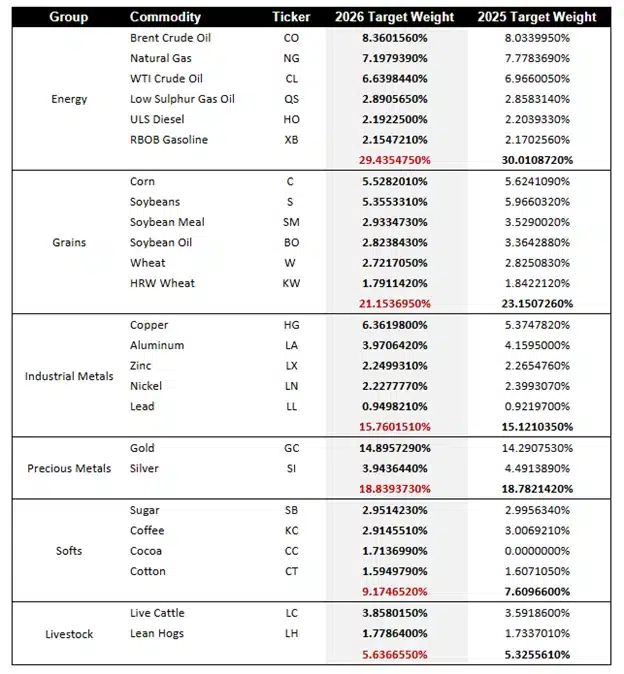
An investor in ZCOM therefore already holds exposure to several of the physical inputs the AI build-out depends on, without having to choose a single commodity or take on the company-specific risk of an individual miner or energy producer.
I want to make something clear though. Commodity prices are driven by many factors, including global growth, supply and production levels, weather, geopolitics, and currency movements, and AI-related demand is only one input among them.
There is no guarantee that rising computing demand will translate into higher commodity prices or positive returns, and commodities can be volatile over shorter periods.
But, it’s an interesting theme nonetheless.
How Can Investors Use ZCOM?
ZCOM can play different roles depending on an investor’s objectives. For shorter-term traders, it may be used as a way to express a bullish view on commodity prices during periods of inflation, supply disruptions, or geopolitical conflict.
For long-term investors, ZCOM may serve as a complementary allocation alongside stocks and bonds. One of the key attractions of commodities is that they have historically behaved differently from traditional financial assets during certain market environments. As a result, adding commodities to a portfolio may provide a third source of diversification beyond equities and fixed income6.
In that role, ZCOM can help investors build portfolios that are less dependent on the performance of stocks and bonds alone, particularly during periods when inflation or commodity prices become dominant drivers of market returns.
*One’s risk profile is comprised of risk tolerance (i.e., willingness to accept risk) and risk capacity (i.e., ability to endure potential financial loss).
- https://bmogam.com/ca-en/products/exchange-traded-funds/asset-allocation-etfs/
- https://www.sciencedirect.com/science/article/pii/S1042443125001325
- https://www.bmoetfs.ca/articles/commodities-a-strategic-shield-against-new-regime-risks
- https://www.bloomberg.com/professional/products/indices/quote/BCOMTR:IND
- https://etfmarket.cboe.com/canada/en/etf-screener?ac=c&s=expense_ratio%20asc
- https://www.investopedia.com/articles/trading/05/021605.asp
- Launched in 2024, the fund has grown to approximately $2.0 billion in net assets, reflecting strong investor demand for physical gold exposure.
- Management expense ratio, MER, as of Dec. 31, 2025
- London Good Delivery (LGD) bars are large, high-purity gold or silver bars meeting London Bullion Market Association (LBMA) standards, widely used in international bullion trading and central bank reserves.
- **ZCOM inception date is October 25, 2025.
- unaudited, estimated MER as of May 31, 2026,
- Estimated as of April 28th, 2026
Disclaimer:
This content is sponsored by BMO Exchange Traded Funds.
This content is intended for information purposes only. This content has been prepared by Dan Kent and represents its assessment at the time of publication. Dan Kent is compensated under this arrangement by BMO Exchange Traded Funds. The content contained herein does not necessarily represent the views of BMO Global Asset Management. The views expressed herein by Dan Kent are subject to change without notice. The content contained herein is not, and should not be construed as, investment, tax or legal advice to any party. Any securities described herein must be evaluated relative to the individual’s investment objectives and risk profile, and professional advice should be obtained with respect to the individual’s particular circumstances.
The views expressed herein by Dan Kent regarding a particular company, security, industry, or market sector should not be considered as an indication of trading intent of any investment funds managed by BMO Global Asset Management. Any reference to a particular company is for illustrative purposes only and should not be considered as investment advice or a recommendation to buy or sell nor should it be considered as an indication of how the portfolio of any investment fund managed by BMO Global Asset Management is or will be invested. This social media network is an independent organization and is not affiliated with BMO Global Asset Management.
The BMO Broad Commodity ETF is an exchange-traded alternative mutual fund within the meaning of NI 81-102. As an alternative mutual fund, the BMO ETF has the ability to invest in asset classes and use investment strategies that are not permitted for conventional mutual funds, including the ability to invest in other alternative mutual funds, employ leverage and borrow cash to use for investment purposes and increased ability to invest in commodities. While these strategies will be used in accordance with the BMO ETF’s investment objective and strategies, during certain market conditions, they may accelerate the pace at which an investor’s investment decreases in value.
Any statement that necessarily depends on future events may be a forward-looking statement. Forward-looking statements are not guarantees of performance. They involve risks, uncertainties and assumptions. Although such statements are based on assumptions that are believed to be reasonable, there can be no assurance that actual results will not differ materially from expectations. Investors are cautioned not to rely unduly on any forward-looking statements. In connection with any forward-looking statements, investors should carefully consider the areas of risk described in the most recent prospectus.
“BLOOMBERG®” and the Bloomberg Index are service marks of Bloomberg Finance L.P. and its affiliates, including Bloomberg Index Services Limited (“BISL”), the administrator of the Index (collectively, “Bloomberg”) and have been licensed for use for certain purposes by BMO Asset Management Inc. (the “Licensee”). Bloomberg is not affiliated with the Licensee, and Bloomberg does not approve, endorse, review, or recommend the ETF. Bloomberg does not guarantee the timeliness, accuracy, or completeness of any data or information relating to the ETF.
Index returns do not reflect transactions costs, or the deduction of other fees and expenses and it is not possible to invest directly in an Index. Past performance is not indicative of future results.
Commissions, management fees and expenses all may be associated with investments in exchange-traded funds. Please read the ETF Facts or prospectus of the BMO ETFs before investing. Exchange-traded funds are not guaranteed, their values change frequently and past performance may not be repeated.
For a summary of the risks of an investment in the BMO ETFs, please see the specific risks set out in the ETF facts or prospectus. BMO ETFs trade like stocks, fluctuate in market value and may trade at a discount to their net asset value, which may increase the risk of loss. Distributions are not guaranteed and are subject to change and/or elimination.
BMO ETFs are managed by BMO Asset Management Inc., an investment fund manager, a portfolio manager, and a separate legal entity from Bank of Montreal.
BMO Global Asset Management is a brand name under which BMO Asset Management Inc. and BMO Investments Inc. operate.


