
The year thus far has been a story of 2 tales.
On the one hand, growth stocks are having a difficult time and rising bond yields are leading to some pretty significant corrections.
On other, traditional value and dividend plays are doing quite well as investors rush to safety.
We’re seeing a bit of a rally over the last few days, but whether or not that sticks around remains to be seen.
Lets have a look at the performances of both our Growth and Dividend Bull Lists in March, which is going to paint a very clear picture on what the investor mentality was over the last 30 days, as we see a heavy transition from growth to value/income plays.
Growth and tech continue to struggle in March
Let’s start with the bad – the Growth Bull List is having a hard time keeping up with the markets.
In the month of March, the list lost 3.59% of its value. In comparison the TSX has gained 2.92%.
Now, this is a far cry from the 7.2% the Growth Bull List was down prior to this 2 day rally, but it is still a clear indication of growth’s struggles over the last 45 days.
Through the first three months of the year, it is a similar story as the list is down 3.10% vs gains of 8.03% for the Index.
Bull List returns have been impacted in a big way by Xebec Adsorption (XBC) which has lost more than half of its value (52.65%) since being added.
While we quickly moved off the company after the internal control issues were made public, the damage was done. We won’t go into details here as we have many times already but bottom line, this is a show me stock, one that Mat and I continue to own, but aren’t purchasing any further positions.
Other stocks which are weighing heavily are Real Matters (REAL), Docebo (DCBO) and GoodFood (FOOD), all of which have lost more than 24% this year.
It’s important to note however, that with the exception of REAL, the others are still sitting on double-digit gains since we first added them to our Growth Bull List.
Real Matter remains an enigma and we consider it to be a value play here. Nothing has changed in our investment thesis and as such, it remains on our Bull List.
It’s not all bad news as Enghouse (ENGH) and Lightspeed (LSPD) have enjoyed a strong month with gains of 7.51% and 18.41% respectively.
And as we’ve witnessed in the last few days, Park Lawn (PLC) has provided strong returns on the back of outstanding fourth quarter results. In fact, the company is now the best performing stock on the Growth Bull List in 2021 with returns of 22.87%.
A close second? Aecon (ARE) with returns of 20.10%.
Overall, it’s important to understand that although growth is seeing a dip, the underlying thesis with all the stocks on our Growth Bull List are still in tact. As we’ve been reiterating in the Discord server over the last month, we need to be thinking 15 years, not 15 days, when we approach any sort of investment. Short term price fluctuations shouldn’t have any impact on your decisions.
If anything changes, much like we did with Xebec Adsorption, we will alert members as soon as possible.
Value and income are outperforming
Now, let’s turn our attention to the Dividend Bull List.
In March, the Dividend Bull List has more than doubled the gains of the TSX Index.
In fact, all stocks are all in the green with the exception of Exchange Income Corp (EIF) which lost 1.86% in March.
On the year, the list is up by double-digits (10.73%) and is being led by CCL Industries and the financial stocks which are also all up by double digits.
Once again, in 2021 every stock is in the green with the exception of Algonquin Power and Utilities (AQN).
The stock is down by 4.34% as rising yields pressure the utility sector, coupled with the overall impacts of the storms in Texas.
Overall, there is a clear shift from growth to safety
This is not surprising and until market confidence returns, we expect this trend to continue.
As we mentioned, there is currently a growth rally going on over the last two days, but a few days is not a strong enough indication of a reversing trend.
It also speaks to why we believe it is very important to have a solid foundation of blue-chip companies to complement one’s growth profile.
In times like these, investors who have a strong foundation won’t feel the sting of the poor performance nearly as bad as those who rely solely on growth stocks.
There are a lot of members here at Premium who have realized in this growth sell off that their portfolio makeups were a little bit above their overall tolerance for risk.
To that, we say it is a strong learning moment, and likely an indication you may need to add more reliable, blue-chip income plays to your portfolio to reduce overall volatility. Which, we provide members via our Foundational Stocks and Dividend Bull List.
On the flip side – growth is still important
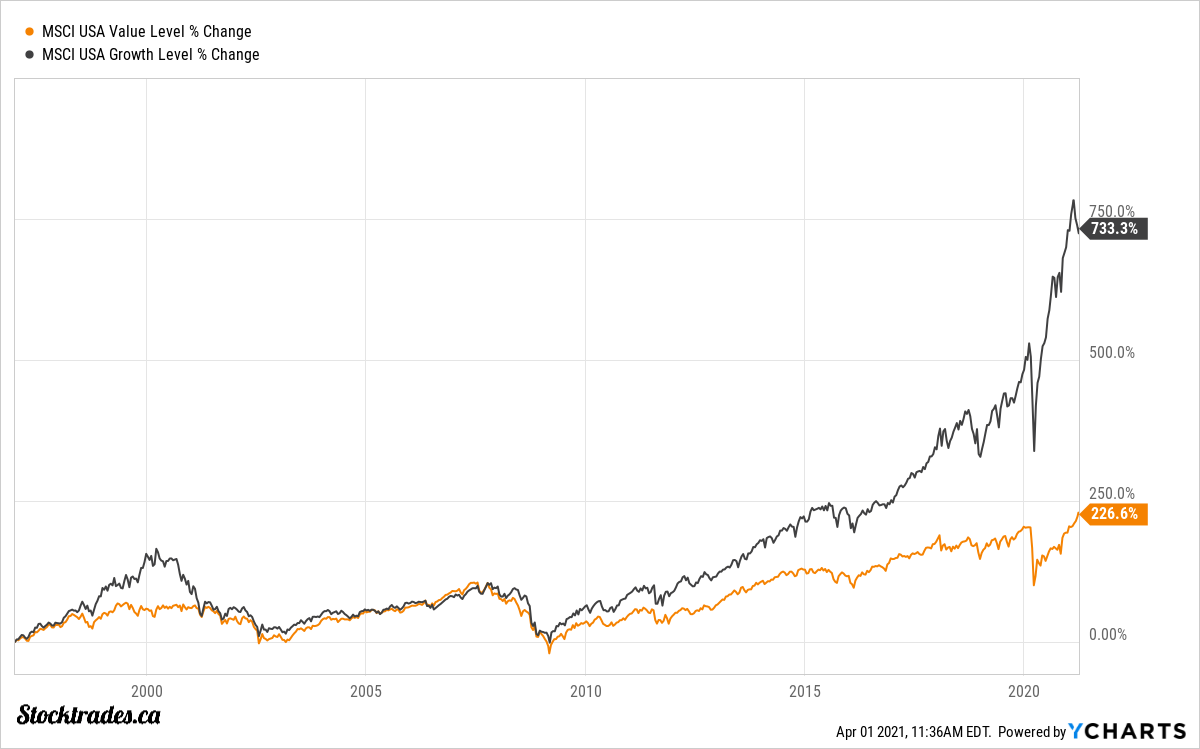
Growth has outperformed value and dividend stocks significantly over the past 13 years and if investors didn’t have growth in their portfolio, they likely underperformed.
A clear example of this? Look at the chart below, which highlights the returns of US growth stocks vs US value stocks since the mid 1990’s.
How long with this bear market last for growth and tech stocks?
We wish we had a crystal ball. What we can say is that we remain confident in our positions and believe they will rebound. It just may take some patience as the growth markets try to find a footing.
*Mat is long XBC, AQN, ARE, LSPD, REAL and DCBO. Dan is long LSPD, XBC, PLC, FOOD and REAL
Emerge ARK ETFs
We had a great chat with Lisa Langley, CEO and Founder of Emerge about the E-ARK suite of products.
While we have sent some emails and talked about it quite a bit in our Discord channel, we did want to flush out a few more details around their products.
This is not unique to the Space Exploration ETF, but in relation to the entire suite of E-ARK products.
Relationship with Cathie Wood and ARK
First, let’s talk about the relationship with Cathie Wood and the ARK team.
It is a partnership that spans a few years and was born out of an idea to offer Canadians more tax efficient options.
It is important to note that E-ARK products are ARK products. As we mentioned in our email, they are the real thing.
Trades are shared daily by the ARK team to Emerge which executes on the trades. There is only one minor difference.
Emerge has a cap on individual holdings (10%) whereas the ARK team doesn’t have a cap. Of note, that was just announced this week – the ARK team has removed the 30% cap on individual holdings.
It hasn’t proven to be an issue yet and the E-ARK products essentially mirror the ARK ETFs.
Cathie Wood is the Fund Manager and makes all the investment decisions. The Emerge Team essentially just executes the trades here in Canada as required by regulations.
This is something that we really wanted to clear up with the Emerge team, as many Canadians feel they’re getting somewhat of a knock-off product when they buy Emerge, and instead go the Ark route to get the “real thing”.
Rest assured, if you’re looking at the Emerge ETF’s to gain exposure to Cathie Wood’s funds, you are getting the real deal.
MER Fees
Next, lets talk about MER (Management Expense Ratio) fees which is a big one.
When the Emerge ARK ETFs first launched they had MERs above 2%. This is largely because of new listing fees, lower inflows and assets under management (AUM).
A general rule of thumb is that as inflows and AUM increase, MER decreases.
This is true with the E-ARK products and is not well known. In fact, most brokers have it wrong.
RBC Direct Investing still lists their products as having MERs above 2% whereas this is no longer the case.
As of today, the MER on all the E-ARK products is at 1.15% and according to Desmond Alvarez, CFO of Emerge, that ratio will drop to below 1% by end of year. He mentioned this to us in our interview.
A MER below 1% essentially wipes out one of the main underlying concerns with the E-ARK ETFs, as Cathie’s U.S. ETFs only have an MER of 0.75%.
Currency fluctuations with E-ARK
A lot of members have raised the question about investing in the Emerge funds and whether or not it’s a good idea due to foreign currency risks.
That is, if you purchase the Canadian variant and the Canadian dollar continues to rise in relation to the US dollar, you will lose money in the form of a forex loss.
So, we asked Lisa whether or not they have a solution. And, Emerge’s ETFs do have a USD variant. For example, the most recent space exploration ETF is traded in Canadian dollars via EAXP, and US Dollars via EAXP-U.
However, we don’t really view this as a solution for one primary reason, and that is volume.
There is some pretty significant liquidity issues with the USD variants of these ETFs. In fact, most of Emerge’s US variants have next to no volume.
Overall, Emerge provides a solution for those looking for exposure to ARK funds in a taxable account
There are some significant tax advantages to owning Emerge’s ETFs. This is one thing that Lisa pushed on us extensively during our interview, and one we actually agree with.
Canadian corporations are taxed more favorably here in Canada than US corporations. So, owning the Canadian domiciled Emerge ETF inside of a taxable account is going to result in higher after tax returns vs the US ARK variant. In fact, I’ve attached an example of a situation below.
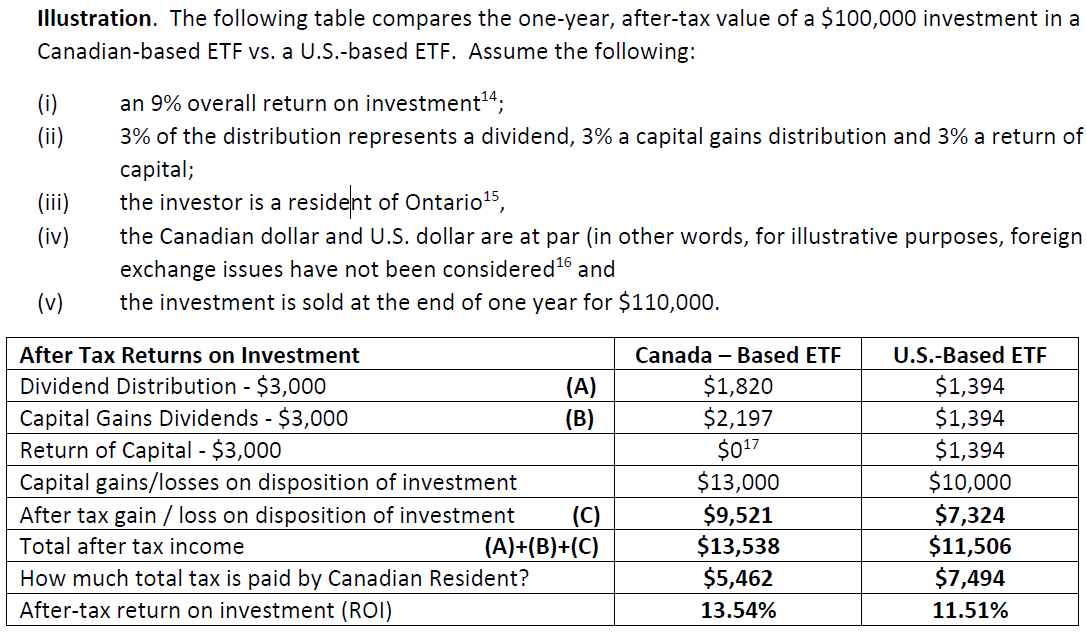
Ultimately, it’s extremely beneficial for a Canadian to own a Canadian listed ETF in a taxable account over a US listed ETF. So in that case, Emerge gets the nod.
However, we realize that many investors hold ARK funds in registered accounts where they aren’t subject to taxes. In this situation, the benefits of the Emerge suite of products is not as apparent.
Right now, in our opinion, the deciding factor on whether or not to purchase Emerge over ARK ETF’s inside of a tax sheltered account would be what currency you want exposure to.
If you want to hold USD, buying the ARK variant is a reasonable solution. If you want to keep your money in your home currency, Emerge provides real deal exposure in CAD.
One thing we can’t reiterate enough however, is don’t go chasing reduced fees
Most brokerages, unless you’re using Norbert’s Gambit, which you can’t even do on a platform like Wealthsimple Trade, will charge excessively high exchange fees.
Right now, if we look to Emerge’s total fees of around 1.15% (with the intentions of being sub 1% by the end of the year) and compare them to ARK’s 0.75% fees, it doesn’t make much sense to pay a 1.5% or higher currency conversion to save on the fees.
In fact, a platform like Wealthsimple Trade charges 1.5% each way. Which means a $10,000 purchase of an ARK ETF on that platform would result in not only being charged a $75 annual management fee by ARK, but $150 when you buy, and 1.5% of your sale price when you sell by Wealthsimple.
The alternative option? Own the Emerge ETF commission free, and pay $110 annually.
