
For crypto enthusiasts, this past week was a notable one as four Ether ETFs went live on the TSX Index. Unlike the Bitcoin ETFs which were staggered in their launch, the majority of Ether ETFs went live on the same day.
While it may not seem like a big deal, having three launch on the same day eliminated the ‘first to market’ advantage that was notably present with the launch of Bitcoin ETFs. In late February, the Purpose Bitcoin ETF which launched under the symbol BTCC saw net asset value (NAV) top $1 billion over the first couple of months.
Two other Bitcoin ETFs launched shortly after – Evolve and CI Galaxy Bitcoin ETFs. Both have been successful, but they did not attract nearly as many inflows as Purpose did. This led to Evolve and CI Galaxy lowering its management fees. While it has made a little difference, BTCC remains top dog in the Bitcoin ETF space despite higher fees.
This time around, there was no such advantage and three of the ETFs launched on Tuesday April 20, 2021. Who launched the funds? Familiar names – Purpose, Evolve and CI Galaxy.
Here were the results after day one:
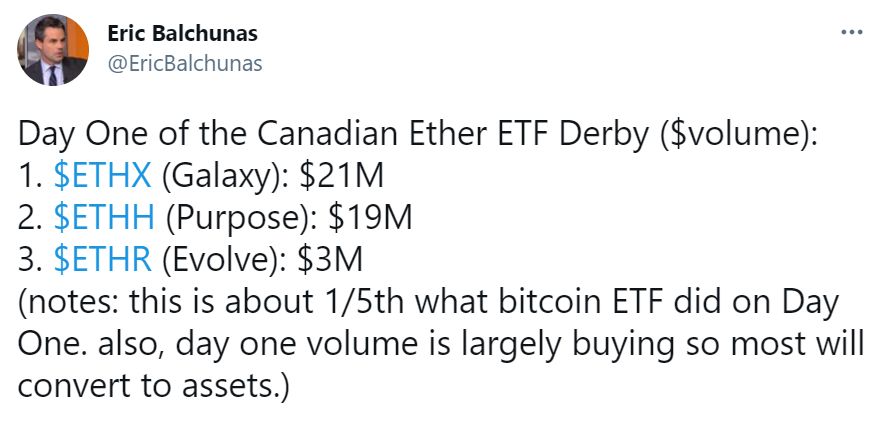
As you can see, the Purpose and Galaxy ETFs accounted for 93% of volume. The early leaders as least in term of popularity.
A fourth ETF led by 3IQ – the first to launch a Bitcoin closed-end fund in Canada (QBTC) – began trading under the symbol ETHQ on Friday April 23, 2021. Unfortunately, it launched to little fanfare (more on that later).
While it may not seem like much, the funds’ NAV is a key indicator. Why? If an ETF struggles to attract investors, and NAV remains persistently low, there is a greater risk that the ETF gets wound down.
While I am not expecting any of these to be in danger in the near term, it will be something to watch. As I’ve discussed with members several times in the cyptocurrency Discord channel, having too many Ether (or Bitcoin) ETFs serves no purpose outside of lowering fees (which are already low to begin with).
They are effectively a commodity ETF whose sole purpose is to track the price of said commodity – in this case Ether.
Too many options is likely to devalue the others, and much like there are only a couple of notable Gold ETFs that track the price of the bullion itself, there are only likely to be a couple that stand the test of time in the crypto space. Perhaps, these four will become the leaders, perhaps not – it is still too early to tell.
That being said, when looking at the four Ether ETFs that launched this week, my attention turns immediately to the Purpose and Galaxy funds. As of end of day Friday – this is where the ETFs stood in terms of NAV:
- ETHX (Galaxy): $92M
- ETHH (Purpose): $39M
- ETHR (Evolve): $8M
- ETHQ (3iQ): $1.2M
Once again, you can see that Galaxy and Purpose account for approximately 93% of volume. Conversely, 3iQ’s launch barely registered with only $1.2M in assets – much lower than the first day volume of the other ETFs. Once again, you see how being second to market has significantly impacted the interest in 3iQ’s product.
Now that we have two clear leaders, it all comes down to fees
CI Galaxy has waived management fees until June 15, 2021 and has capped the MER at 0.95% of NAV. After June, the management fee will revert back to 0.40% of NAV.
For its part, Purpose’s ETF has a management fee of 1.00% which is in-line with its Bitcoin ETF. Purpose has also capped the MER ratio at 1.50% of NAV
Outside of fees and assets, there is little that separate these ETFs. They are all likely to do a good job of tracking the price of Ether and all hold their crypto in custody with Gemini Trust.
Given this, if (more like when) Dan or I decide to purchase an Ether ETF, I am likely to go with CI Galaxy’s Ether ETF under the symbol $ETHX. At this point, there is little reason for me to choose any of the others.
Of note CI Galaxy has a CAD unhedged version (ETHX.B) and a USD version (ETHX.U). Which you decide to invest in will be dependent on your views on the CAD vs USD and funds available.
Rising rates sooner than later? What should you be doing?
It’s practically impossible to get any sort of reliable information when it comes to interest rates these days.
Case in point, at this time last year the Bank of Canada had reiterated that interest rates “will be low for a very long time.”
However, the tune seems to have changed and it now expects interest rates to rise in 2022. This is primarily due to estimates of nearly 6.5% growth in Canada over the next year. This type of growth is simply unprecedented in an advanced economy, and it is very likely the Bank of Canada will need to raise interest rates to “cool” economic growth to prevent rapid inflation.
It’s also important to keep in mind that these are the same people who were predicting a severely scarred economy because of the COVID-19 pandemic. So, as investors we must take what they say with a grain of salt, but we also must prepare our portfolios in the event that rates do rise next year due to a soaring economy and inevitably, inflation.
Our last 3 highlights on our Bull List have been Savaria, a Canadian healthcare company with an expanding market reach. Intact Financial, a leading property and casualty insurance company. And finally Equitable Bank, a leading alternative lender here in Canada.
If you haven’t noticed, we’ve transitioned to more of what we like to call a blended approach when it comes to our Bull List highlights. That is, we’ve stopped focusing on pure growth plays and instead have started to highlight companies that we feel still have the potential to outperform the broader markets, but also pay a healthy dividend and have solid footings in their industries.
And, two of the last three highlights have been from the financial sector, particularly those that would benefit from a shift in interest rates.
The impact of rising rates on the financial and consumer sectors
In a rock bottom interest rate environment, Canada’s Big Banks and alternative lenders like Equitable Bank and Goeasy Limited reported outstanding results. So, it’s safe to say that in a rising rate environment, these companies will be able to continue to drive growth for shareholders. It’s exactly why they’ve been the key focus of a lot of swaps in our model portfolios, as well as highlights on our Bull List.
To look at how interest rates could impact a financial company, we can look no further than our most recent Bull List highlight Equitable Bank (TSE:EQB).
The company states that a 100 basis point shift (1%) in interest rates could lead to a near $20 million increase in the income it generates in the form of interest on its loans. A 200 basis point shift? Nearly $40 million, or about an 8% increase.
The impact will be felt industry wide, as not only will alternative lenders stand to benefit but major financial institutions and even life insurance companies like Dividend Bull List stock Manulife Financial (TSE:MFC).
The housing situation will leave some financials better off than others
As rising interest rates are a boon for financial companies, it’s also poor news for the housing market.
Why? Well, it’s fairly simple. As rates rise, so do mortgage rates, leading to more people getting priced out of the market. Houses they could afford at rock bottom rates are now out of their price range.
A cooling of the housing market would ultimately be a non-factor for life insurance companies like Manulife Financial, but would impact many of Canada’s financial institutions that generate revenue from the issuance of new mortgages.
Although the net impact of rising interest rates is positive, this is something to take into consideration. And of note, Dividend Bull List stock The Bank of Montreal (TSE:BMO) is the Canadian bank with the least exposure to the Canadian housing market, and thus would be least impacted by a slowdown in the market.
Overall, if you’re looking to up your financial exposure in this environment, a balanced approach is best
Holding a diverse portfolio of Canadian financial companies is the best way to take advantage of the environment we’re very likely to be headed in for the next 3-4 years.
Different financial companies will be impacted by rising rates in different ways, and it’s very important to not make blanket assumptions.
My approach is to hold a basket of Canadian financial companies from 3 key sectors. I have some of Canada’s best financial institutions in The Bank of Montreal, TD Bank and The Royal Bank of Canada. I have Canada’s leading life insurer and in my opinion one of the cheapest companies in the insurance sector right now in Manulife Financial, and I’ve also recently taken a position in alternative lender and recent Bull List addition Equitable Bank, which is taking the digital banking scene by storm.
And on a final note in this regard, we wouldn’t advocate trying to time the sector. Yes, financials do have the chance to outperform in the coming years, but holding a basket of Canadian financial stocks for the long term should be done in almost all economic circumstances.
Interest rate increases are far from guaranteed, and likely won’t come for another 9-12 months anyways if the Bank of Canada sticks to its plan.
So if you’re underweight Canadian financials, it may be worth a look to diversify or add to your positions. But, we wouldn’t suggest going overweight on the sector, as circumstances can quickly change.
Rising rates will likely tame consumer spending and the consumer discretionary sector
One of the key strategies of monetary policy is to use interest rates to either kick start or cool down the economy. This is exactly why we saw the Bank of Canada drastically reduced interest rates during the COVID-19 pandemic, and this is why there is a good chance we can see them raise interest rates next year to reduce the velocity of money and overall spending.
When spending gets out of control, you often see rapid inflation. So, interest rates go up and overall, people become more particular with their money. When the cost to borrow goes up, people think twice about excessive spending.
The end result will be a reduction in discretionary type spending, and you might see particular sectors of retail struggle. A prime example? Look no further than former Bull List stock BRP Inc (DOO).
The company makes recreational vehicles, and it would be reasonable to assume that spending in this sector would see a swift reduction in light of rising interest rates. Especially considering a lot of consumers finance the equipment they buy when it comes to recreational vehicles.
Consumer staples on the other hand, purchases that are deemed essential regardless of the economic situation, will likely remain steady. Think of things like toiletries, groceries and cleaning supplies.
And finally, rising interest rates will no doubt impact heavy indebted companies
Growth accelerated extensively in 2020, primarily due to the fact that interest rates were slashed and the cost to borrow was the lowest it’s been in a very long time.
This benefits growth companies, as most depend on capital to fuel extensive growth. However, as interest rates rise, so does the cost to borrow. And with most growth companies, you’ll see a direct impact on the company’s bottom line from higher financing costs. Higher financing costs is also a concern for high-CAPEX companies like utilities and pipelines.
Companies that are heavily in debt will feel the impacts more than a growth company that carries no debt, like Bull List stock Lightspeed POS (LSPD) for example. However, rising rates will shine a negative light on most growth companies regardless of their current situation, as investors view a rising rate environment as bearish for growth.
Overall, the key thing you need to understand is that to eliminate all economic events and market noise like this, the strategy is pretty simple: buy solid companies, and hold them for the long term.
Much like fixed income in which you can avoid all interest rate volatility by holding the bond to maturity and collecting the interest, you benefit from equities, whether or not they’re growth, income or value plays, by holding them for the long term.
There’s a reason why active investors on average have underperformed the S&P 500 by significant margins over the last decade. The vast majority of investors fail at attempting to time the market.
