
Investing in an overvalued market
As we move forward in 2021, there is no questioning the fact that the markets are overvalued.
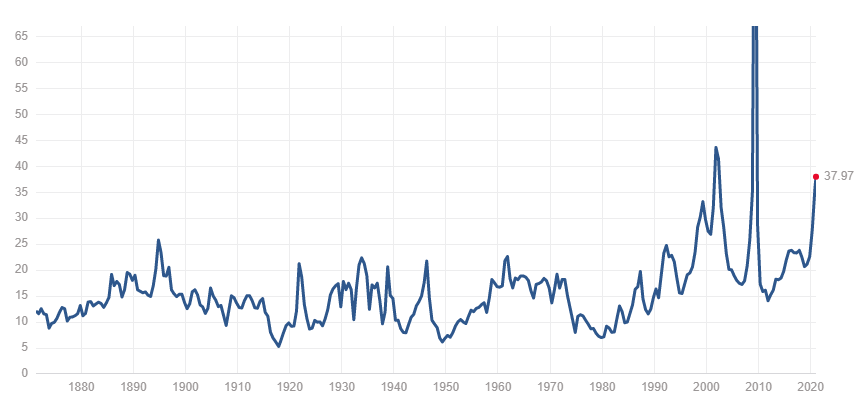
In fact, as I’m writing this article, the price to earnings ratio of the S&P 500 is 37.97. As you can see in the chart below, it typically hovers around the 15-20 range.
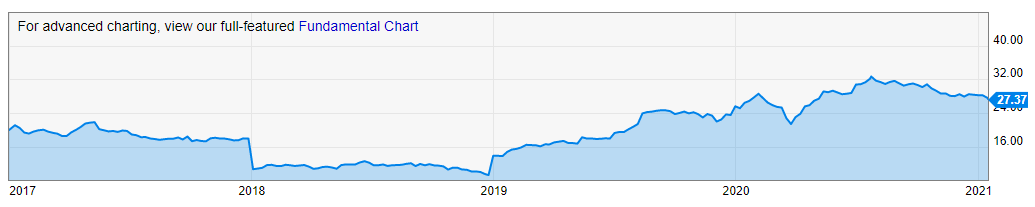
And, if we look a little closer to home, the price to earnings ratio of the TSX, albeit lower, is still drastically higher than historical averages at 27.
So naturally with prices this high investors are becoming worried that another crash or correction is on the horizon. They’re collecting cash, hesitant to place it in the market.
Which, considering we’re likely going to be entering an environment of high inflation due to stimulus and fiat currency being pumped into the economy, is going to shrink buying power at an even faster rate.
Naturally during times like this investors do a few things. They either purchase fixed income like bonds, or take positions in gold, whether it be physically, through an ETF, or through purchasing a producer.
However, with the government having to reduce interest rates at an astronomical pace to keep the economy alive, fixed income has taken an absolute beating, almost to the point where even mediocre credit quality bonds are paying negative real returns (the return on the bond minus inflations equals the real return.)
And as we’ve witnessed recently, Bitcoin is taking the world by storm and as such, gold has become somewhat of a secondary option. Even though gold is hovering between $1830 and $1900 USD an ounce, a company like Bull List stock Kirkland Lake (TSE:KL) is trading at the same price as it was when gold was at $1250 an ounce.
It seems the only logical thing to do right now, is to invest in the stock market. And with high levels of inflation, it is even more important to select companies capable of producing strong cash flows. Because in an inflationary environment, companies that consume cash will face the brunt of the impact, while companies that produce cash will survive.
The shift to small-cap, speculative companies due to market euphoria has been swift, and extensive
While the key to investing in an inflationary environment is to select strong companies, ones that are capable of generating significant and consistent cash flow, it seems that for the most part the United States has shifted in the opposite direction.
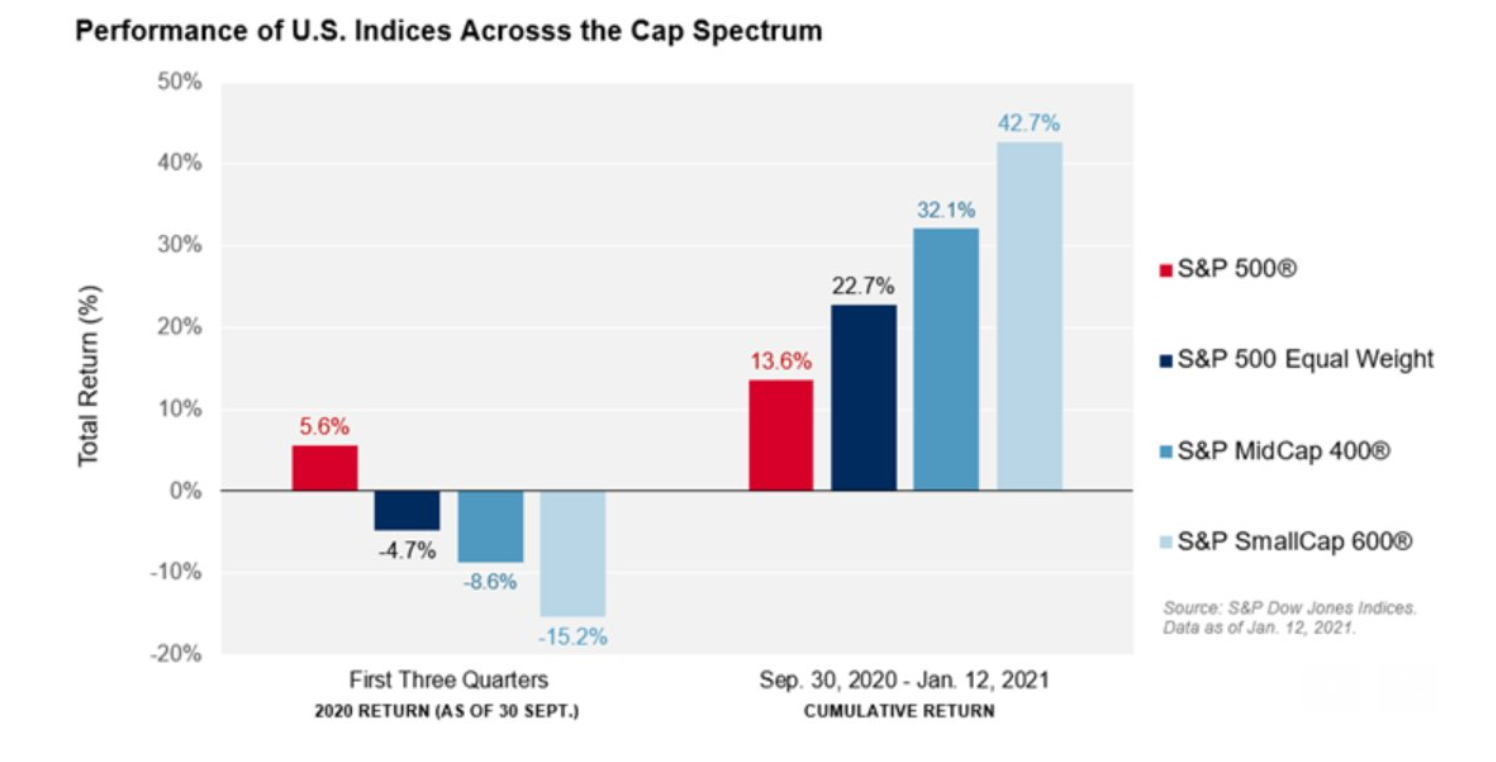
This chart highlights the fact that before the March 2020 crash, large cap stocks were carrying the brunt of the returns.
However, as we move into later 2020, the small-cap trend gained tremendous strength. And as we sit now, the clear path to outperforming in the US was through small-cap companies. Many of which are not capable of producing consistent cash flow, and are instead speculative companies, ones that are no doubt promising, but grossly inflated in price.
As investors, it’s hard to sit on the sidelines and watch this happen. We’ve always been told that deploying a long term strategy and purchasing companies that are fundamentally strong is the key to success.
However, we’re consistently reminded of those who are investing in companies that are seeing 30%, 50%, heck even 100% gains in the matter of a month, some that haven’t even generated a penny of revenue.
The shift to these types of speculative stocks, in our opinion, has two primary causes:
- The exponential surge in “green” investors entering the market in 2020 due to the crash
- The ability for social media platforms like TikTok, Facebook, Twitter and Instagram to deliver information to investors in a matter of seconds
Attention grabbing headlines, trading halts, heck even share offerings have been known to send stocks parabolic because of the delivery of this information to investors who may not exactly know how to digest it.
Case in point, Blackberry’s most recent deal with Amazon, which had no actual details on how the partnership was going to increase Blackberry’s revenue stream, saw the stock more than doubling since October.
So how do we invest in this overvalued market?
Instead of sitting on the sidelines, it becomes more important now than ever to invest in strong, stable companies.
In the event of a market crash, your portfolio will be significantly impacted. This is unavoidable, and something you must learn to live with if you’re going to be an investor who purchases stocks.
However, the important thing to note is the fact that your recovery will be much smoother if you hold strong companies, while those who are placing a significant amount of their portfolios in the speculative euphoria that is going on right now will likely pay a very dear, and often permanent price.
Although it is no doubt painful, avoiding these avenues of investing is critical to your long term success. No matter how many people speak on the astronomical potential of a company, there is rarely an instance where paying $1 for every penny of a company’s earnings or even future potential earnings, will turn out to be a profitable endeavor.
There are still plenty of growth options available to invest in. Look no further than most of the options on our Growth Bull List. No, these aren’t the Mind Medicine’s or the Loop Insight’s of the world, but they have a record of strong, consistent revenue, and in some cases, earnings growth. This is something that the vast majority of stocks going parabolic over the last few months don’t have.
Will the stocks on our Growth Bull List take a significant hit in the event of a market crash? Absolutely. Growth stocks are primarily the first thing to be sold off in a market crash. But as we’ve seen in 2020, a recovery will come.
There is still value in “boring” stocks like Canadian utility, telecom and financials, primarily due to the fact these companies don’t carry the “exponential gain” factor with them. A prime example? Most of our Foundational Stocks.
But as you’ve probably heard the phrase “a rising tide lifts all ships”, when the tide goes back out these companies will still be afloat. The same cannot be said about a lot of popular stocks right now.
As someone who has witnessed investors losing in excess of $200,000 just as recently as the cannabis boom on speculative companies, it’s times like this where understanding that investing is a marathon, not a sprint, is critical to succeeding when the vast majority of retail investors fail.
