
It was an interesting week on the markets. US inflation data came in below estimates, and as a result, rate cuts at the Federal Reserve’s next meeting are back on the table. In fact, the markets are pricing in a strong chance that the Fed will indeed cut.
Because of this news, there was a rotation out of high-growth technology stocks into defensive/rate-sensitive stocks. As a result, the TSX ended up being the best-performing North American index on the week.
Let’s take a look at the inflation numbers south of the border, go through some earnings reports, and then finish off our mid-year review of the US Foundational Stocks.
First, my portfolio moves, as I did make a notable addition this week.
My portfolio moves
I added a 2.5% position to recent Bull List Stock Toromont Industries (TSE:TIH) with some cash I had been holding in my taxable account.
I won’t go too in-depth on why I added Toromont, primarily because it is all laid out in our recent report on the company, which you can read here.
The company is trading at a valuation multiple that I feel is attractive enough to take a position and has historically provided outsized returns moving forward whenever the company becomes this cheap.
The company’s backlog is hitting 10+ year highs, bookings are strong, and with policy rates likely to decline in the future, we could see corporate and government infrastructure spending increase.
US Inflation comes in lower than expected
The path to rate cuts in the United States became a bit clearer with last week’s inflation print. Inflation cooled for the third straight month, and core prices in the United States grew just 0.1% on a month-over-month basis, well below the 2% annualized target the Federal Reserve sets.
The markets are now predicting a 75% likelihood of a cut in September.
As Canadians, what does this do for us? It could allow the Bank of Canada to be more aggressive when it comes to cutting its policy rates.
Although we can deviate a bit from the US in terms of interest rates, we can’t go too far, or else money flows out of Canada to places where interest rates are higher. Ultimately, this would put pressure on our dollar, decreasing its value and likely fueling inflation further because we have to pay more for our imports.
On the stock end of things, the chance of a September rate cut is bullish for companies that are particularly rate-sensitive. Think sectors like utilities, telecoms, and to a certain extent banks, which would no doubt be able to scale back provisions for credit losses because of the relief consumers would get with lower rates.
This is why we saw a rotation out of high-growth technology stocks and into more “real economy” rate-sensitive stocks, which is exactly why the TSX posted the strongest gains on the week out of any major index.
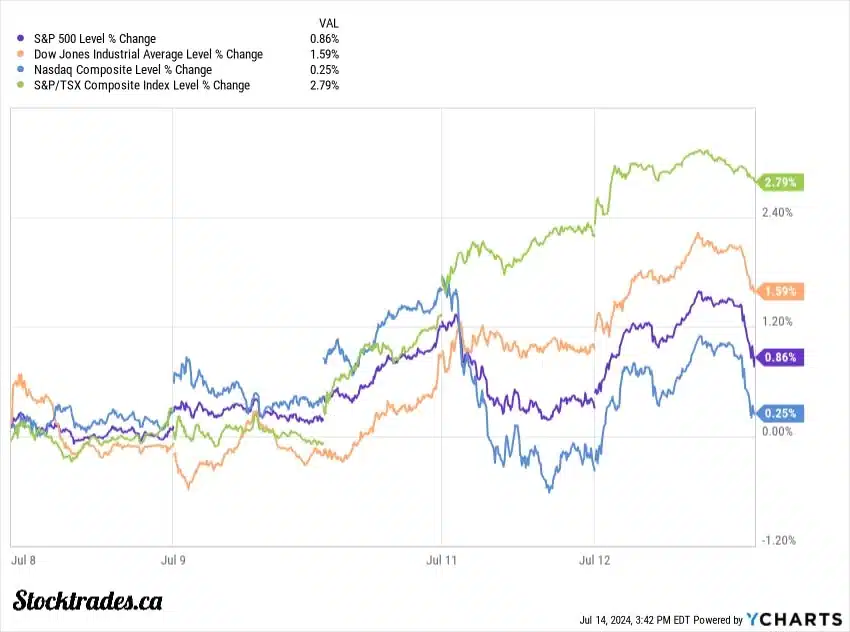
Although nothing is ever guaranteed, a move towards a more aggressive reduction in policy rates will likely result in money flowing back into some beat up sectors. This is precisely why I have held on to many of my struggling stocks as of late. I feel it is a “when,” not “if” situation when money starts to flow back into these companies.
Earnings
Alimentation Couche-Tard (TSE:ATD)
Couche-Tard posted its second mixed quarter in a row. The company posted revenue of $17.59B and earnings per share of $0.48, a beat on top-line analyst estimates but a miss on earnings estimates.
The company is currently being impacted by a softer consumer, as many scale back on spending due to a relatively rough economic environment. Fewer consumers are filling up with gasoline and buying routine goods from the convenience stores.
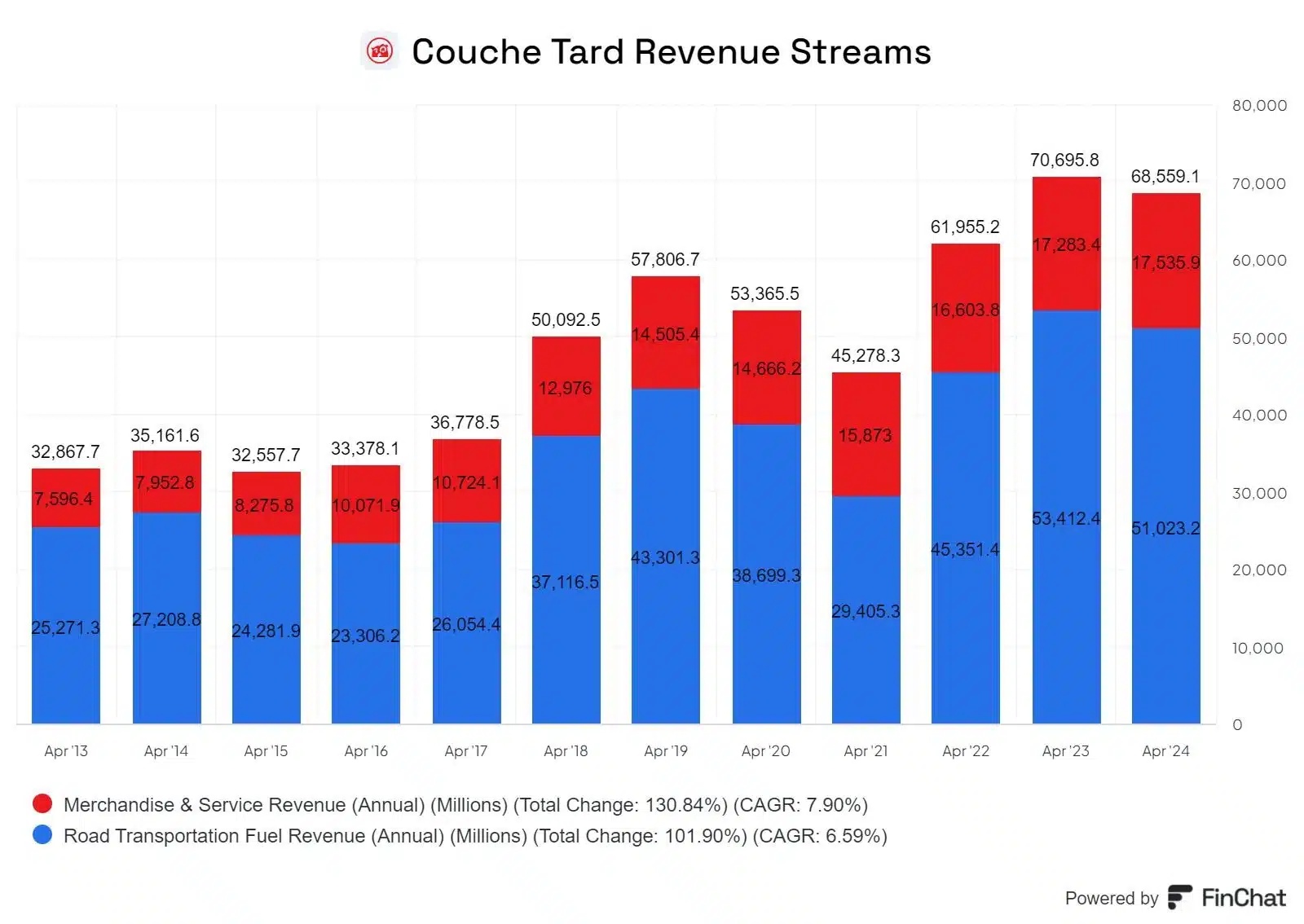
Merchandise same-store sales declined by 3.4% in Canada, 0.5% in the United States, and 2% in Europe. These numbers make sense, as Canada is arguably in the roughest economic shape of the three, and Canadian consumers are currently really feeling the pinch of higher rates and ballooning costs of living.
The company is currently undergoing some pressures when it comes to fuel margins due to the volatility of pricing, which is no doubt impacting results. Gasoline is a major contributor to the business, and as margins continue to be volatile, earnings will also be volatile. The company did say things are starting to normalize as we get into the second half of 2024.
In other notable news, the company’s CEO, Brian Hannasch, has announced his retirement. This is considerable news, as the company has only had two CEO’s in its 45+ year history. Alex Miller, the current Chief Operating Officer, will take over as the new CEO, and Brian Hannasch will be an advisor to him over the short term.
The quarter is a weak one, but it’s important that we understand that Couche-Tard is a high-quality corporation going through some headwinds it can’t really do anything about. The consumer is weak, spending is lower, and as a result, people are consuming less fuel and fewer goods at the company’s convenience stores.
This will not be a permanent shift in spending habits but temporary headwinds until interest rates come down, disposable income rises, and North Americans (and Europeans) spend more.
This will likely be a strong opportunity to add Couche-Tard at more attractive prices moving forward.
Pepsi (PEP)
Pepsi reported a solid second quarter. Revenue of $22.5B came inline with estimates and earnings per share of $2.23 topped expectations by about 7 cents.
What is becoming obvious in Pepsi’s results is the weakness of the North American consumer. When we look across all of their business segments in North America, including Frito-Lay, Quaker Foods, and PepsiCo Beverages, its beverage segment was the only one to not report a small decline in year-over-year revenue.
The slack is being picked up, for the most part, by strong continued growth in its international segments. Although it doesn’t segment each individual business out on an international basis (only in North America), its Latin America segment posted high single-digit year-over-year growth, while its European and African segments posted low single-digit growth.
Despite the low single-digit growth in terms of revenue, the company managed to continue to grow earnings at a 10%~ pace due to keeping input costs down. Eventually, cost efficiencies will run their course, and the company will need to get back to growing the top line. But for now, it is doing well despite the harsh economic climate.
The company modified its 2024 guidance in which it expects 4% organic revenue growth on the year and at least 8% growth in its earnings per share on a constant currency basis.
It continues to mention that the consumer is becoming more cost-conscious in light of higher interest rates and a ballooning cost of living. Many consumers are now looking to discount brands despite the lower quality products.
Myself, along with the company, are fairly confident that when interest rates inevitably decline, it should provide some relief among North American consumers and they will get back to normal spending habits. Until then, investors must remain patient.
US Founational Mid-Year Reviews
Blackrock (BLK)
Blackrock had a strong finish to 2023 but has come up relatively flat in 2024, up just 2.91% on the year. As an asset manager that is primarily focused on the financial markets, you would think the resurgence in US equities would be bullish for Blackrock’s share price. However, it hasn’t materialized yet.
The one important thing to understand about the company is that operationally, it is doing just fine. Assets under management now sit at $10.5T, a 15% increase on a year over year basis and both revenue and earnings per share have grown by 11% and 37%, respectively.
The one difficulty with Blackrock at this point is the fact that the company is so large that it struggles to grow organically at a rapid pace and must fuel a lot of its growth through acquisitions. Because of its dominant stance in the financial world, its economic moat puts the company trading at a premium valuation. Relative to its growth, there have been some other asset managers out there that are trading cheaper and, as a result, are attracting a bit of the attention at this point.
I’m willing to be patient on Blackrock as a core holding in my portfolio. Although valuations are still quite high, I believe the company’s position in the financial space, particularly with the surge in interest when it comes to Exchange-Traded Funds, will be a long-term tailwind for the company that won’t be slowing down anytime soon. At this point, I’m willing to pay that premium valuation for the peace of mind.
In the past, the company has done fine acquiring companies and merging them into the fold to drive growth. I’m confident it can continue to do so today.
Costco (COST)
What else can I say about Costco outside of just wow. Despite what many felt were sky-high valuations that many investors should avoid, the company continues to provide exceptional shareholder returns, up 28% in 2024 and a whopping 65% over the last year.
As we’ve stated time and time again, investors need to be looking at the quality of the business prior to valuations.
If we first look to valuations and then the quality of the business, we will end up screening out a lot of high quality companies.
Although I certainly don’t believe in a perfectly efficient market, stocks rarely deviate away from reasonable valuations for years, and Costco has always demanded a premium.
The company continues to drive mid-single digit comparable sales growth, sky-high renewal rates (in excess of 92%~) on its memberships, and the company’s stores are arguably the most popular they’ve been in history because of the rising costs of living and consumers’ desires to get cheaper prices on groceries.
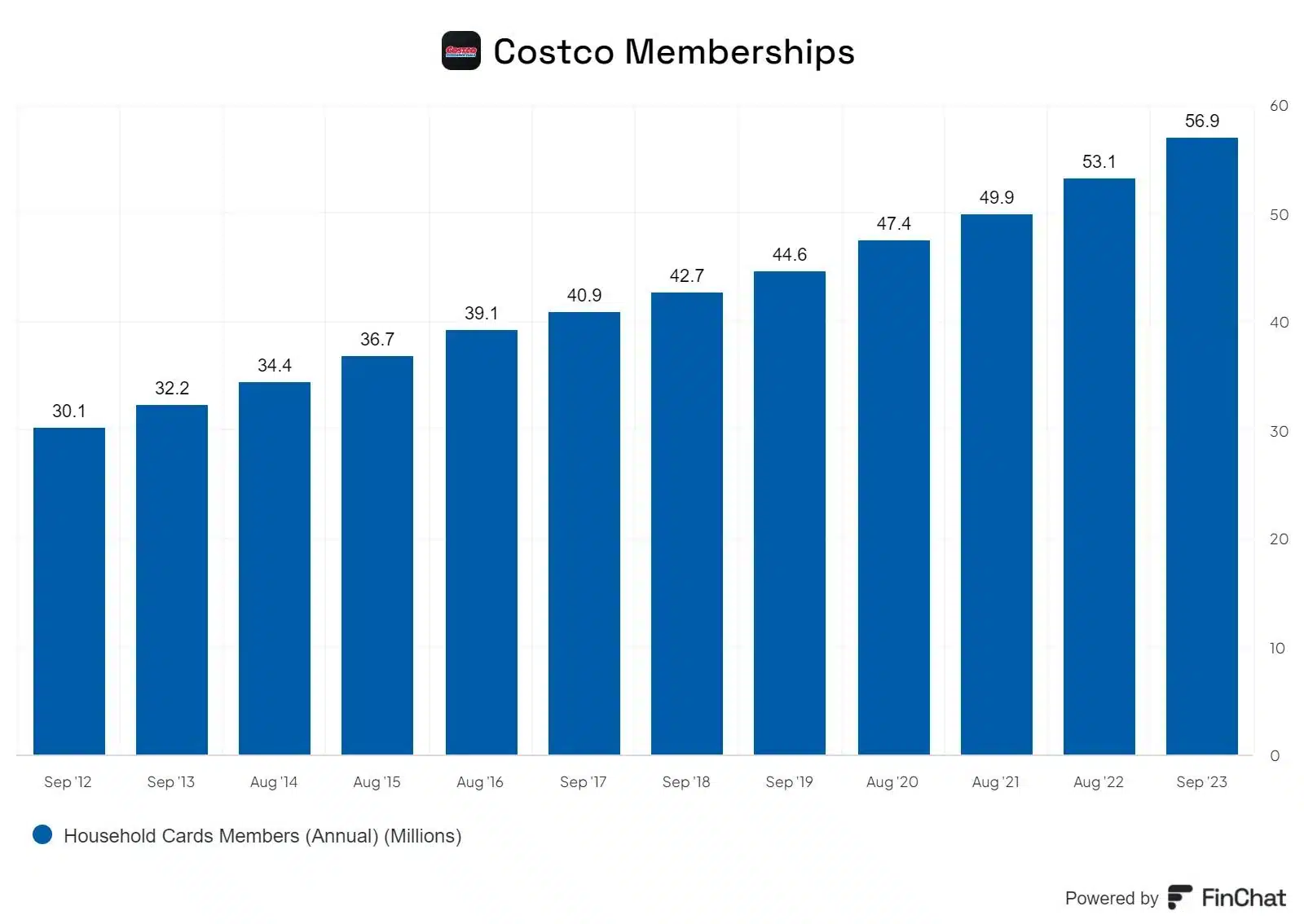
We’re noticing this even more in Canada, which arguably has a much weaker consumer than the United States.
The company finally bumped its membership pricing up by $5 per year. In the end, this doesn’t seem like much, but this is one of the more profitable segments of the business, and the company is likely attempting to thread the needle in terms of raising its membership pricing without impacting renewals. Considering the overall cost savings many members have when it comes to shopping at the store, it is highly unlikely a $65 annual membership impacts renewals at all.
It is also important to note that, for the most part, Costco is driving this same-store sales growth with some big headwinds when it comes to discretionary items. It is likely the shift of consumers seeking out cheaper alternatives for groceries is permanent. So, when rates come down and the consumer becomes more willing to spend capital on discretionary items, we could see further growth from Costco.
Alphabet (GOOG)
It has been quite the year for Alphabet, the parent company of Google. Not only is the stock up 33% in 2024, but it has announced its first ever dividend payment. Yes, the yield is relatively small, sub 0.5%, but the fact the company is looking to return capital to shareholders via a dividend highlights the maturity of the business, and it is likely we see Alphabet develop into a rock-solid dividend growth company.
The company has made notable changes to its search algorithm which at this point in time is driving significant growth in its advertising segment. Revenue is up 16% year over year and earnings have climbed by more than 62%.

Despite Google having a dominant market share when it comes to search, the company continues to find ways to drive growth. As more and more companies come back to the platform to advertise after a rough 2022, Google should be able to continue to be the main engine behind the company. In addition to this, its YouTube platform is finally back to posting year-over-year increases in revenue after it had some tough comparables to keep up to during the pandemic-driven lockdowns in which video content was being watched at an exceptionally high level.
Its Cloud segment also continues to be a strong driver, reporting nearly 30% year over year growth.
At the start of the year, we stated that we believed Alphabet to be one of the more attractively priced Magnificent 7 stocks. That value gap has closed at this point in time, and as of right now we’d view it as a rock-solid GARP (Growth at a Reasonable Price) play for investors. Its economic moat when it comes to both text-based search and video search is simply unmatched, and it is hard to imagine a company being able to penetrate the market Google currently holds.
For quite some time, the story was that platforms like ChatGPT would be the ones to steal market share. But thus far, the story hasn’t really done much of anything.
