
January Update
We will keep our January update brief as we want to spend most of this time talking about the factors impacting the current investment environment.
January is off to a choppy start and tech in particular is seeing considerable pullbacks from their highs. It is why our Bull List with gains of 0.88% is currently trailing the 1.5% posted by the TSX Index.
Dragging the average down are REAL (-10.19%) and DCBC (-17.00%) which are seeing notable pullbacks.
Are we worried? Not in the least.
We’ve talked at length about REAL’s position in the Q&A, the updated report and Discord.
And of note, remember the Discord server is live. So, if you’re interested in joining, just click the link in the left hand menu!
If you don’t feel like participating in the chats, it’s completely fine. But, it’s a pretty great resource of extra information, even if you just want to read.
Instead, a few brief words on DCBO. Nothing here has changed.
No changes to fundamentals and no earnings reports. Quite simply, this is a company that is pulling back after seeing considerable gains over the last 6 months. In our opinion, this pullback is healthy.
Our Dividend Bull List is holding up a little better with gains of 1.20% thus far. There are no double-digit winners or losers – not surprising considering these are intended to be less volatile than our Growth Bull List.
Although we removed TC Energy from the Dividend Bull List due to it getting an upgrade to a Foundational Stock, we do track our picks indefinitely on these lists.
So, leading the way in January is TRP (+7.11%). Despite the fact that President Biden cancelled Keystone XL, we discussed a few times before that this was a non event as the news was already baked into the company’s share price.
* Dan Kent is long REAL and TRP. Mat Litalien is long REAL and DCBO.
Markets in 2021
As 2020 closed out, we weren’t sure there was going to be much that could top the events of one of the most eventful years in decades.
However, it didn’t take long for the markets to show us that things are far from over. 2021 has already been one of the most eventful times we’ve witnessed as investors. And, we’re only in February.
This introduction isn’t exactly to comment on the “meme-stock” fiasco, but instead highlight four key factors we feel are going to continue to drive bullish activity through 2021 and even into 2022.
However, what is harder to pinpoint moving forward is the overall trajectory the markets will move at. A gradual, rocky slope, or a more vertical line? Lets get started.
Four driving market factors that could very well extend this bull market into 2022
Fixed income rates are becoming even more undesirable
Fixed income is an important part of a diversified portfolio. However, in the particular situation we’re in right now, it isn’t providing much value.
When we look at the overall return on an investment, it’s important we look at the real, not nominal rate of return.
What this means, is we need to be accounting for inflation and the overall impacts it will have on our investments.
A lot of people who are unaware of this concept are happy to park all their money in a 1-1.5% high interest savings account, thinking it’s a “great rate of return.”
While this may make sense for an emergency fund, some people are doing it with all the money they have. Primarily out of nonsensical fears of investing in the stock market.
We’ll return to this in a bit here, but in short, it’s not a strong strategy.
The bond market is providing some of the lowest returns we’ve witnessed in a very long time.
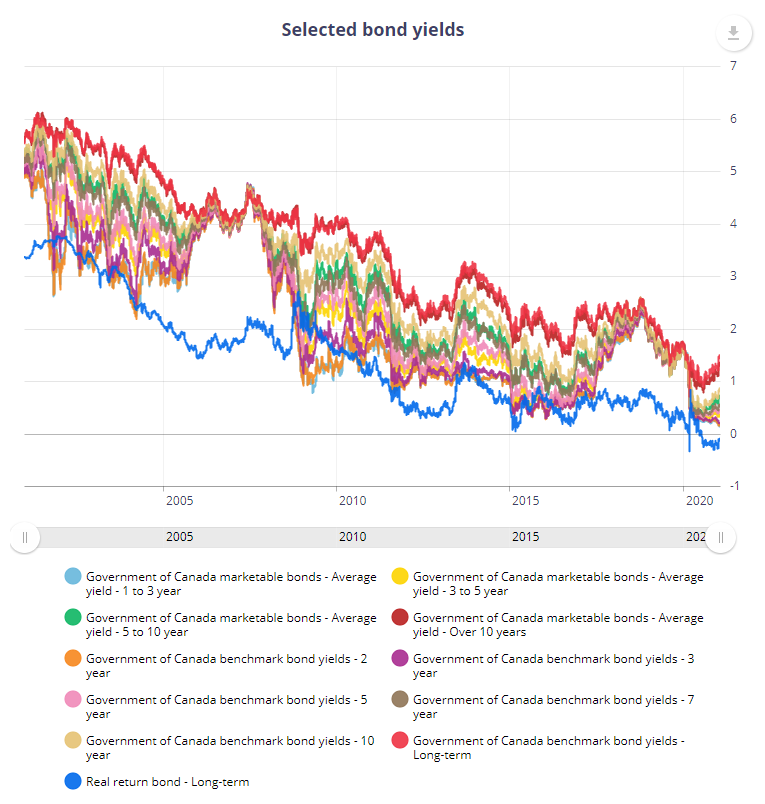
Above is a chart of the Bank of Canada bond yields. We’ve essentially hit the lowest point in terms of overall yield in the past 15 years.
Long term Government of Canada bonds are providing returns in the 1.4% range. Which, if we align with past inflation and median inflation estimates moving forward, are presently providing at best, break even real returns.
If we look to corporate bonds, they’re naturally higher as they aren’t guaranteed like Government or municipal bonds. However, in some cases, they are still providing negative real returns.
The two easiest things to do when investors want to avoid the fixed income market is either hold cash, or buy stocks.
Heading into an environment where we can expect a high level of inflation, holding on to cash would be viewed as somewhat of a disaster.
In fact, even if we look back to the previous 12 years, a $100 basket of goods back then would cost you $121 today.
Inflation is very real, and it’s eating away at your buying power as we speak.
So, one of the primary alternatives for retail investors is to buy stocks. And obviously, as a Stocktrades Premium member, you are one of them.
The current fixed income environment is leaving investors very little choice as to where to park their money. And as a result, we feel it will fuel the markets moving forward.
Low borrowing costs will continue to drive growth stocks
When we think of company expansion, most often forget the fact that it’s not uncommon for high-growth stocks to take on debt to expand infrastructure, new product lines, or pay for acquisitions.
The Bank of Canada has stated it has no plans to increase interest rates for the next few years, and the Fed has stated it could be 2024 before rates increase down south.
As a result, borrowing has become extremely cheap. We’ve seen this fuel the real estate market, and it’s very likely to help accelerate the top and bottom line growth of high growth companies.
Why?
Well first off, debt already on the books is likely to be rolled into lower interest rates when it expires, and new debt taken out will also be at lower rates.
Financing has costs, costs that ultimately erode the earnings of both income and growth companies. So, the more a company can lower costs, the more it can improve its bottom line, which is in the end, what we’re trying to invest for.
In terms of a company’s top line, low borrowing costs may not have a direct impact on revenue. But lower expenses when it comes to acquisitions, which in turn fuel revenue growth, are a contributing factor.
To add to this, a lot of companies have toned down acquisitions in 2020 to preserve capital, and as a result are sitting on some heavy cash positions. In fact, we even saw Bull List stock Enghouse issue a $1.50 special dividend because of this.
The combination of low financing rates and tempered acquisitions in 2020 has the potential to fuel growth in acquisition heavy companies moving forward.
And as we’ll speak about next, retail investors love a good headline.
Headline news of vaccines and economic recovery
Although it’s clear to see a lot of the economic recovery from life getting back to normal is already priced in to the stock market, in our opinion, news of vaccine successes and a surge in GDP growth in mid to late 2021 and 2022 is going to keep the bull market going.
Earlier this year, prior to Blackberry being firmly in Wall Street Bet’s radar, the company released news stating they’d be partnering up with Amazon.
I won’t get into the logistics of the deal, but what’s important to understand here is that the deal presented nothing concrete in terms of how this will help Blackberry moving forward.
It was good news, but it wasn’t good enough to justify sending Blackberry’s share price nearly doubling.
So, if vaccines go well and we start to see headlines of rapid GDP growth in late 2021 and 2022, even if a recovery is already priced into stocks as we speak, you can bet the market is going to respond positively, much like it did back in November of 2020 when vaccines were first announced.
Retail investors soaking up more of the market
Retail investing has ballooned in recent years, tripling in terms of activity during the most volatile days.
The catalysts for bull markets and market selloffs were firmly in major institutions hands. And, don’t get me wrong. They still are, but it’s not as drastic.
Prior to the crash in 2020, despite a hard and swift correction in 2018, we’d overall been on a rapid bull run. In fact, one of the best bull runs in history.
As a result, many investors were sitting on the sidelines, as they’ve been told for the longest time to buy low, and sell high. Particularly Millennials. In fact, prior to COVID-19, it was estimated that less than 25% of Millennials actually had money invested in the markets.
Once the market crashed in March, this changed. It was estimated that nearly 10 million retail investors opened up an account for the first time in 2020 in the United States alone.
These are young, relatively green investors.
Ones that are primarily interested in investing in disruptive industries like renewable energy, cryptocurrency and electric vehicles. Meanwhile, industries like oil and gas and the material sector, primarily gold miners, continue to suffer.
With the news of vaccines and a return to normal at least in sight, retail investors are more optimistic now than ever.
You could argue that their exuberance is likely due to a lack of overall knowledge when it comes to the markets and valuations, but now that they control a significantly larger portion of daily activity, we feel this will continue to fuel the markets moving forward.
These are our thoughts, but how will we get there? Is a correction possible?
We were on the brink of what we thought could be a double digit correction when the GameStop/Meme-stock madness erupted last week.
Investors were starting to worry that the liquidation of hedge fund assets, which in the end would result in fundamentally sound companies being sold off to pay losses, would result in the market crashing.
Couple this with the fact that if hedge funds were to go bankrupt, who would be around to pay the margin calls, putting brokerages and ultimately investor capital at major risk.
Both of these issues, along with the fact that when something is happening like we’re seeing right now, investors tend to get a little uneasy anyways, and we saw the markets take a 4% dip in a matter of a couple days.
And with all that said, we definitely don’t expect our bullish thesis to result in a continuous line upwards.
In fact, we still wouldn’t be surprised if we saw a short term market correction in the low double digits before resuming this bull run.
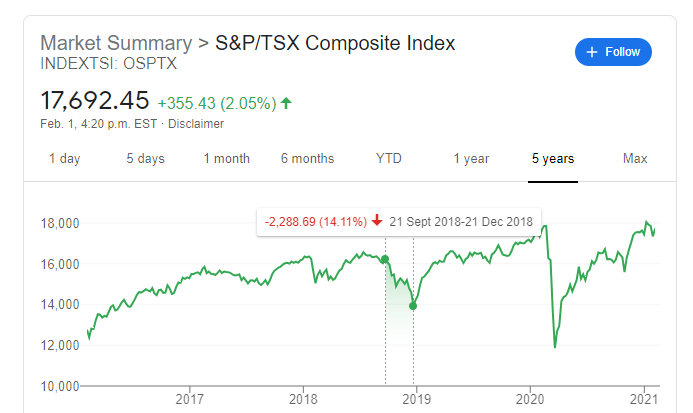
Will it be as drastic as the one highlighted above in 2018, when the TSX lost over 14% of its value in 3 months?
Difficult to say. But, the number one thing we need to understand is that in the accumulation stage of investing, we should be welcoming a market correction, especially with the exuberance in the markets right now.
And secondly, if you’re holding strong companies, you have nothing to worry about in the event of a correction.
During the 2020 crash, we re-iterated this to members. The markets always recover. They always have, and they always will.
The fear in the heat of the moment is primarily from thoughts of “it’s different this time.”
But as we realized in 2000, 2008, in late 2018 and again in 2020, this time is no different.
