
We feel, although nowhere near as drastic as the fall outs back in March of 2020, that an update was needed for members in light of falling stock prices.
We hope through the availability of both our Dividend Bull List and Foundational Stocks that members have constructed a well balanced portfolio, one that is built to withstand short term price impacts like this.
But, we’re also not oblivious to the fact that it is very likely some members were overweight on growth stocks because of the current market environment.
Although we’ve advocated pretty extensively to avoid going overweight on growth in almost any situation, it’s human nature to want to drift towards where the gains are being made.
If you are overweight growth and are feeling now that it is well out of your comfort zone and risk tolerance, it’s likely something you’re going to have to deal with over the short to mid-term here, as sell offs are definitely overdone.
The most important thing that you understand, and what we’ve preached to members ever since starting this platform, is that this short term noise shouldn’t impact your thought process right now.
In this piece, we’re going to explain what exactly is going on with the markets, but a really quick summary?
We’re not sure we have ever witnessed the markets acting so nonsensical, in either direction. The meteoric rise in 2020 was overboard, and this quick and swift sell off of growth options is also overboard. We’ll thoroughly enjoy when we find some sort of happy medium.
Rising bond yields are causing outright panic in the markets, especially with growth stocks
If you don’t already, a key economical indicator to keep an eye on is the 10 year treasury rate. This is a U.S. Treasury bond that is a key indicator of the future outlook of the economy, especially when it comes to interest rates and inflation.
Most governments stated rates would not move from historic lows until 2023 at best. But, with fears of inflation there is a general uneasiness to the markets, and rates are rumored to be on the rise.
And when large institutional investors make the switch to fixed income due to higher yields, it can cause the markets to get quite rocky.
But as you’ll see below, the current interest rate of a 10 year Treasury bond is hardly approaching levels seen in 2019. So it’s not necessarily the actual yield the bond is offering, but the fact it’s rising that is scaring investors.
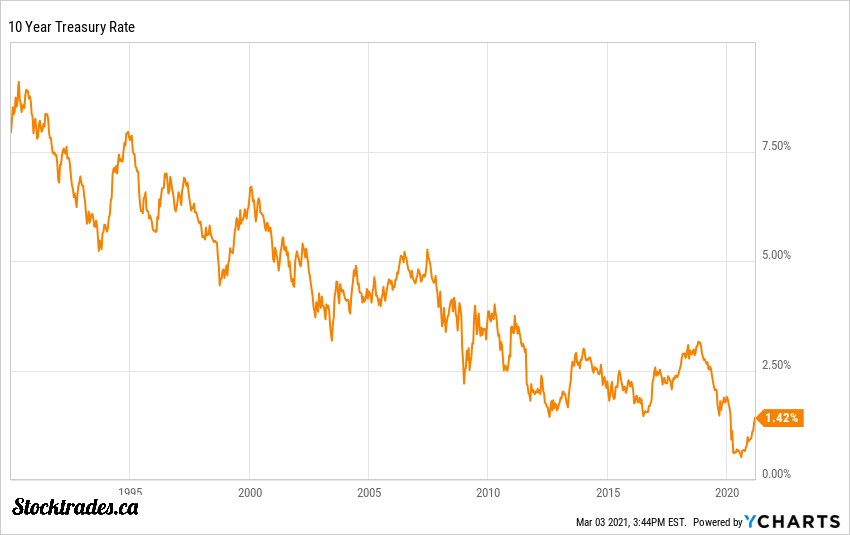
The second “fear” factor we can see in a situation like this, and one that is accelerating the losses (paper losses, that is) of growth investors is the fact that interest rates are rumored to be on the rise.
Remember back in our piece on investing in an overvalued market where we stated that it is absolutely crucial in this environment to own companies that generate, rather than consume cash?
Here is a direct quote:
“And with high levels of inflation, it is even more important to select companies capable of producing strong cash flows. Because in an inflationary environment, companies that consume cash will face the brunt of the impact, while companies that produce cash will survive.”
One of the reasons for this is in a rising interest rate environment, those who consume cash will often need to borrow that capital. They can do this through credit facilities, issuing debentures or bonds, or issuing equity (stocks). All of which, in a rising interest rate environment, are poor for the company’s stock price.
For one, if rates rise and the company is forced to borrow, interest paid will come directly out of the company’s bottom line. The same goes with rising bond yields. If companies issue debt, it will be at a higher interest rate, eroding earnings.
And finally, if a company issues shares, it will dilute current shareholders, and also decrease earnings per share due to more shares outstanding.
So as a result, growth stocks tend to fall
So as we sit now, it is very likely the growth portion of your portfolio is suffering extensively. Mine sure is.
But again, as we can see by the chart above, bond rates are still below levels even seen in 2019.
And although interest rates are rumored to be on the rise, nothing has happened yet.
The swift sell off of growth stocks is, in our opinion, extensively overdone.
We’re seeing companies like GoodFood Market (TSE:FOOD) trading in the low $10 range when just 7 days ago it completed a bought deal offering for $60 million at $12.50 a share.
In fact the company came out today and said subscriber acquisitions are up 30% year over year.
Strong subscriber growth coupled with institutional investors grabbing this company at $12.50 a share, and the market has rewarded it by sending it into the sub $10 range for parts of the day.
There wasn’t much that escaped the growth selloff over the last few weeks.
Looking through our Growth Bull List, as well as our more speculative plays on our Watch List, there wasn’t a single situation where the fundamental outlook on a company has changed.
A well diversified portfolio is absolutely critical
If you’ve been a Stocktrades Premium member for any reasonable amount of time, you’ve probably heard us preach about stocks being right for your portfolio, whether it be your overall risk tolerance our just the overall makeup.
In fact, we’ve probably annoyed you saying it so much. But it really comes down to times like this where diversification is absolutely critical.
Although the growth portion of my portfolio (Dan) is suffering significantly, my overall portfolio is only down around 5.7%.
That is because while investments in companies like Good Natured Products, GoodFood Market, Xebec Adsorption and Gatekeeper Systems have fallen, the blow has been more than cushioned by a very strong showing when it comes to my industrial and financial plays, particularly my Canadian banks, insurers and railroads.
We’ve fielded questions about these types of stocks extensively over the course of 2020 and into 2021. Investors wondering if they should have the time of day for them in this market environment.
Why invest in blue-chips like railroads and banks, when you can earn significantly more in a speculative growth play?
I think the events that have unfolded over the last couple weeks should be a clear cut answer to that question.
Risk Tolerance
In times like these, investors also get a good sense of their risk tolerance.
You can fill out as many surveys as you want – until you experience considerable market volatility, you won’t truly understand what it means to have a high risk tolerance. People may believe they have a high risk tolerance, until volatility hits.
This is especially true of those who just got started in 2020. You’ve seen nothing but green, so this might come as a bit of a shock.
Over the past few days, were you checking your portfolio daily? Hourly? Minute-by-minute?
Were you overcome with anxiety with the stress of seeing your portfolio drop?
Did double digit losses in some of your stocks cause you to rethink your investment?
Where you close to hitting that sell button? Or even worse, DID you hit the sell button?
The answer to these questions will help you better understand your risk tolerance.
We mentioned XBC and GDNP above. They have been hit hard over the past week and as we’ve said, they are more geared towards investors with a higher risk tolerance.
Especially GDNP, which is a smaller cap stock trading on the TSX Venture.
We (Mat & Dan) both own these stocks, and neither of us has been phased by the recent downtrend.
We are of course aware and had there been some material news that changed the investment thesis, we may have acted – and of course let members know why the investment thesis has changed.
However, nothing has changed outside of momentum. In the short term, this can be tough to withstand but investing is not a short term endeavor.
It is very much a long term game.
We’ve said it many times – we don’t buy these growth stocks unless we are prepared to hold them for years.
If you need the cash in the next year or two, best to keep them away from equities in general.
So what should you do?
Well, if your sweating this mini-downturn then it may be time to re-align your thoughts on risk tolerance.
Perhaps, you may want to build a strong foundation or simply re-think the makeup of your portfolio.
Dan mentioned it a few times, growth accounts for about 40% of his portfolio. Mine is similar, probably a little lighter – around 30%.
These are based on our own risk tolerances – which for the record, we didn’t figure out overnight. In fact, it often took corrections like this for us to fine tune it.
I (Mat) started out as a completely risk averse investor and over the years as I got more comfortable, I switched gears and became more aggressive. It helped having a solid foundation to build off of.
That worked for me. Others, may start off with more risk and be comfortable doing so with the intent of becoming more risk averse as the years go by.
Bottom line, no portfolio make up is the same – nor should it be. We all have our own personal risk tolerance that will complement our own unique situations.
The single most important takeaway from times like these – never make decisions based on emotions.
It is the number one reason why retail investors underperform the markets.
As we’ve said many times before, sometimes the best course of action is no action.
