
Options are a form of derivative. If you’re unaware of what a derivative is, it is essentially a financial instrument thats value is based on an underlying asset.
So, a futures contract on the price of oil is a derivative. A forward contract based on a particular currency is a derivative. And, what we’ll be talking about today, an options contract on a particular stock is a derivative. Many institutional investors and big banks use derivatives to hedge.
Options trading, for the most part, carries with it a wide degree of speculation and those who aren’t extremely proficient at it tend to lose money, and the losses can be exorbitant.
However, there’s one option strategy that many investors are using today, myself included, to increase the overall income of their portfolio, and that is covered call writing.
But first, lets quickly dive in to what exactly an options contract is and the process of purchasing options. Knowing this is the foundation of understanding how covered calls work.
If you’re looking for a more intense guide on what options are, head here. Investopedia’s guide is simply amazing. It’s going to teach you everything from reading an options table to understanding how different types work.
For the sake of not extending this article to over 3000 words, I’ve simplified it a bit just to get you headed in the right direction to explain covered calls.
Different types of options contracts
At its core, an options contract is a contract that is going to give an investor the right, but never the obligation, to buy or sell the underlying stock at a particular price. This definition gets even easier to understand if we look at specific types of options, which are calls and puts.
Call options
A call option gives the owner of the option contract the right, but not the obligation, to purchase the underlying stock at the strike price of the options contract.
So for example. If an investor purchases A December 18th (Expiry) $80 (Strike Price) call option on Lightspeed POS (TSE:LSPD) (Underlying Asset), they’re paying for the right, but not the obligation, to purchase Lightspeed at a price of $80 a share on or before December 18th.
Put options
A put option gives the owner of the option contract the right, but not the obligation, to sell the underlying stock at the strike price of the options contract.
So for example. If an investor purchases A December 18th $70 put option on Lightspeed POS (TSE:LSPD), they’re paying for the right, but not the obligation, to sell their shares of Lightspeed at a price of $70 a share on or before December 18th.
What you pay for an option contract
Option contracts are always sold in 100 share lots. This means that if you buy a call option on Lightspeed, you’re paying for the right to purchase 100 shares at a particular price. However, there is a premium you must pay to purchase the contract.
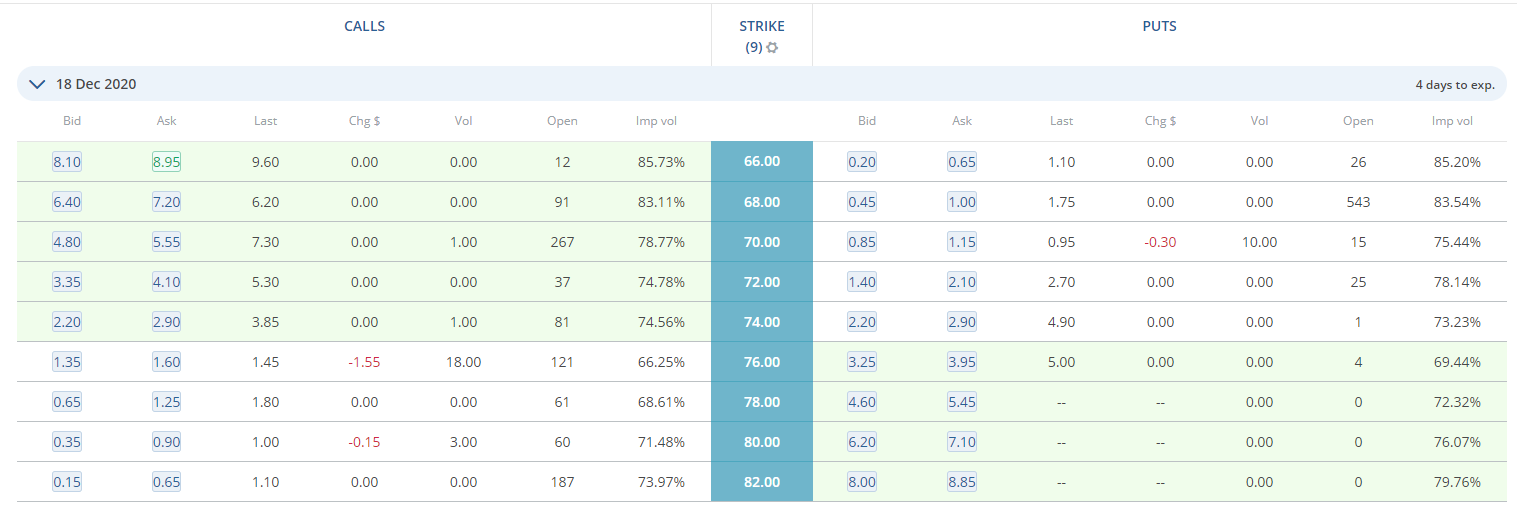
This is a basic options quote from Questrade on Lightspeed POS (TSE:LSPD). Calls are on the left, and puts on the right.
In the middle, we can see the strike price.
So, lets go back to the example above and say we want to purchase an $80 call on LSPD. If we look to the “last” section on that chart, the last call option that was sold on Lightspeed with a strike price of $80 went for $1.
So what exactly does this mean?
As I mentioned before, options contracts are always sold in 100 share lots. So, you’re paying $100 (100 shares X $1 per share) to purchase the contract.
So, your brokerage debits you $100, and you now have the ability to purchase 100 shares of Lightspeed at $80 any time before December 18th.
So how do you make money?
So with Lightspeed trading in the $76 range right now, obviously it makes no sense for you to execute your option right now. You’d pay $4 more than it’s worth.
So, this option is deemed “out of the money”. If Lightspeed never goes over $80 before December 18th, your contract expires useless and you lose $100.
However, if Lightspeed rises above $80, you’ve now got an in the money option contract, and you can execute it whenever you want before December 18th.
But, you do have a break even price. If it cost you $1 a share to buy the contract, and you can buy Lightspeed for $80, you only profit from the option if Lightspeed is above $81.
But, what if Lightspeed goes to $90 before the 18th? You can now execute your option, and buy 100 shares at $80.
You could turn around and sell those same Lightspeed stocks for $90 on the open market, profiting $900 (remember, you paid a $100 premium). Or, you can keep the shares.
A final option, you could sell your options contract instead of executing it, which would now trade for way more money as it is in the money. But we won’t go too in depth with that, this should at least give you an idea of how an option contract works.
A quick highlight on put options
Purchasing a put option on a stock is the same process as a call. If we look to Lightspeed $70 puts on the chart above (right hand side) we can see that the last put contract sold for $0.95.
So essentially you’d be paying $95 for the right, but not the obligation, to sell Lightspeed shares at $70 a share on or before December 18th.
You purchase put options if you think a stock price is going to go down. If Lightspeeds stock stays above $70, it wouldn’t make sense for you to execute your put option and sell it for less than market value.
However, if Lightspeed falls to $65, you now have the added security of being able to sell your shares for $70. Your break even price would be $70 a share minus the $0.95 premium.
So now that we know how options work, how do we earn more with selling covered calls?
In the options world, in order for people to be buying options contracts, someone has to write (sell) the options contracts. This is where the covered call seller comes in.
Instead of paying the premium, you instead receive the premium from the investor purchasing the contract from you.
Lets bring the Lightspeed chart back up again.
Now that we know how call options work, we understand if we buy a call option, especially one that is out of the money (below the strike price) we hope the stock price will go up.
If Lightspeed trades at $73, we aren’t buying an $80 call option unless we think it’s going to go over $80. Unless we like wasting money of course!
So, if we want to sell a call option, we’re essentially being paid a premium by someone else, who has the right, but not the obligation, to purchase Lightspeed shares from us for a specific price.
So in this case we don’t want the stock to go up. We want the stock to stay below the strike price, so that we keep our shares, and the premium.
So, lets say we’re bearish on Lightspeed and we feel it’s going to stall in price over the next couple weeks. We choose to sell a $76 call option listed above. Because the bid price (what someone is willing to pay for the contract) is $1.35, we’d receive $135 in premiums for selling this option.
If Lightspeed stays below $76, the person who bought our call option will have it expire useless, and we’ll profit the $135 premium.
If Lightspeed goes over $76 however, we’ll likely be faced with an exercised option.
And this is where options get very risky for those looking to skirt a critical safety measure. That safety measure is the “covered” portion of a covered call.
Covered calls vs naked calls, what’s the difference?
So before you sell a covered call option, there’s one absolutely critical thing you need to have in place.
You need to own the shares of the underlying stock.
If you’re selling a call option on Lightspeed, you need to own 100 shares of Lightspeed before doing so.
Ok, you don’t absolutely need to own them. But if you don’t, you’re turning one of the safest options strategies into one that poses an infinite level of risk. Lets have a look as to why.
Selling a covered call on Lightspeed
Lets say your average purchase price on Lightspeed is $50 a share and you own 100 shares. You’re looking to squeak some extra income out of the shares so you sell a call option for $76 and receive the $135 premium.
Lightspeed rises to $85, and your options contract is exercised. You sell your shares for $76 a piece to the person who bought your call option.
You ended up selling Lightspeed for less than market value. However, your purchase price was $50, and maybe you were looking to sell in the $76 range anyways. There is a loss in share price, but there is no real out of pocket expense.
Selling a naked call on Lightspeed
Lets assume the same situation above, except you don’t own any shares of Lightspeed. You sell the call option for $76 and receive your $135 premium.
Lightspeed rises to $85 and your contract is exercised. You’re forced to buy 100 shares of Lightspeed at $85, and sell them to the call option holder at $76.
You’ve now spent $8500 to buy 100 shares of Lightspeed, only to sell them for a $765 loss (remember, you received $135 for selling the contract.)
As we amplify the stock price, the situation gets even scarier. Lets take a look at Shopify to see how investors can run into significant trouble selling naked calls.
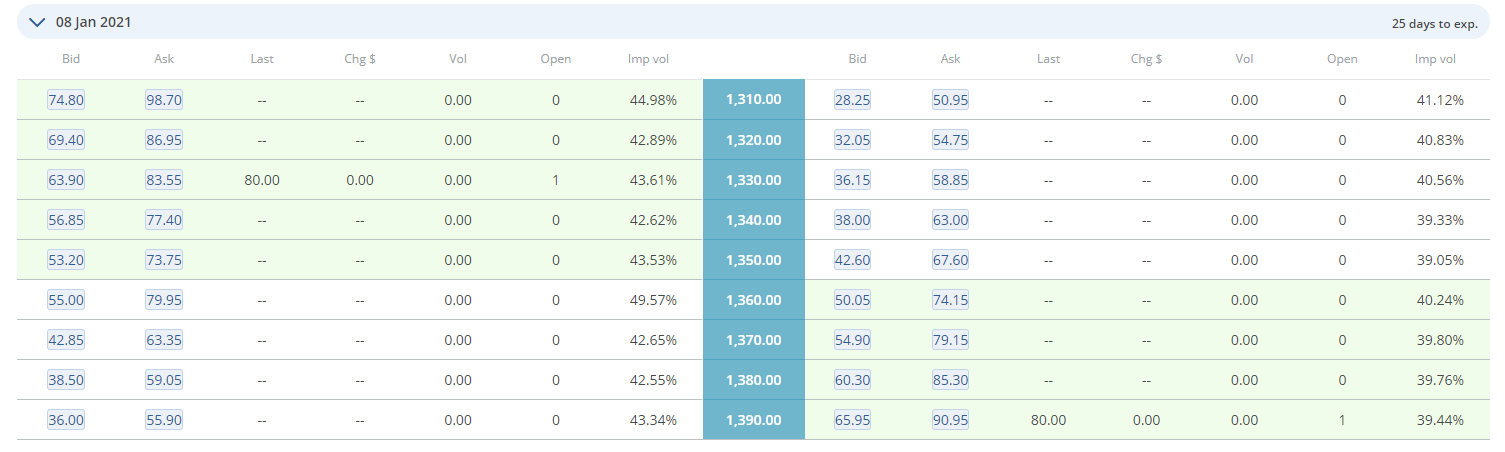
These are Shopify calls and puts expiring on January 8th. Lets say you’re bearish on Shopify, and you don’t think the price will break $1360 by January 8th. You sell a naked call (you don’t own 100 shares of Shopify) at a $1360 strike and your brokerage account is credited $5500 (the bid price of the contract X 100 shares.)
Wow, $5500 is a lot of money right? All Shopify has to do is hover under $1415 (the strike price plus your premium you received) and you make money!
Next week, there’s news about a partnership for Shopify and another major retailer, the first of its kind and is expected to drive more revenue growth. Shopify breaks all time highs and soars to $1600 a share.
The call option you sold is now exercised. You buy 100 shares of Shopify at $1600 a share, and are forced to sell them to the call option holder for $1370, a loss of $23,000 in share price, and a total loss of $17,500 after your premium received is taken into account.
If the investor instead owned 100 shares of Shopify, although they would have had to sell their shares for a discount to market price, there is no money that comes out of pocket from the options seller, because they chose to cover their call option.
As a result, covered calls cap your upside, but limit downside
Both covered and naked calls have one thing in common, their upside is limited. The most you can make from selling a covered call, share price movement aside, is the premium you receive.
However, they have one stark difference.
A covered call has limited downside considering you already own the shares, while a naked call has unlimited downside.
For this reason, an investor looking to generate some extra income inside of their portfolio via call options should have absolutely no reason to sell naked calls.
In fact, a naked call strategy makes next to no sense in almost all situations.
So when should you sell covered calls?
The number one reason investors sell covered calls is to simply gain more income inside of their portfolio. However, there’s a few rules I tend to follow before deciding to sell a call option.
My strategy for selling covered calls is fairly simple. For one, I need to be in the green with the company.
An example of this would be if my average purchase price on a stock was $50, I wouldn’t sell a covered call with a strike price below this.
If it’s exercised, I don’t want to have to sell the stock at a loss. So as a result, you’ll likely see me selling covered calls on stocks I wouldn’t mind taking a profit on and selling if the option got exercised.
Most recently, I sold a December 18th covered call on Lightspeed POS at $76. Considering my average purchase price is well below this, if the stock price went above $76 and it was exercised, I wouldn’t be too upset. I’d lock in some very solid profits.
And if it stayed below $76, which it is looking like it will now, I got paid $240 (the contract had a price of $2.40) per contract for my troubles, which I can now deploy to other stocks.
If you’re adamant on keeping shares, don’t sell covered calls on those shares. There is a chance the option will be exercised and you’ll be forced to sell them.
However, if you’re willing to speculate a little, covered calls are one of the lowest risk ways on the markets to do so. No, you won’t strike it rich, but if you develop a knack for predicting short term price movements, you can become quite good at collecting premiums and watching options contracts you sell expire useless.
And, all those collected premiums do add up over time!
And keep in mind, because of their low risk nature, covered calls can be sold inside of a TFSA and RRSP! So, premiums can be gathered tax free!
How to sell covered calls at my brokerage?
This is a question I will no doubt be getting a ton from members, so I figured I’d just answer it in here.
Selling options contracts varies with every brokerage. So, it’s very important you study how your brokerages system is set up, and make sure you’re doing it correctly.
Also, it’s very likely you’ll have to fill out paperwork giving your brokerage permission to have you access the options portion of their platform.
