[]
Login Join Premium

Bull List Report – ASML Holdings – ASML

ASML Holdings – ASML

ASML is the leader in photolithography systems used in the manufacturing of semiconductors. Photolithography is the process in which a light source is used to expose circuit patterns from a photo mask onto a semiconductor wafer. The latest technological advances in this segment allow chipmakers to continually increase the number of transistors on the same area of silicon, with lithography historically representing a high portion of the cost of making cutting-edge chips. ASML outsources the manufacturing of most of its parts, acting like an assembler. ASML’s main clients are TSMC, Samsung, and Intel.

Focus area

Score

Valuation

54

Profitability

91

Risk

26

Returns

92

Dividend

85

Outlook

75

Debt

88

Growth

72

Overall

74

Click the KPI images to expand them if needed!
Pros

  • ASML is the sole supplier of extreme ultraviolet (EUV) lithography machines and has a 90%~ market share
  • The increasing adoption of technologies like AI, 5G, IoT, and electric vehicles drives long-term demand for advanced chips, which ultimately will benefit ASML
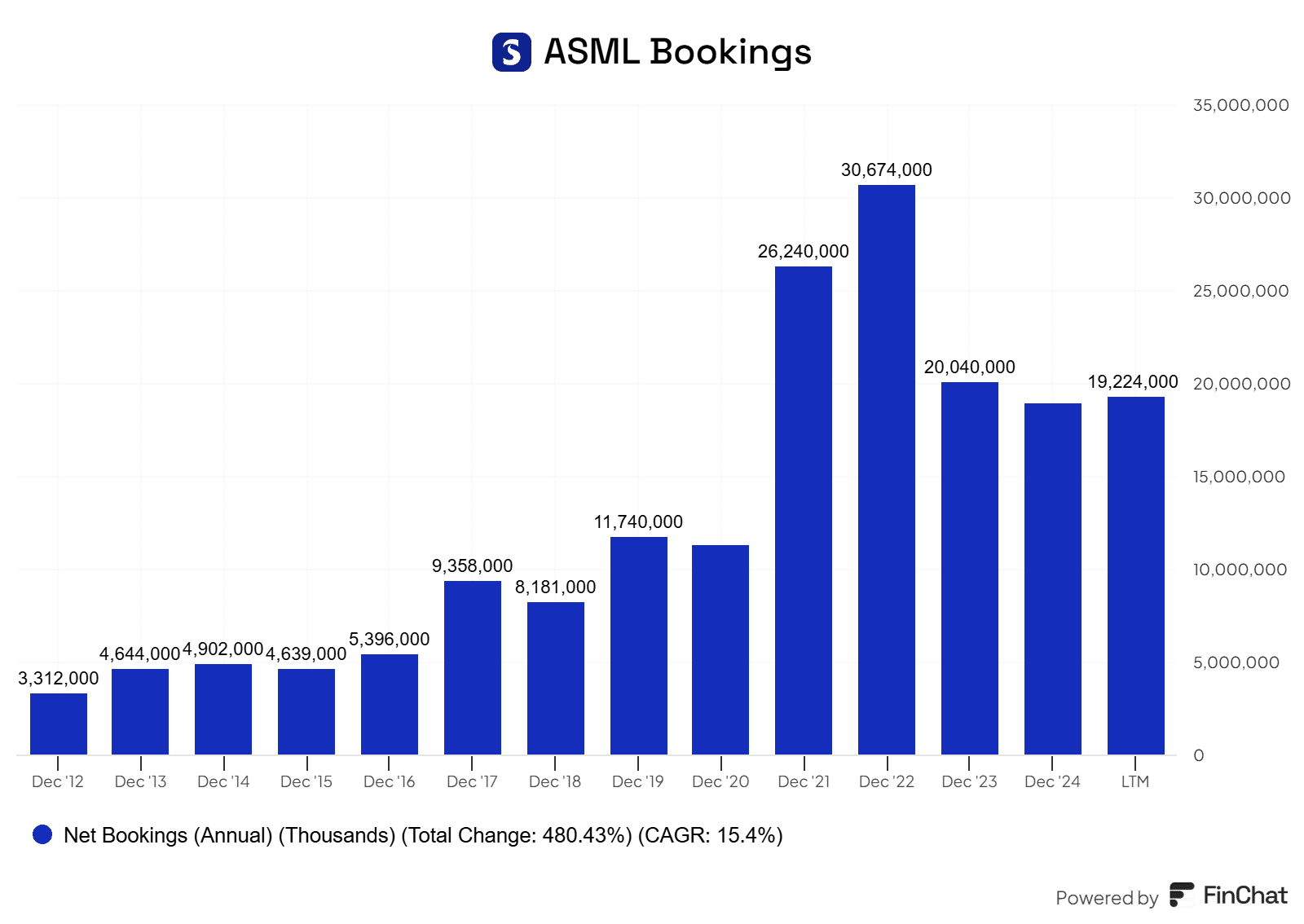
  • Although the company’s bookings are softer than expected, this is likely a cyclical downtrend that will not last
  • The company has achieved near-50% returns on equity and 37% returns on invested capital
  • The company has exceptional margins, with gross margins of over 50% and operating margins of 31%
  • The company carries little debt ($5B in debt versus $10B in trailing twelve-month free cash flows)
  • The company expects to grow at a double-digit compound annual growth rate through 2030, primarily fueled by 10%~ annual growth in the semiconductor market

Cons

  • The company relies heavily on a small customer base. Companies like Samsung, Intel, and Taiwan Semiconductors make up a large chunk of the revenue
  • Trade wars and geopolitical risks. Export restrictions and global tensions could disrupt the company’s supply chains and its ability to sell to particular markets. This could put significant pressure on the stock price
  • The AI industry is young. Although ASML maintains a dominant market share right now, new advancements in technology could reduce the overall demand for its machines
  • Although the company is one of the cheaper options in the semiconductor space, valuations are still at the point where double-digit growth will be needed to justify them
  • Trumps flip-flopping nature on tariffs is causing significant volatility in its share price.

I had been waiting for a high-conviction entry point into the semiconductor space for some time, and it looks like the addition to the Bull List in the $700 range has paid off handsomely with ASML.

As the undisputed king of photolithography, ASML manufactures the massive, complex machines required to “print” blueprints onto silicon wafers at a microscopic scale. To visualize the technology, imagine taking a standard construction blueprint, increasing the detail by 100x, and shrinking it down to the size of a fingernail. These systems are among the most complex pieces of equipment on earth, with price tags often exceeding $150M. And for the newest High-NA units, well over $300M.

What makes ASML the “toll booth” of the digital age is a moat that is about as close to a monopoly as you can get. There are always constant fears that China will eventually take a bite out of this monopoly. But many pundits say it would take a decade, at least.

They hold a 90%+ market share in Deep Ultraviolet (DUV) lithography and a literal 100% monopoly on Extreme Ultraviolet (EUV) lithography. Simply put, you cannot build a cutting-edge chip for AI, smartphones, or data centers without going through ASML.

This creates a highly reliable, dual-engine revenue stream: the initial sale of the systems and the high-margin, recurring maintenance and software upgrades for the existing installed base. As the global demand for artificial intelligence accelerates, ASML remains the primary beneficiary of the industry’s need for increased transistor density.

While some investors worry about technological disruption (the China element I explained), ASML is essentially competing against itself. Any future innovation in lithography is almost certain to emerge from ASML’s own R&D labs rather than a competitor.

With the semiconductor industry projected for double-digit growth over the next half-decade, I expect ASML to grow its revenue and free cash flow at an equal or greater pace. While geopolitical tensions involving the U.S., China, and Taiwan have caused the share price to be volatile, I view this as short-term noise. Considering the company’s indispensable role in the global supply chain and its best-in-class margin profile, I am more than happy to hold this one for the long term.

Beta

1.9

Best monthly return

30.4%

Worst monthly return

-19.1%

Max drawdown

56.9%

ASML’s machines are extremely expensive. As mentioned above, they often come at a minimum of $150M. For this reason, the company’s client base is hyper-focused on larger players in the industry. With the company holding a 90%+ market share in the EUV/DUV market, there is the possibility that the scaled-back ordering and maintenance of these machines would materially impact revenue. We witnessed this in 2024, as bookings came in softer than anticipated.

Another risk, and one that is likely to cause the largest amount of volatility in terms of share price, is geopolitical tensions. China is a large market for the company. However, pressure from the United States has caused the company to be limited in the EUV machines it sells to China. It can still sell its DUV machines there, but there are talks of furthering restrictions to exclude these as well.

Although the company has already issued a significant reduction in guidance in terms of Chinese revenue for 2025, which is likely already reflected in its share price, it is the risk of further restrictions that could cause volatility.

Additionally, while ASML is by far the world leader in EUV and DUV machines, technological disruptions in such a young industry are always an added risk. If new technology materializes and produces products at a lower cost point, we could see a reduction in demand for ASML systems if they do not have a significant share in the technological advancement.

TTM

Historical average

Forward numbers

P/E

35.9

39.6

33.6

EV/EBITDA

27.5

31.7

Free cash flow yield

2.7%

P/FCF

36.6

PEG ratio

1.0

ASML is one of the more attractive companies in the semiconductor space right now on a valuation basis, despite its recent runup in price. It trades at a discount to a major company like NVIDIA and around the same valuations as Advanced Micro Devices.

The difference when we look to a company like AMD is the expected growth rates and margins. Although they operate in different businesses, ASML’s operating margins are nearly 5x that of AMD. In addition, the company is projected to have larger growth rates in the future after absorbing the short-term headwinds of geopolitical issues and softer bookings.

ASML projects it will earn between $46B-$63B in revenue by 2030, with gross margins expected to be between 56%-60%. At the top end of guidance, this would represent a 16% compound annual growth rate on revenue, and at the bottom end, 9.2%. So, what investors can take from this guidance is the fact that the company is expecting to hit double-digit growth rates on a compound annual basis moving forward for the next half-decade.

I would expect earnings and free cash flow to expand at this pace as well, at minimum. If the company hits its gross margin targets, it would represent a possible 9% improvement to gross margins on the top end of guidance, which would have earnings and free cash flow outpacing revenue growth.

Running a relatively basic discounted cash flow analysis on the company, I believe there is still a margin of safety here at the midpoint of the company’s 2030 guidance. If it can hit the upper ends of guidance, the margin gets larger.

From a valuation standpoint, the main risk would be the company’s bookings and demand remaining soft moving into the future and guidance coming in lower. We are starting to see this as companies are scaling back orders due to the tariff uncertainty.

Overall, I believe ASML to be a Growth at a Reasonable Price play in a rapidly expanding industry, but one that will be heavily cyclical based on overall order demand and the growth of the industry in general.

ASML (ASML)

Applied Materials (AMAT)

Lam Research (LRCX)

Gross margins

52.5%

48.5%

48.7%

P/FCF

36.6

29.4

31.3

5-year EPS growth

24.8%

24.6%

22.4%

5-year annualized return

19.2%

27.1%

29.4%

ROIC

44%

26.6%

38.5%

As you can see from the table above, ASML is the most expensive out of major industry competitors. However, one thing to note is that the price-to-free cash flow ratio is slightly inflated due to some larger capital expenditures regarding production capacity. This ratio is likely to normalize over the next bit here.

The company trades at a premium to the other manufacturers on this list. One important thing to consider here is that they are not direct competitors to ASML. In fact, ASML has nearly no direct competitors, as it holds a 90%+ market share in the production and sale of EUV and DUV machines. For this reason, the company trades at a large premium to these other industry players, who have much more competition to contend with.

Yield

0.8%

Payout ratio (EPS)

-%

5-year dividend growth %

21.5%

Money Spent/Received on Buybacks and Share Issuances

$4286.8

ASML’s dividend is quite sporadic. There are a few reasons for this, with the first being that it is paid out in Euros. If you buy ASML on the US market, you are buying a NYRS (New York Registry Share). The main difference between an American Depository Receipt and a NYRS is the fact that NYRS’s are issue directly by the company themselves whereas ADRs are issued by depository banks.

ASML will convert the dividend from Euro to USD and pay it out that way to shareholders who hold it on the US market. Foreign currency fluctuations will come into play here, and it is unlikely you ever receive the same dividend on a quarterly basis unless the USD/EURO stays stable.

The company has been a relatively consistent dividend grower. The growth accelerated during the COVID-19 pandemic, with the company bumping its distribution from €2.75 per share in 2020 to €5.50 in 2021. Since then, it has made annual €0.30 raises to the dividend.

The one thing you will notice is the large amount of capital spent on share buybacks over the last year. With the company trading at discounted valuations, it is highly likely that management continues aggressively buying back shares. Over the last half decade, the company has reduced its overall share count by 6%, and I expect them to continue to reward shareholders in that regard.

Last quarter

EPS

Revenue

Expectations

$6.23

$8.7B

Reported

$6.36

$8.9B

Surprise

2.1%

-2.4%

Annual estimates

EPS

Revenue

2025

$28.4

$37.5B

2026

$29.9

$39.3B

2027

$35.9

$44.2B

ASML reported a steady quarter. Keep in mind, this is more of a transitional quarter, and was far from a blowout. ASML is entering a point in its business cycle where geographical allocations are changing, product mix is shifting, and the company is gearing up for potential future acceleration.

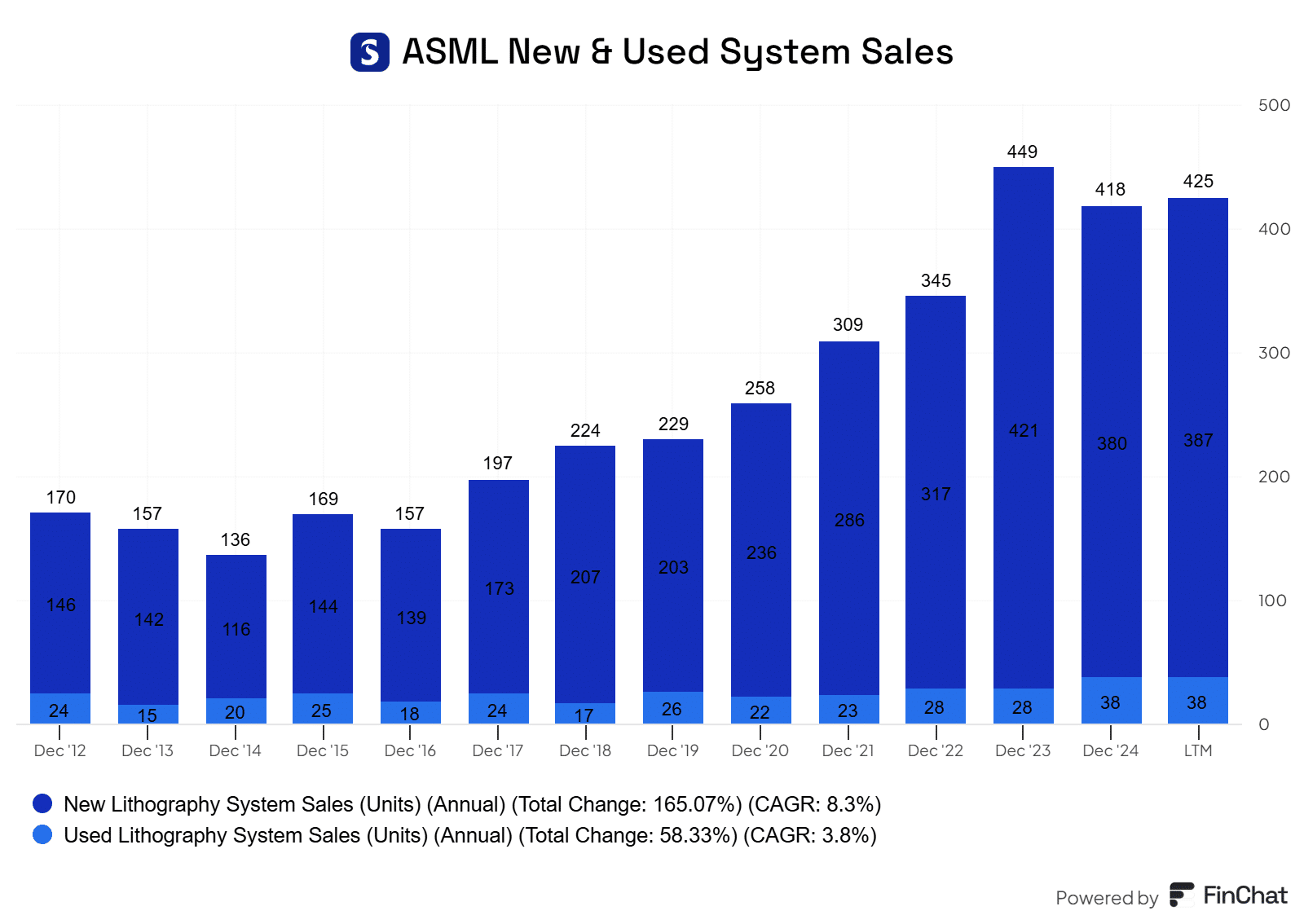
Revenue’s were down 2% compared to last year. This is primarily due to the fact that there were 66 new systems sold, which is 1 less than last year. In addition to this, management (or servicing) sales were down around 6%. Some would begin to question why ASML has gone on such a run over the last while if sales are trending downward. It is primarily due to the upbeat nature of the forward environment, primarily from chip companies like Taiwan Semiconductor, AMD, Intel, etc.

Management confirmed their full-year guidance for ~15% revenue growth and ~52% margins. Bookings came in at €5.4 billion, including €3.6 billion in EUV orders, which kept the backlog steady. However, they warned of a meaningful drop in Chinese demand starting in 2026. This is what I mean by geographical allocations.

Unfortunately, due to restrictions put in place that restricts China from gaining access to ASMLs most powerful machines, this is a headwind we will likely have to accept and deal with as shareholders. But, the company is priced appropriately for this.

Margins ticked down slightly Q2’s 53.7% to 51.6% in Q3. The main reasoning for this is lower overall servicing revenue, which is the higher margin side of the business. Because the servicing side of this business will be lumpy in regards to clients needing services, margins are prone to volatility.

As mentioned, the sharpest shift in narrative came on China. ASML now expects a material step-down in China-related system sales in 2026. They mentioned this was primarily because of a large pull-forward in terms of demand over the last few years. The market has generally priced this in, but the company will need to continually adapt to mitigate the impacts of lower sales in China, which it seems to be doing.

Despite the lack of sales from China, the company still maintains the fact that revenue in 2026 will be higher than 2025. Considering how much this company relied on China in the past, this is a good sign.

As mentioned, this wasn’t a breakout quarter, but not a lot of people expected one. China weakness is a known headwind, but the broader investment cycle in AI infrastructure definitely creates a reasonable offset to this. What the company needs at this point in time is an order rebound form non-China regions. This should help ease the decline in China sales next year.

In my opinion, ASML will remain one of the most strategic and defensible franchises in global tech. Obviously there is execution risk here, but ASML has navigated the environment very well thus far.

Disclaimer

By utilizing this report, you agree that you are a Stocktrades Premium member, and you agree to our terms and conditions and privacy policy. You acknowledge that any distribution of this report outside of Stocktrades Premium could result in the immediate cancellation of your Premium subscription. You also agree to the following:

This stock report is solely for informative purposes, and does not represent a buy or sell recommendation. The information expressed in this report is the opinion of the analyst about the subject company and our database of stocks in general. The information the analyst used to compile this report comes from sources we believe are reliable. Stocktrades Ltd however makes no warranties of any kind as to the completion or correctness of the information within this document.

All information in this report is accurate as of the date of this report, and all data contained within this report of the subject company is of the analyst’s best judgement at the date of the report. The information contained in this report is subject to change without notice. The information provided in this report is provided for informational purposes by Stocktrades Ltd and Stocktrades Ltd assumes no legal responsibility or liability. Anyone using this report assumes full responsibility for whatever decision is arrived at by using the details of this report.

Stocktrades Ltd. assumes no liability or legal responsibility for the resulting actions and or consequences of using outdated information. No version of this report outside of the original located at www.stocktrades.ca/premium/ is to be considered to contain live, or accurate information. These reports are updated quarterly and it is the users responsibility to insure they have the most recent updated version.

You may not alter or distribute this report in any way without the full consent of Stocktrades Ltd.

The decision to purchase or sell of a security depends on a multitude of individual factors such as but not limited to risk tolerance, financial situation, and investment objectives.