[]
Login Join Premium

Bull List Report – Brookfield Asset Management – TSE:BAM

Brookfield Asset Management – BAM.TO

Brookfield Asset Management Ltd engages in providing alternative asset management services through an ownership interest in a alternative asset management business. It offers a range of alternative investment products to investors around the world including public and private pension plans, endowments and foundations, sovereign wealth funds, financial institutions, insurance companies, and private wealth investors.

Focus area

Score

Valuation

27

Profitability

91

Risk

54

Returns

0

Dividend

10

Outlook

100

Debt

74

Growth

35

Overall

54

Click the KPI images to expand them if needed!
Pros

  • BAM is a pure-play, asset-light compounder. There are no heavy capital expenditures dragging down the balance sheet. This structure allows high margins and consistent fee-generation
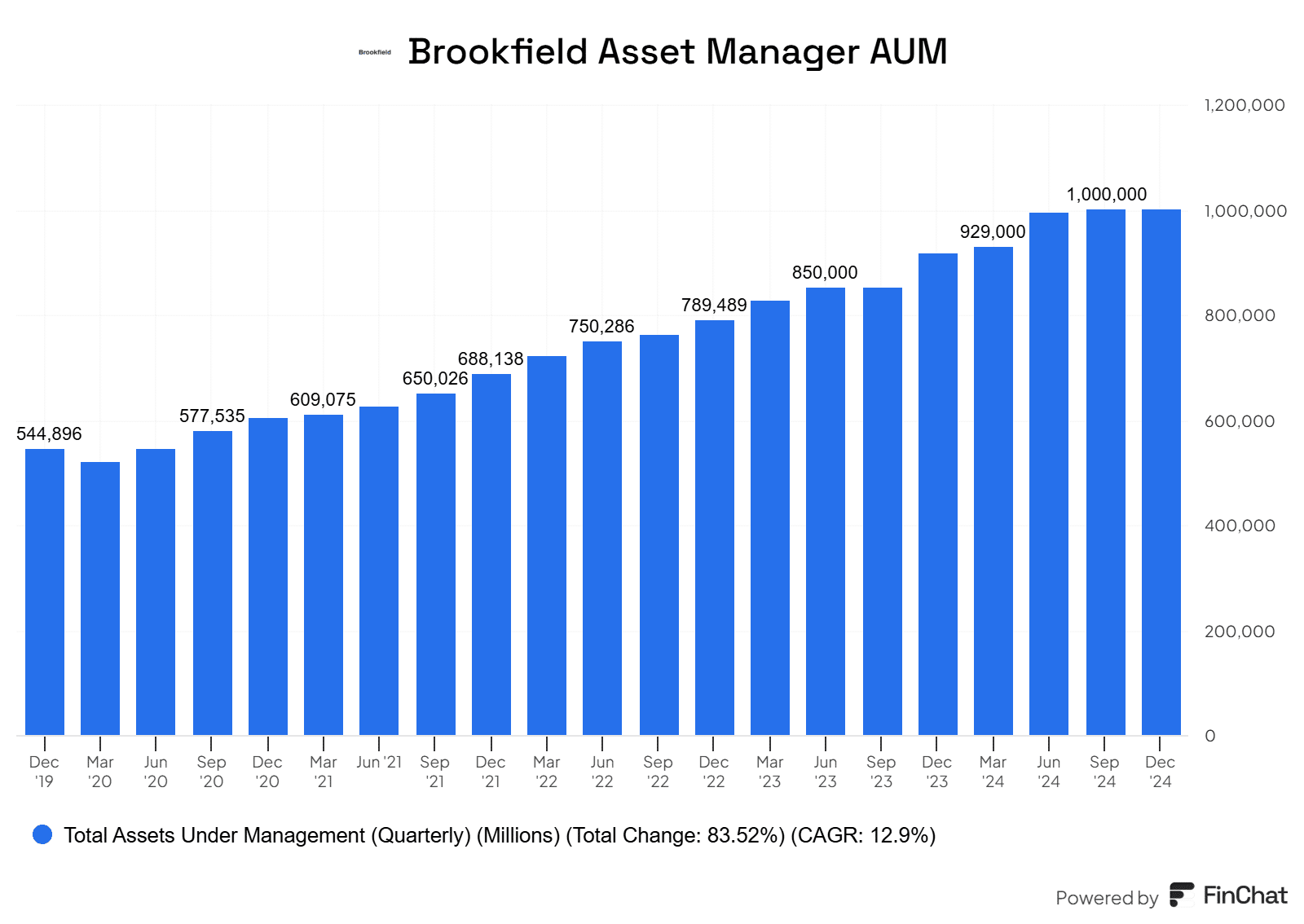
  • The “flywheel” is spinning faster than ever, with assets under management nearly tripling since 2015
  • The strength of this business model is the long-term, sticky nature of the capital. This isn’t money that can exit at the first sign of a market downturn. The revenue is tied to long-term contracts, providing a level of visibility and stability that few other financial stocks can offer
  • Brookfield is positioning itself perfectly in front of massive secular tailwinds like the AI and energy transition supercycles.
  • Because the business requires very little capital to operate, the vast majority of earnings can be flowed back to shareholders. With high growth in fee-related earnings, we should see a steady, predictable increase in dividends moving forward.

Cons

  • Fundraising is the lifeblood of this entire model. It relies heavily on the ability to raise new capital from institutional investors. If we hit a recession or if institutional money dries up, the growth engine stalls
  • Since the spinoff, the market has largely woken up to the quality of this business and the value gap has closed. The stock is now what I would consider fully valued.
  • While BAM is simpler than the parent company, the Brookfield ecosystem of spinoffs, Oaktree integration, and partner managers can still confuse the average investor.

The main thesis behind an investment in Brookfield Asset Management at this point is that it is a capital-light manager generating a significant amount of recurring revenue from fees to manage assets. Originally, my main thesis behind the original addition to the Bull List was that it was a value play based on the general confusion surrounding the spinoff. The value angle is no longer the case, with the stock nearly doubling since our addition to the Bull List.

I view Brookfield Asset Management as fairly valued now and more so a GARP (Growth at a Reasonable Price) play. Buying high-quality companies at fair valuations is never a bad thing, as the market tends to assign a premium to these companies.

By “capital-light,” I mean the company primarily generates revenue (through fees) by managing other people’s capital rather than deploying its own. Ultimately, this does lead to a higher-margin profile and more profitability. The company also raises capital with long lock-in periods, which provides consistent revenue, and redemption risk remains relatively low.

It also helps that the company has Brookfield Corporation as one of the largest stakeholders. Brookfield Corporation, a Canadian Foundational Stock, is one of the highest-quality asset managers on the planet, in my opinion, and it certainly doesn’t hurt BAM that it can get new capital fed into it from Brookfield.

The rise of alternative assets, such as private credit, also allows the company to charge higher fees on these types of assets as they are niche. In addition, the company should be able to drive significant growth from assets in the renewable and artificial intelligence space.

Brookfield Asset Management issued guidance that it expected to grow its earnings at an 18% pace or greater through to the end of 2029. At first, I was speculative as to whether or not the company could hit this guidance, even though I felt it really didn’t need to in order to justify its cheap valuation at the time. However, the company is hitting those targets and now has full confidence it will be able to continue doing so in the future.

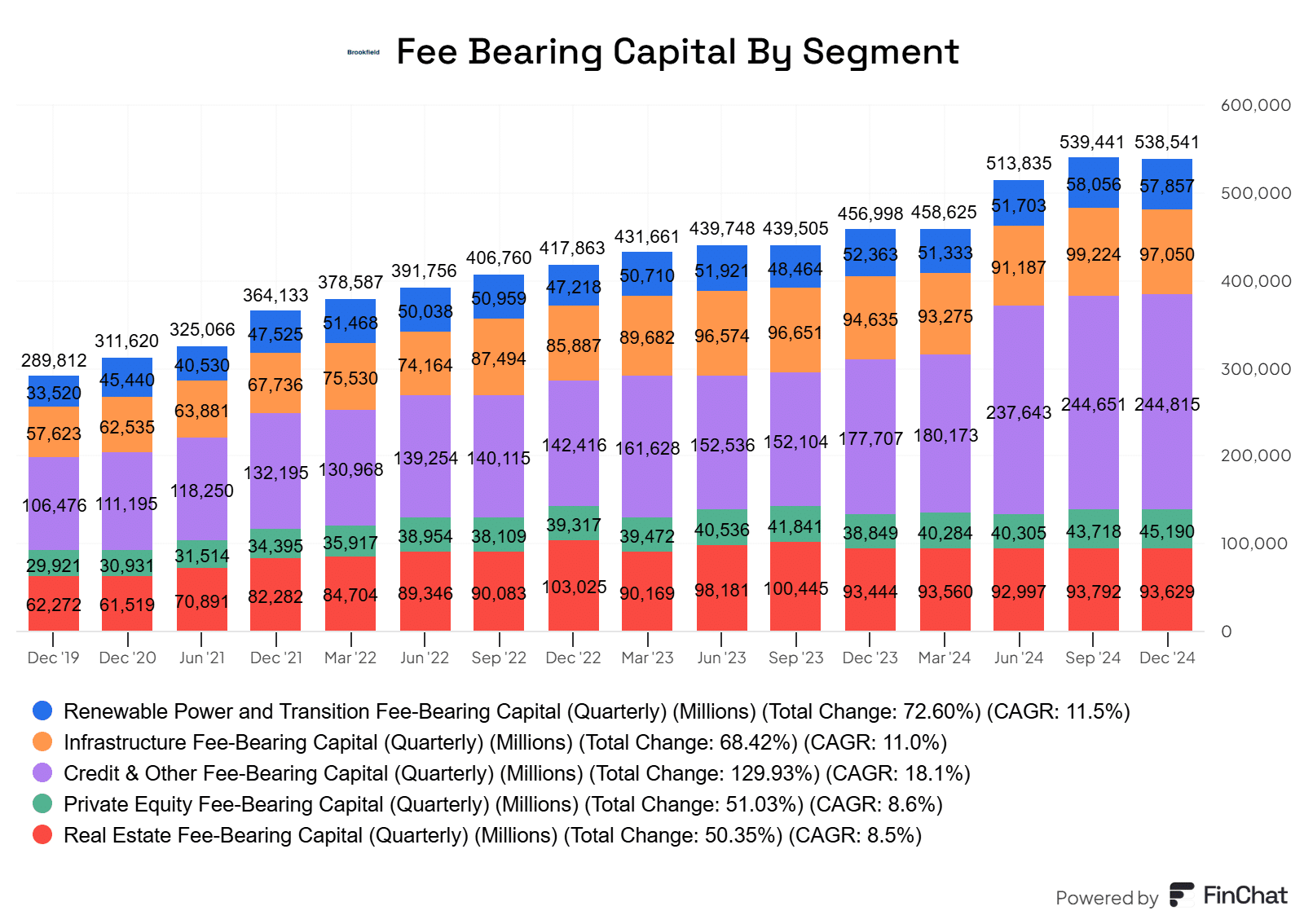
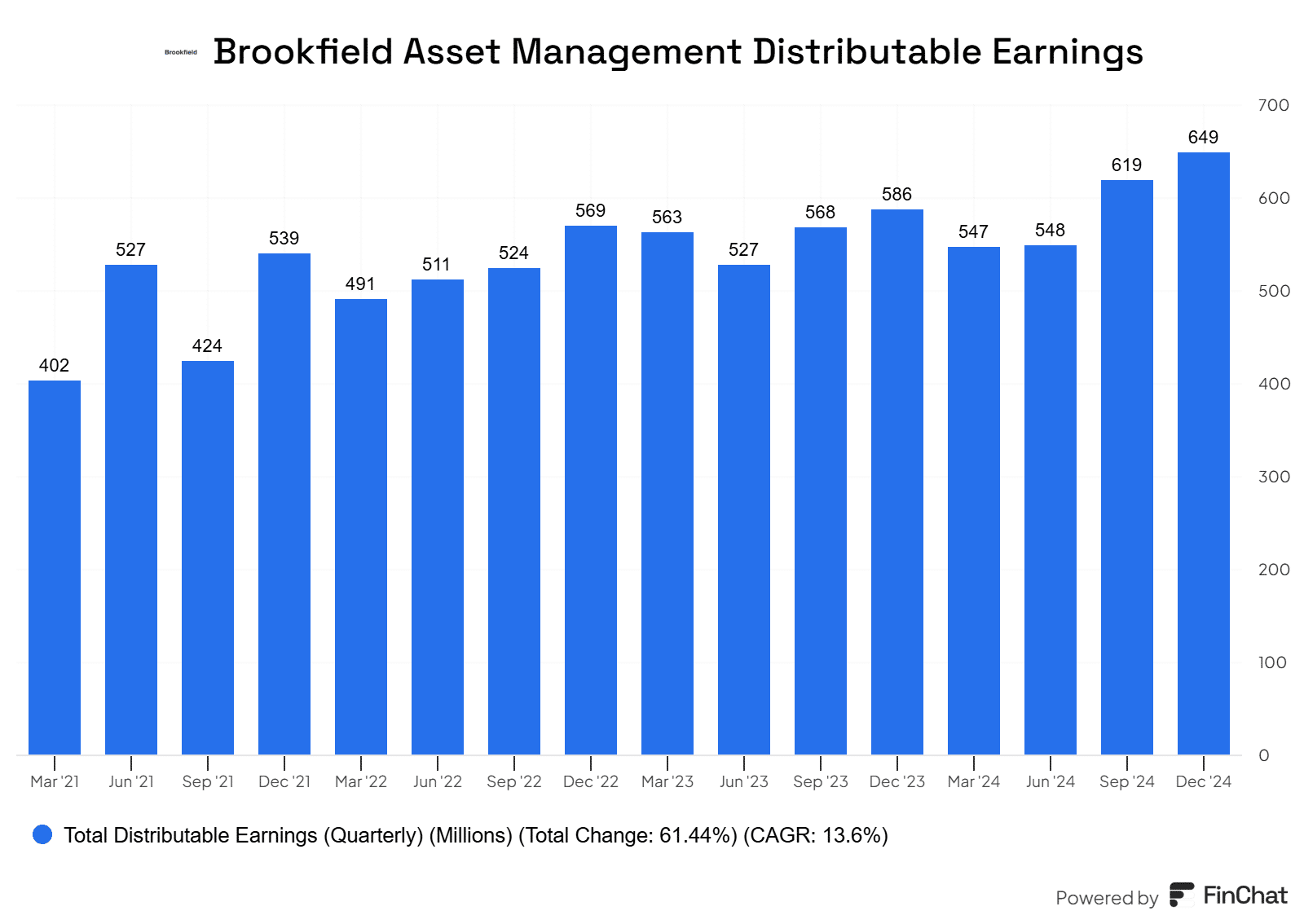
Since the spinoff, the company has had a compound annual growth rate of 17.5% on fee-related earnings, 13.6% on distributable earnings, and has grown fee-bearing capital at a 13% rate. Remember, the capital it manages that is able to generate fees is certainly the higher-margin, more profitable side of the business, which is what we want to see.

Overall, the primary thesis here is a fair-valued company that will continue to capitalize on the private markets, raising substantial amounts of capital in the renewable, infrastructure, real estate, and credit space. This will allow Brookfield to compound fee-bearing capital and fee-related earnings at a market-beating pace. As long as results remain strong, valuation multiples should be maintained, and if that is the case, I can see the company providing returns in line with its projected earnings growth.

Beta

Best monthly return

Worst monthly return

Max drawdown

As you’ll notice above, I don’t have any risk metrics available for Brookfield Asset Management. This is because the company simply hasn’t been an individual publicly traded entity for long enough. As it continues to trade, I will eventually have this data and be able to display it.

Given the new structure in which Brookfield Corp owns 75% of the Asset Management company and the fact it can nominate one-half of the board members, the success of BAM is highly dependent on the relationship between these two companies. While it is unlikely that these two won’t see eye-to-eye, it is possible that the interests of the Corporation (BN) and the Manager (BAM) don’t line up. As such, decisions made at the corporate level could negatively impact BAM’s business.

For example, the corporation has the right to participate in up to 25% of any new sponsored fund but not the obligation. This means that if the corporation does not participate, it may have to go elsewhere to seek funds, which could hamper the company’s ability to grow. Ultimately, BAM does rely heavily on BN.

From a business perspective, the company’s success depends on its ability to fundraise third-party capital, deploy it, and deliver returns. Fundraising generally depends on the macro environment, and it faces competition from others in the space seeking to raise funds simultaneously. Competition for capital is intense, and success relies heavily on reputation and performance. Any slip-up in those three areas has a ripple effect across the business.

As for Oaktree, which manages its credit strategies, the company states: “Weak economic environments have tended to afford the best investment opportunities and best relative investment performance to (credit) strategies.” However, a prolonged economic recession can have the opposite effect and negatively impact their ability to generate positive returns.

There is also the added risk that the company has some revenue that is based on performance fees. So, a downturn in the private or public markets can impact revenue.

TTM

Historical average

Forward numbers

P/E

31.9

32.6

EV/EBITDA

44.3

Free cash flow yield

2.5%

P/FCF

40.8

PEG ratio

1.3

Given that BAM is the spinoff, there will be little historical data to base ourselves on – at least from a standard data point of view. We can compare its share price against Fee Related Earnings (FRE). As an asset-light company, Brookfield generates revenue through fee-related services in the following 4 buckets: Base Management Fees, Incentive Distributions, Performance Fees, Transactions & Advisory Fees.

Over the last twelve months, the company generated $2.8B in fee-related earnings (FRE). As of the end of Fiscal 2022, BAM was trading at 25.1X FRE. Today, BAM is trading at 29x FRE, a large but not surprising jump. Brookfield’s share price has jumped by more than 50% since its spinoff, not including dividends. The market finally took note of the company’s undervaluation in 2024 and has rewarded it accordingly.

How does it compare to Blackstone, arguably its most direct competitor? It now trades around 27x FRE. This means that Brookfield is trading at a premium after many quarters of trading at a discount. It is important to understand that Brookfield’s expected growth rates are higher, so we don’t really mind the premium valuation relative to its largest competitor.

Not only will Brookfield benefit from stronger investor sentiment, but given the company’s impressive outlook, I’m still bullish on BAM. However, I do believe the company is fairly valued at this point.

If you remember, our November 2023 value call featured Brookfield Asset Management, and it turned out to be well-timed. In that newsletter, we mentioned that, on average, large multi-strategy asset managers typically trade for around 28-29x FRE. So today, BAM would appear slightly expensive. However, I believe the company’s overall results are a reflection of the higher multiple given.

If you consider the company’s expected FRE growth rate (which is expected to be greater than their 15% target in 2025), then you start to see how, at the very least, BAM’s share price should track their growth rates. I would argue it deserves a premium since no large multi-national asset manager is poised to grow at BAM’s pace.

BAM (BAM)

Blackstone (BX)

KK&R (KKR)

Returns on equity

25.1%

26.7%

7.8%

Forward P/E

32.6

26.5

23.3

Next Year Expected EPS Growth

2.6%

6.4%

6.8%

1-Year return

-5.5%

-19.9%

-20%

ROIC

21.3%

16.4%

4.4%

Brookfield Asset Management does not have a lot of historical data to go off of just yet, as it is a relatively new spinoff. However, as you can see above, it is the most expensive alongside 2 main competitors, Blackstone and KK&R. However, I believe this valuation is justified because of the company’s exceptional returns on equity and invested capital.

Brookfield is also the company that is expected to grow earnings the least out of these 3 companies. As a result, many may believe that the discounted valuations offered by Blackstone and KK&R might be better opportunities. I believe the combination of Brookfield outpacing much of its projected results and the fact it has the backing of the major corporation in Brookfield Corporation justifies the higher valuation.

Is Brookfield Asset Management cheap? No. In fact, Blackstone is quite a bit cheaper. However, results haven’t been as good, and Brookfield has shown over its short tenure as a publicly traded company and for numerous years pre-spinoff that it is the more efficient asset manager. As a result, I feel the premium valuation is justified.

Yield

3.3%

Payout ratio (DE)

98.3%

5-year dividend growth %

Money Spent/Received on Buybacks and Share Issuances

211.1M

Initially, Brookfield Asset Management was expected to be a higher-yielding play. However, with its large runup in share price, it now has a lower yield. As always, I’m a total return investor through and through, so I’m not complaining whatsoever.

The company is likely to make routine double-digit dividend raises as it continues to grow distributable earnings. Its most recent raise to $0.4375 USD represents a 15% increase, in line with what I would expect. You’ll probably notice above that the company is now paying out around 110% of its distributable earnings towards the dividend. I’m not overly concerned with this for a few reasons.

For one, this is a trailing payout ratio. The only way I would be concerned with this 110% is if Brookfield Asset Management was not growing distributable earnings. The payout ratio would likely get under 100% on a forward basis, even if the company had a lackluster year next year. If the company continues to grow DE at the pace that it is, the distribution will be more than covered.

As mentioned, the initial idea here post-spinoff was that Brookfield Asset Management would be a higher-yielding play. It has now turned into a high-growth play with double-digit dividend growth. If it can keep up its current growth rates in terms of distributable earnings, it is likely the company’s yield is maintained at the 3% range.

Last quarter

EPS

Revenue

Expectations

0.55

1.87B

Reported

0.57

1.76B

Surprise

4.25%

-5.97%

Annual estimates

EPS

Revenue

2025

$2.22

$7.41B

2026

$2.57

$8.55B

2027

$3.02

$9.69B

It was another textbook quarter from Brookfield Asset Management. While the market chased headlines on AI chipmakers, Brookfield quietly executed the largest organic fundraising period in its history, pulling in over $100 billion in the last twelve months alone. Make no mistake, this is the metric that moves the needle.

Fee-related earnings jumped 17% to $754 million, and while distributable earnings only grew 7%, largely due to interest expenses and timing, the fee-bearing capital flywheel is spinning faster than it ever has. The results reflect what Brookfield does best, which is position itself in front of massive secular trends with precision.

The company closed its second Global Transition Fund at $20 billion, the largest of its kind ever raised. For me (and shareholders), the takeaway should be pretty clear. The world is short on power, and Brookfield is the one building the solution. They announced a massive $80 billion partnership to build nuclear reactors and are launching a dedicated AI Infrastructure Fund. While others talk about AI disruption, Brookfield is buying the power plants and data centers that AI relies on. It is the ultimate “picks and shovels” play for the next decade, although very few people would feel this is an AI play at all.

You might see the flat margins at 58% and get concerned, but this is simply a timing issue. The core business margins are expanding exactly as you want to see.

Moving on to Oaktree. The move to acquire the remaining 26% of the business for $1.6 billion is a smart, long-game play that simplifies the structure and fully integrates their massive credit platform.

Overall, it was an outstanding quarter. If you are banking on a quick multiple expansion overnight, this might not be for you, but if you are looking to accumulate one of the best compounding machines in the market that is essentially building the infrastructure for the future of the global economy, the flywheel is working perfectly.

Disclaimer

By utilizing this report, you agree that you are a Stocktrades Premium member, and you agree to our terms and conditions and privacy policy. You acknowledge that any distribution of this report outside of Stocktrades Premium could result in the immediate cancellation of your Premium subscription. You also agree to the following:

This stock report is solely for informative purposes, and does not represent a buy or sell recommendation. The information expressed in this report is the opinion of the analyst about the subject company and our database of stocks in general. The information the analyst used to compile this report comes from sources we believe are reliable. Stocktrades Ltd however makes no warranties of any kind as to the completion or correctness of the information within this document.

All information in this report is accurate as of the date of this report, and all data contained within this report of the subject company is of the analyst’s best judgement at the date of the report. The information contained in this report is subject to change without notice. The information provided in this report is provided for informational purposes by Stocktrades Ltd and Stocktrades Ltd assumes no legal responsibility or liability. Anyone using this report assumes full responsibility for whatever decision is arrived at by using the details of this report.

Stocktrades Ltd. assumes no liability or legal responsibility for the resulting actions and or consequences of using outdated information. No version of this report outside of the original located at www.stocktrades.ca/premium/ is to be considered to contain live, or accurate information. These reports are updated quarterly and it is the users responsibility to insure they have the most recent updated version.

You may not alter or distribute this report in any way without the full consent of Stocktrades Ltd.

The decision to purchase or sell of a security depends on a multitude of individual factors such as but not limited to risk tolerance, financial situation, and investment objectives.