[]
Login Join Premium

Bull List Report – Brookfield Renewables – TSE:BEP-UN

Brookfield Renewable Partners – BEP.UN.TO

Brookfield Renewable is a globally diversified, multitechnology owner and operator of clean energy assets. The company’s portfolio consists of hydroelectric, wind, solar, and storage facilities in North America, South America, Europe, and Asia and totals over 20 gigawatts of installed capacity. Brookfield Renewable invests in assets directly, as well as with institutional partners, joint venture partners, and through other arrangements. The company offers two separate listings for investors: Brookfield Renewable Partners and Brookfield Renewable Corp.

Focus area

Score

Valuation

48

Profitability

28

Risk

16

Returns

57

Dividend

74

Outlook

45

Debt

10

Growth

70

Overall

33

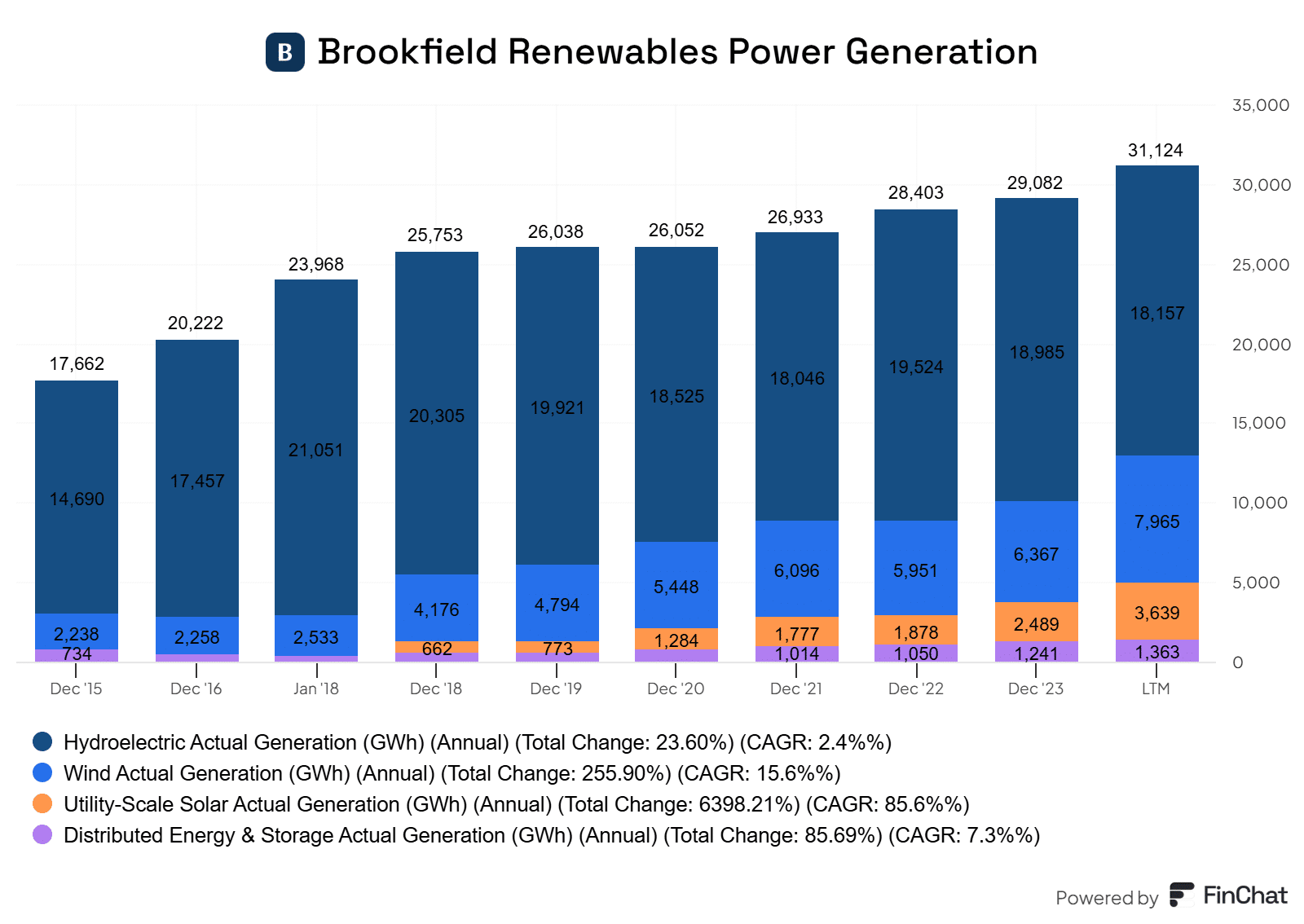
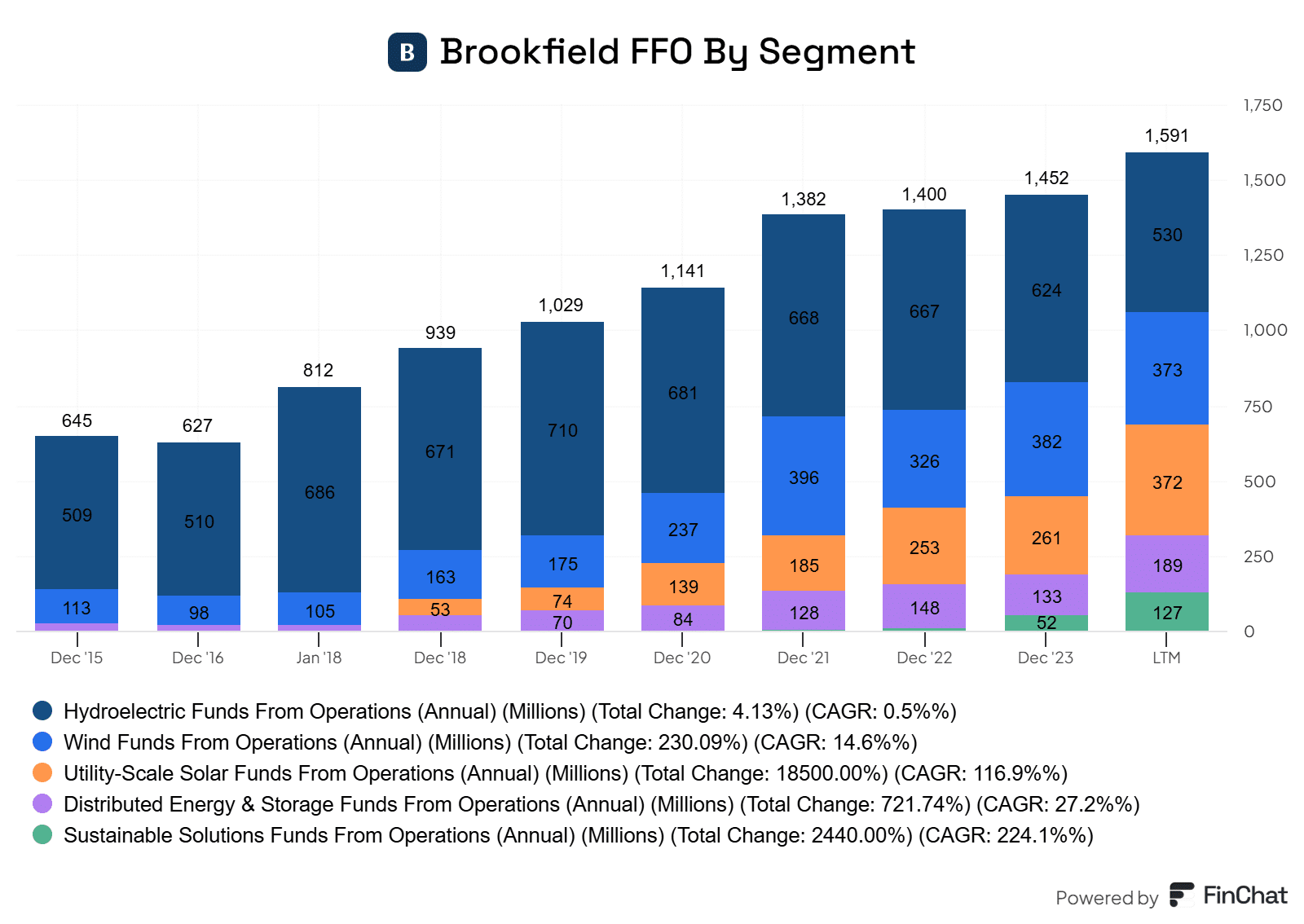
Click the KPI images to expand them if needed!
Pros

  • Of note: The company’s poor rating in our screener is primarily due to the complex operations and accounting for Brookfield Renewable, not because it is a poor quality company
  • The company is the largest renewable energy player in the world
  • Its large size allows it to capture contracts and deals that smaller players would not have access to. For example, the Microsoft deal
  • As more and more companies and governments move towards carbon-neutral policies, Brookfield stands to benefit
  • The company is in the Brookfield suite of companies, which gives it better access to financing and new contracts
  • Despite a harsh environment price-wise, the company is growing FFO at a strong pace, which should allow for consistent dividend growth
  • The company has a lot of potential tailwinds in regards to artificial intelligence, as it is one of the only renewable players that can handle the current capacity demand

Cons

  • A Republican party win is ultimately going to push back the growth of renewable players, as Trump believes them to be inefficient and wasteful
  • The company is caught up in a significant pricing downtrend over the last 3-4 years despite operations being strong
  • Renewable players are heavily susceptible to varied political ideologies and regulations, which will no doubt cause volatility

Many researchers and pundits believe that by the end of 2026, renewable energy capacity will have grown by 60% over 2020 levels. These levels of growth are expected to continue as China, one of the world’s largest economies, is expected to contribute nearly 60% of the new renewable energy capacity by 2030.

I am not going to debate for or against the issue of climate change. Instead, we will focus on the fact that the world will eventually need to move on from fossil fuel production and find renewable energy options. Many aggressive climate change believers want this to happen much sooner than I believe to be possible. However, it doesn’t necessarily need to happen fast for Brookfield Renewables to benefit substantially.

One initial note on my decision to remove the company from the Foundational Stocks List in 2025. I made this decision primarily because I believe Brookfield Corporation, the roll-up of Brookfield companies (and former Bull List stock), is the more appropriate “core” holding for one’s portfolio. I am increasingly stubborn in my opinions on Brookfield Renewables being an outstanding company despite the recent drawdown in share price, which is why I transitioned it to the Dividend Bull List.

The company is the largest renewable energy company in the world. It should stand to benefit from long-term tailwinds no matter what political party is in power. The company has a diverse asset base consisting of wind, hydro, solar, and more. Additionally, if we look to the KPI charts above, we can see that although the company’s main form of production is hydro, the other segments of the business are also growing well.

The company has an extensive pipeline of new projects, ones it is able to acquire not only because it is part of the larger Brookfield family but also because it is one of the only renewable energy players capable of taking on such large projects. We can look no further than the deal it signed with Microsoft. This size should allow it to scale the business much easier than smaller players.

Despite the company’s share price being impacted in a big way, funds from operations are still growing at a double-digit pace, which should support strong dividend growth moving forward. This is a hybrid utility play in my opinion, one that provides strong income like most utility players but has the added tailwinds of growth due to the expansion of the industry.

Unfortunately, renewables are so politicized that we have to accept the fact there will be significant volatility simply based on sentiment and government spending. However, if we think long-term, it is hard not to find Brookfield attractive at these price levels.

Beta

1.2

Best monthly return

33.3%

Worst monthly return

-13.6%

Max drawdown

50.6%

Interest rates would be one of the main risks that impacts not only Brookfield but utilities in general. As you can imagine, infrastructure costs when it comes to energy producers are extensive. As a result, Brookfield does have to finance a lot of these capital expenditures. When rates are higher, the long-term returns they generate from these assets decrease, along with the fact that debt has to be refinanced at higher rates, and floating rate debt incurs immediate interest expense increases.

In addition to this, as a utility, the company is often relied on for its income. As rates are higher, fixed-income options become more attractive as they produce similar income with lower volatility when it comes to equities.

Wholesale energy prices are also another risk. Although the bulk of the company’s energy production is under long-term purchase agreements, it is still exposed to a certain degree to the varying prices of energy, which can ultimately impact the funds from operations the company can generate.

As I’ve mentioned in the thesis portion, regulatory and political risk will unfortunately impact the industry for the foreseeable future. With climate change opinions and the viability of renewable energy being a hotly debated topic, the industry will be exposed to large discrepancies in funding and incentives. A lot of renewable energy infrastructure relies on incentives, subsidies, and favorable policies. A change in government can swing prices fairly quickly.

TTM

Historical average

Forward numbers

P/FFO

11

12

EV/EBITDA

22.8

20.8

One of the best ways to value a company like Brookfield is on a “price-to-funds-from-operations” basis. Brookfield operates in a capital-intensive industry with significant investments in long-lived assets like hydroelectric dams, wind farms, and solar installations.

These assets are subject to high depreciation and amortization charges, which ultimately impact the company’s earnings. While these charges reduce net income (affecting P/E), they don’t reflect the actual cash-generating ability of the business.

FFO adds back non-cash depreciation and amortization, providing a clearer picture of cash flows available to the company.

Prior to the recent runup in price, Brookfield was trading at a large-scale discount in terms of its price to FFO from a historical standpoint. At one point, it even got as low as 8X when its historical average was 12X. Now, we have a bit more reasonable valuation levels, with the company trading around 11X.

A lot of the stock price issues have to do with the current situation regarding political parties in power and their likelihood to provide funding to the renewable industry, which is vital for it to grow. However, at this point in time, with pent up energy demand due to data center expansion and artificial intelligence in general, there is likely a consensus that it might be an “all systems go” ideology from governments, as they simply cannot afford to hold back development due to a lack of power capacity.

I would view the company as fairly valued right now. However, it did take a 40%~ runup over a 6 month timeframe to get there. I do believe sentiment will return to the industry on the back of declining interest rates and the growing need for alternative forms of energy, and I do believe there is still upside here at these price levels.

Brookfield has numerous competitors; however, most of them pale in comparison to the production capacity and energy generation provided. The company has around 30% more installed capacity than its next largest competitor, NextEra Energy. With Brookfield’s overall project pipeline being in excess of 200,000 MW, it is unlikely that there will be a competitor to overtake Brookfield as one of the largest renewable players.

That said, it does come down to valuation. However, at this point in time, Brookfield is trading at discounts to most of its major competitive peers, highlighting the fact that it is one of the more attractive renewable energy players on the market.

Yield

4.8%

Payout ratio (FFO)

-%

5-year dividend growth %

1.2%

Money Spent/Received on Buybacks and Share Issuances

$48.6M

As with most utilities, Brookfield Renewables offers a high dividend. However, because this company is continually expanding its generation capacity at a relatively rapid pace, much faster than most regulated utility producers, the dividend tends to make up a smaller portion of FFO or “funds from operations.” It currently sits around 55%.

Because the company pays its dividend out in USD, you’re going to get a consistently fluctuating dividend payment that hits your account. However, when we look to the company’s dividend growth on a USD basis, it is relatively consistent. It is taking a more prudent approach in recent times and slowing overall dividend growth, but I’d view this as a strong sign management is taking the forward economic and interest rate situation seriously.

Overall, the company’s high yield combined with the potential share price appreciation certainly makes it an attractive proposition for not only investors seeking income but those seeking total return as well.

It’s time to stop looking at Brookfield Renewable as just a green utility and start recognizing it for what it actually is. A massive, diversified infrastructure play that is effectively front-running the energy needs of Big Tech. And unless you’ve been living under a rock, those energy needs are large.

The most important takeaway from this quarter isn’t the 10% FFO growth, which is outstanding by the way, but it’s the fundamental shift in how management is talking about the grid. For years, the narrative was “transition,” which sounds like a slow, expensive replacement of old assets. Now, they are calling it “energy addition.” That is a massive distinction. It means the demand curve is no longer flat, it’s vertical. Between the Microsoft framework and the Google hydro deal, BEP is essentially becoming the outsourced power department for the Mag 7, and in my opinion it is the only renewable company large enough to do so.

The hydro segment is the secret weapon here. While the market gets obsessed with solar for example, BEP’s hydro assets are being re-contracted at premium prices because they provide the one thing wind and solar can’t: 24/7 baseload power. Signing 20-year, inflation-linked agreements for hydro isn’t just good business, it’s genius. This is the one source of reliable renewable power. If you’re a shareholder, this is exactly what you want to see. These are high-margin, moaty assets that are finally getting the valuation respect they deserve because of the AI power crunch.

I also think the market is still sleeping on the Westinghouse acquisition. A few years ago, nuclear was a dirty word. Today, BEP is sitting on a gigantic agreement with the U.S. government for new reactors. That fuel and maintenance business is basically an 80-year guarantee from the government. When you combine that with their battery shift, quadrupling capacity to 10 GW in three years, you see a management team that is incredibly smart. They aren’t married to one technology. They are married to whatever generates the highest risk-adjusted return.

The real magic of the Brookfield model, whether it is BEP or the mothership BN, is the capital recycling. They generated $1.3 billion in net proceeds by selling assets at the high end of their target returns. In a high-rate environment where other developers are struggling to fund their pipelines, BEP is literally selling its old projects to buy newer, higher-returning ones. They’ve essentially created a recurring revenue stream out of asset sales.

The bottom line?The supply-demand imbalance in power is the biggest secular tailwind of the decade, and Brookfield has the scale, the capital, and the specific assets (hydro and nuclear) that everyone else is scrambling to find.

Disclaimer

By utilizing this report, you agree that you are a Stocktrades Premium member, and you agree to our terms and conditions and privacy policy. You acknowledge that any distribution of this report outside of Stocktrades Premium could result in the immediate cancellation of your Premium subscription. You also agree to the following:

This stock report is solely for informative purposes, and does not represent a buy or sell recommendation. The information expressed in this report is the opinion of the analyst about the subject company and our database of stocks in general. The information the analyst used to compile this report comes from sources we believe are reliable. Stocktrades Ltd however makes no warranties of any kind as to the completion or correctness of the information within this document.

All information in this report is accurate as of the date of this report, and all data contained within this report of the subject company is of the analyst’s best judgement at the date of the report. The information contained in this report is subject to change without notice. The information provided in this report is provided for informational purposes by Stocktrades Ltd and Stocktrades Ltd assumes no legal responsibility or liability. Anyone using this report assumes full responsibility for whatever decision is arrived at by using the details of this report.

Stocktrades Ltd. assumes no liability or legal responsibility for the resulting actions and or consequences of using outdated information. No version of this report outside of the original located at www.stocktrades.ca/premium/ is to be considered to contain live, or accurate information. These reports are updated quarterly and it is the users responsibility to insure they have the most recent updated version.

You may not alter or distribute this report in any way without the full consent of Stocktrades Ltd.

The decision to purchase or sell of a security depends on a multitude of individual factors such as but not limited to risk tolerance, financial situation, and investment objectives.