[]
Login Join Premium

Bull List Report – BRP – TSE:DOO

BRP – DOO.TO

BRP designs, develops, manufactures, distributes, and markets snowmobiles, all-terrain vehicles, and personal watercraft under the Ski-Doo, Sea-Doo, Can-Am, and Lynx brand names. It also builds engines under the Rotax brand (after shuttering the Evinrude outboard engine business in 2020) and offers clothing, parts, and accessories that cater to its core consumers. In 2018, BRP created a marine group, acquiring boat manufacturers Alumacraft, Triton (which makes Manitou pontoon boats), and Telwater (in Australia), a segment which all brands are currently up for sale. At the end of fiscal 2024, the company sold its products through a network of more than 2,450 independent dealers and 150 distributors in around 130 countries.

Focus area

Score

Valuation

50

Profitability

24

Risk

30

Returns

28

Dividend

72

Outlook

40

Debt

29

Growth

33

Overall

37

Click the KPI images to expand them if needed!
Pros

  • Global play with exposure in over 130 countries
  • The company holds many high-quality brands, some of which have a dominant market share. Can-Am, Sea-Doo, and Ski-Doo are a few
  • The company’s cash flows allow it to invest in new models and products, which keep it ahead of the competition
  • The company’s valuations are now attractive
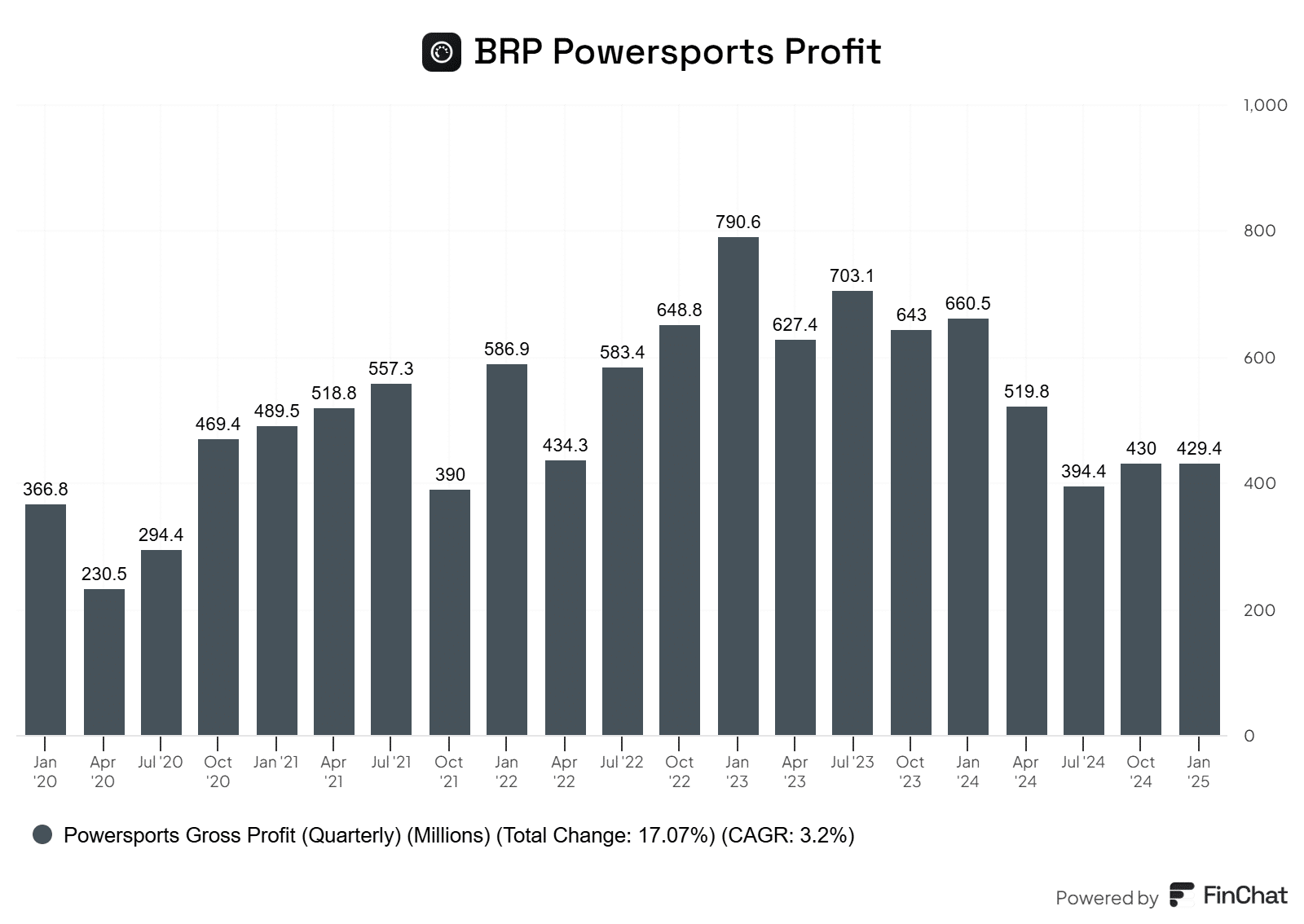
  • The company recently sold off its underperforming marine segment to focus more on its higher-margin powersports segment
  • If rates decline in the US, financing rates will start to become more attractive which should fuel the popularity for BRP’s products

Cons

  • Although this is a Canadian company, most of its revenue is generated in USD. A high Canadian dollar can have an impact on revenue
  • Highly cyclical business tied to discretionary spending and macroeconomic trends
  • There is a significant downturn in the company’s powersports segment, which makes up over half of the revenue
  • Potential for prolonged dealer destocking to weigh on near-term revenue
  • Stickier inflation could lead to higher rates for longer, which could weigh on discretionary spending.

BRP is a leader in the recreational vehicle industry. Although it is a Canadian stock, it provides global exposure for those who wish to own it, with exposure to 130 different countries. It has some of the strongest brands in the industry and a well-established footing in terms of market share. A prime example? The Ski-Doo brand has over 50% of the market share in the United States, the highest it’s ever been.

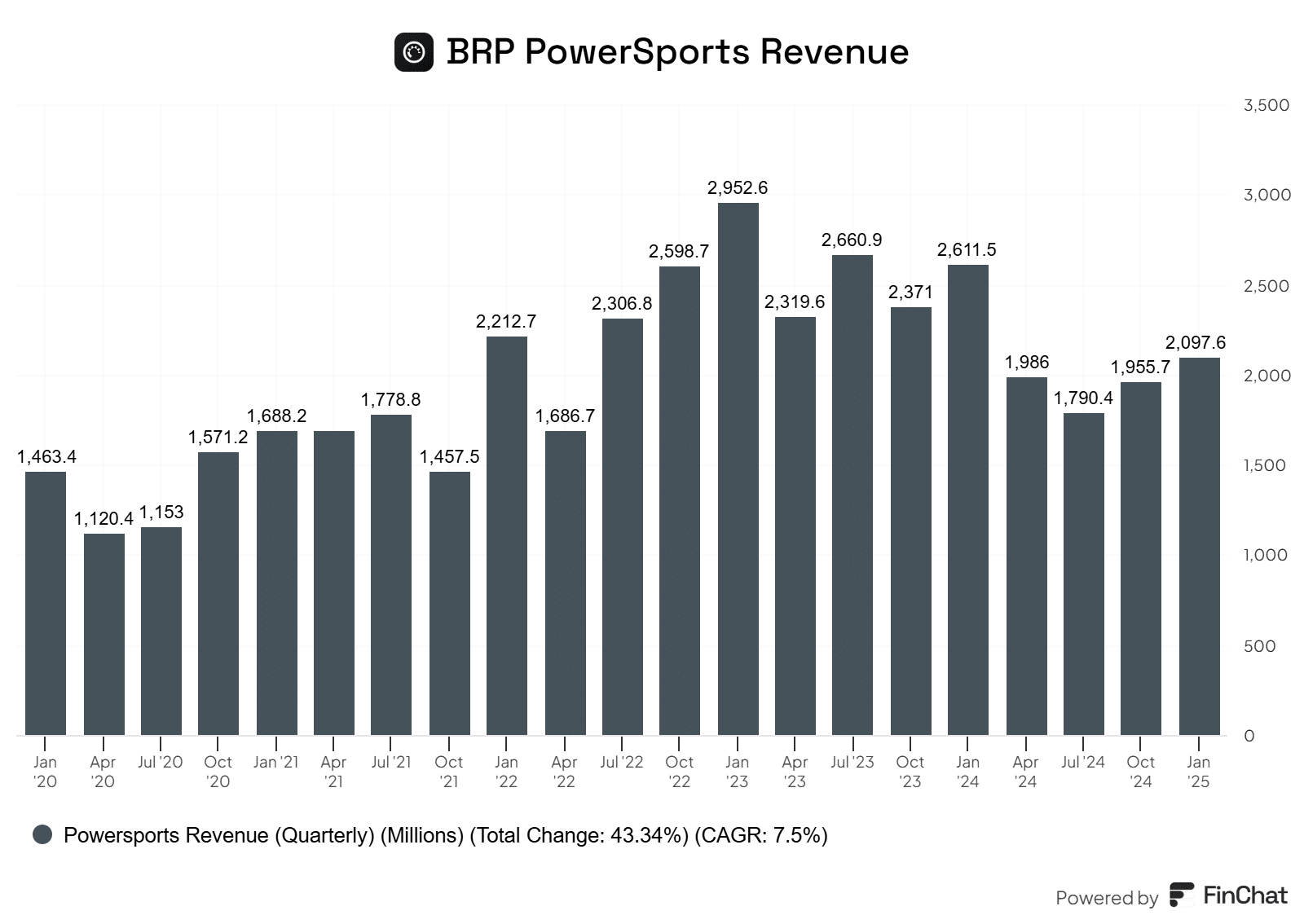
The near-term backdrop is challenging. Sales and net income declined significantly in FY2025, driven by softer demand, elevated dealer inventory, and margin compression. However, in my opinion, these challenges are cyclical, not structural. Management is actively working through the downturn, and I believe there will eventually be brighter days ahead for this company. We are already starting to see this in its most recent quarterly results.

The company has the cash flow and the market share to expand in a number of different ways. The first would be a product-driven rebound. If consumer demand increases, BRP’s current positioning should allow it to benefit the most out of any recreational vehicle producer. Another would be the exit from its lagging marine business. This should allow it to invest more in areas in which it is particularly adept, such as powersports. This should mean higher margins in the future once the environment normalizes.

More importantly, and I’ll discuss this later on, is the company’s valuations. The market is pricing in sustained economic weakness at this point. If BRP can even get back to reasonable earnings growth in the future, valuations are at a point that should allow for market-beating upside. However, make no mistake about it, the road to that point is likely to be a rollercoaster.

Beta

1.0

Best monthly return

29.4%

Worst monthly return

-19.3%

Max drawdown

63.2%

One of the main areas of risk regarding BRP is macroeconomic risk. The company is cyclical, depending heavily on the consumer. This means higher interest rates or a consumer that isn’t confident about the economy moving forward can result in a decline in earnings like we are seeing now.

Additionally, during slow times there can be buildups of inventory, much like we are seeing in 2024/2025. In this situation, BRP must mark down vehicles in order to move out old inventory and also scale back production due to lower demand. Ultimately, this can hit margins and impact the company’s profitability. Dealership levels are now normalizing. However, this is an issue that will inevitably happen again in the future, and is a risk you should be comfortable with so you don’t panic when it happens.

Because the company trades in CAD but is primarily exposed to USD, its earnings will be impacted by fluctuating currencies. It also has exposure to numerous other countries that can vary wildly depending on the strength of the dollar. This is something to keep in mind with BRP, especially in an environment where the USD is expected to fluctuate quite a bit.

As always, with these types of companies, competitive pressures exist. Although BRP has a dominant share of the market right now, in order to keep that market share it will need to invest heavily into R&D to make its products continually superior and competitive, or else it risks losing market share to companies like Polaris, Yamaha, or whichever new entrants surface in the space.

TTM

Historical average

Forward numbers

P/E

21.6

EV/EBITDA

9.8

7.0

Free cash flow yield

3.6%

P/FCF

27.5

PEG ratio

Generally, the best time to buy cyclical stocks is when their price-to-earnings ratios are high. This may seem counter-intuitive, but with a cyclical stock, it makes perfect sense. Let me explain.

During economic downturns, cyclical companies typically experience declining earnings due to reduced demand for their products or services. BRP is a prime example of this.

As earnings drop, the P/E ratio tends to rise, even if the stock price has fallen. This can make the stock appear expensive based on its earnings multiple, but this can be a potential buying opportunity since the cycle is near its low.

On the flip side, during economic booms, cyclical companies benefit from increased demand, leading to higher earnings. At this stage, stock prices often rise, but earnings grow even faster, compressing the P/E ratio. This results in a low P/E, which can signal a potential selling point as the economic cycle nears its peak.

Stock prices are forward-looking and tend to anticipate economic recoveries or slowdowns before they occur. Because the market is forward-looking, they know high and low points in terms of earnings are likely not going to be the “norm” which is what leads to this reversal of valuation thinking.

A high P/E during a downturn might reflect the market’s expectation of a rebound, making it a good time to buy. Similarly, a low P/E during a boom could indicate the market’s expectation of a slowdown, making it a good time to sell.

At this point in time, I believe we are likely at an economic bottom for BRP. This reverse thinking on cyclical companies in regards to BRP played out well in 2025, as the company went on to double in price over the span of 4 months when P/E ratios were trading at 3x the company’s historical average.

BRP (DOO)

Polaris (PII)

Yamaha (YAMHF)

Gross margins

21.1%

18.3%

31%

Free Cash Flow Yield

3.6%

15.1%

4.4%

EV/EBITDA

9.8

13.2

6.04

5-year annualized return

3.5%

-11.5%

-20.9%

ROIC

4.3%

-3.1%

8.5%

When we look at competitors, the numbers are going to be relatively rough all around. Returns on capital have dipped, gross margins have taken a hit, and valuations have plummeted. However, on a historical basis, BRP has been one of the more efficient recreational vehicle companies in North America, more efficient than Polaris and Yamaha.

If we look to margins, returns on capital, and earnings growth on a historical basis, BRP excels in all areas over its competition. At this point in time, when most of these numbers are in the gutter, it is difficult to judge. However, if we make the assumption that the recreational vehicle market will return at some point, BRP should be able to revert back to historical numbers, which are industry-leading.

Yield

1.0%

Payout ratio (FCF)

26.7%

5-year dividend growth %

16.0%

Money Spent/Received on Buybacks and Share Issuances

$162.1

BRP pays a relatively small dividend. Yielding in the 1% range, it is unlikely to attract many income investors. However, it’s important to note that prior to the company halting its dividend as a precautionary (and likely not needed) action during the COVID-19 pandemic, it had increased its dividend payment from $0.13 on a quarterly basis to $0.215 over the span of just four years.

The company increased the dividend to $0.16 per share to kick off 2022, representing 100% growth since it issued its first dividend in 2017. In 2023, the company grew the dividend yet again by $0.02 to $0.72.

The company increased the dividend by 17% at the end of Fiscal 2024, from $0.72 to $0.84. The company has always been solid regarding returning cash to shareholders via buybacks and dividends.

If you notice in the chart above, the company has spent $160M over the last year on buybacks. I expect this to change. The company has renewed its share buyback plan, but I just don’t see them aggressively buying back shares at this point.

Instead, the company will utilize its current free cash flows to shore up its balance sheet in the event the situation continues to get worse over the next few years. The more capital it has to weather the storm, the better it will come out of this slide in consumer spending.

Last quarter

EPS

Revenue

Expectations

$0.45

$1.77B

Reported

$0.92

$1.88B

Surprise

102%

6.37%

Annual estimates

EPS

Revenue

2025

$4.58

$8.24B

2026

$5.53

$8.64B

2027

$6.85

$9B

BRP delivered a second quarter that looked soft on paper, but was a large-scale beat on expectations and could be a potential indicator of a turnaround in its operations and the macro environment. The company posted 4% revenue growth and earnings per share of $0.92, which more than double analyst expectations. Margins compressed slightly because of tariffs, but considering the strength elsewhere, I view this as a non-issue.

The real story is that BRP is now sitting on one of the cleanest inventory decks in the powersports industry. If you’ll remember the last few quarters, I had consistently mentioned dealership inventories and how they had escalated and were becoming an issue. Long time Premium members will also remember Aritzia, another Bull List Stock, got into a similar situation.

When you get rising inventories, you have to move out product, and in order to do so you need to discount it. Nobody wants to pay full price for old products. As such, margins take a hit.

For BRP, we are starting to see a turnaround. Network inventory is down 20% year-over-year, and with the exception of snowmobiles, dealers are now well-positioned to start taking shipments of fresh product. The timing lines up perfectly with the company’s most aggressive overhaul of models.

Year round products increased by 13%, seasonal products fell 13%, and parts and accessories increased 7%.

Retail declined 11% in North America overall, with Canada up +4% and the U.S. down –15%, reflecting macro pressures and competitive discounting. But BRP continues to win relative to competition in regards to sales where it has inventory. In ORV (Off-Road Vehicles) alone, it gained 3+ points of market share in current units. A lot of this is due to new products on the Can-Am market, including the Defender and Electric Outlander.

If you will remember from previous quarters, BRP continually reduced its guidance to the point where it ended up having to pull it entirely because of the environment. It has now reinstated guidance, expecting revenue to grow 8-12% and earnings to grow at a relatively wide range, from 28-51%. If the company can hit the upper end of its earnings guidance, despite doubling in price over the last 4 months, shares are still cheap.

One thing to note, don’t expect much of this to come to fruition next quarter. BRP expects the fourth quarter to do the bulk of the heavy lifting.

As I had mentioned, BRP’s biggest earnings headwind over the last 12–18 months has been dealer destocking. With that behind them, they’re now in position to churn out more vehicles and get them to market. This will lead to lower markdowns and an improvement in margins.

Yes, tariffs are a headwind (C$90M this year, potentially C$120–130M next year if nothing changes). But BRP is already adapting via sourcing changes and selective pricing. Margins will still expand in H2 despite the drag

I want to stress to members that this quarter was less about the numbers and more about the future setup. That setup looks strong.

BRP now enters its strongest shipping window of the year without the drag of bloated inventory, new flagship products, and a dealer base ready to buy. While macro conditions still weigh on consumers, BRP’s brand loyalty and market share will make it so they are the first thing new entrants see when they want to buy a rec vehicle.

Disclaimer

By utilizing this report, you agree that you are a Stocktrades Premium member, and you agree to our terms and conditions and privacy policy. You acknowledge that any distribution of this report outside of Stocktrades Premium could result in the immediate cancellation of your Premium subscription. You also agree to the following:

This stock report is solely for informative purposes, and does not represent a buy or sell recommendation. The information expressed in this report is the opinion of the analyst about the subject company and our database of stocks in general. The information the analyst used to compile this report comes from sources we believe are reliable. Stocktrades Ltd however makes no warranties of any kind as to the completion or correctness of the information within this document.

All information in this report is accurate as of the date of this report, and all data contained within this report of the subject company is of the analyst’s best judgement at the date of the report. The information contained in this report is subject to change without notice. The information provided in this report is provided for informational purposes by Stocktrades Ltd and Stocktrades Ltd assumes no legal responsibility or liability. Anyone using this report assumes full responsibility for whatever decision is arrived at by using the details of this report.

Stocktrades Ltd. assumes no liability or legal responsibility for the resulting actions and or consequences of using outdated information. No version of this report outside of the original located at www.stocktrades.ca/premium/ is to be considered to contain live, or accurate information. These reports are updated quarterly and it is the users responsibility to insure they have the most recent updated version.

You may not alter or distribute this report in any way without the full consent of Stocktrades Ltd.

The decision to purchase or sell of a security depends on a multitude of individual factors such as but not limited to risk tolerance, financial situation, and investment objectives.