[]
Login Join Premium

Bull List Report – Cargojet – CJT.TO

Cargojet – CJT.TO

Cargojet Inc operates a domestic air cargo co-load network between several Canadian cities. The company also provides dedicated aircraft to customers on an Aircraft, Crew, Maintenance, and Insurance basis, operating between points in Canada, USA, South America, Europe, and Asia. In addition, it operates scheduled international routes for multiple cargo customers between USA and Bermuda, between Canada, UK, and Germany, between Canada and Asia, and between Canada and Mexico.

Focus area

Score

Valuation

73

Profitability

50

Risk

20

Returns

14

Dividend

78

Outlook

35

Debt

26

Growth

17

Overall

31

Click the KPI images to expand them if needed!

Pros

  • The company’s poor grading on our screener is primarily an element of weak returns over the last 5 years due to the pandemic surge
  • Despite its small-cap nature, the company has a significant moat and is an industry leader in the air cargo space in Canada
  • The company has long-term contracts, including renewal options with major providers like Amazon, Canada Post, DHL, Purolator, UPS, and TFI International
  • The industry requires significant capital investments to enter, increasing barriers to entry
  • The company’s ACMI (Aircraft, Crew, Maintenance & Insurance) segment, which I’ll explain more in the thesis, provides recurring revenue and mitigates input costs
  • I believe the market is incorrectly weighing Cargojet down on tariff threats, which would be a tailwind, not a headwind
  • The new deals with Amazon and DHL provide consistent volume for the next 5+ years.

Cons

  • The company is heavily concentrated on a select few customers, Amazon in particular. It accounts for more than a third of the company’s revenue. Its current contract structure should have the agreement extending into 2031; however, the back end of the contract is shorter durations (2~ years). Although it is unlikely that Amazon will choose not to renew, it would have a material impact on Cargojet. I explain more on this in the thesis section
  • The pandemic caused a substantial surge in overnight shipping and e-commerce, which vaulted Cargojet’s stock and operational results. It has been caught up in a multi-year downtrend as demand slows
  • The company is expanding its fleet due to demand from China. This is likely to result in short-term cash outlays and volatile quarterly results
  • Interest expenses have doubled since 2022, and with the company expanding its fleet, more debt may have to be issued

First, I’d like to quickly explain the weaker grading when it comes to Cargojet on our screener. The primary thing dragging this company down in terms of grading is the weaker past returns and lower profitability due to a slowdown in shipping demand. The lower grade is nothing more than the cyclical nature of freight demand, which witnessed a substantial rise during lockdown environments. The main points for my Cargojet thesis come from the Valuation and Outlook options, both of which are strong.

It is rare for a small-cap company to have a wide economic moat like Cargojet. One of the main reasons Cargojet can maintain its moat is due to strict regulations from the Canadian government regarding domestic cargo shipping. Under Canadian aviation law, 51% of a Canadian airlines voting shares must be owned by Canadians.

Because of this, it has been pretty much impossible for major shipping companies like Amazon, UPS, DHL, etc., to establish their own cargo airlines here in Canada, as they’ve done in the United States. This allows Cargojet, a company only worth $1.6B~, to have a stranglehold on domestic shipping in Canada.

Another added element: Even if there weren’t strict regulations, is the Canadian market big enough for many of these major players to lay out the capital expenditures to develop an air cargo fleet here in Canada? I would argue it isn’t, and the bulk of their capital expenditures will likely go to improving their US logistics network while they continue to outsource to companies like Cargojet here in Canada.

The company has major agreements with some of the largest shippers on the planet, including the ones I mentioned above. Amazon accounts for about a third of the company’s revenue, and although it has a new deal signed through to 2029 with the potential extension to 2031, the way the stock reacted to the new deal just shows you how much it depends on Amazon.

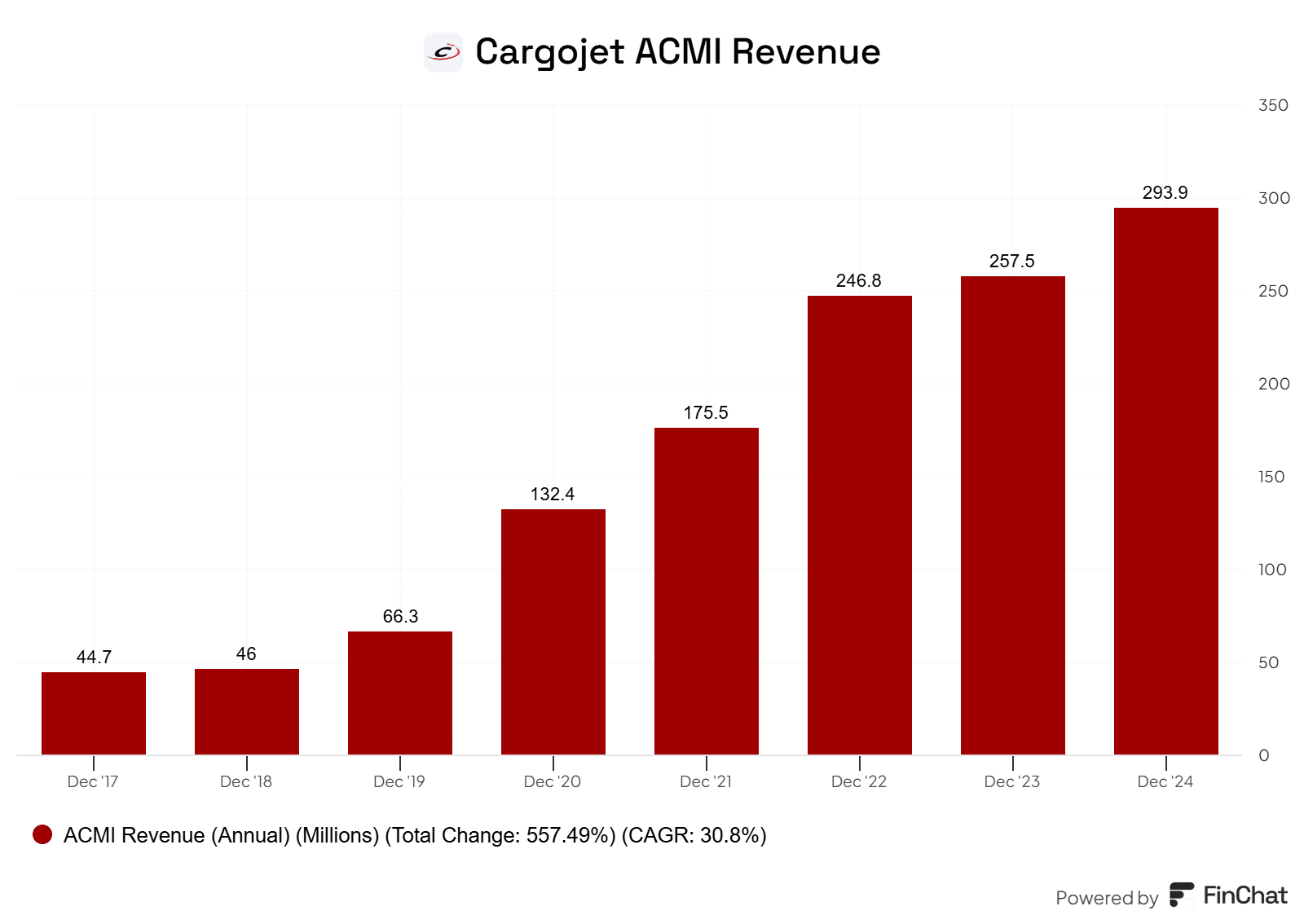
One of the company’s main forms of revenue generation is from its ACMI segment. This stands for Aircraft, Crew, Maintenance, and Insurance. Cargojet provides all of these to distributors like UPS and Amazon, and in return these distributors pay them a stream of recurring revenue. Although Cargojet is on the hook for maintenance of the aircraft, one thing it is not on the hook for in its ACMI segment is fuel costs. The distributors witness all of that volatility.

The company has been caught up in a multi-year downtrend in terms of lower demand for freight. There is nothing Cargojet could have done about this, as it was the pandemic that pushed a substantial amount of growth forward due to skyrocketing freight demand and consumer spending amidst lockdowns.

However, as interest rates continue to fall here in Canada, consumer wallets should start to open up again and as a result, I expect domestic and international cargo shipping to pick back up. This may not happen immediately, but I do expect it to happen over the short to medium term.

There is also the added tailwind of potential tariffs for Cargojet. If Canada and the US impose new tariffs on goods, it could indirectly benefit Cargojet by increasing demand for domestic air freight. As Canadian companies rely more on domestic manufacturing and distribution, demand for fast, overnight cargo transport within Canada rises.

In addition to this, higher tariffs and trade uncertainty can slow down cross-border trucking, leading some companies to shift to air freight for speed and efficiency.

At this point, I believe Cargojet provides an attractive risk/reward proposition from both a valuation standpoint and a growth standpoint. Although the company’s expansion in terms of fleet to keep up with Chinese shipping demands is likely to result in some costs over the short term, I expect double-digit growth out of the company moving forward.

Beta

0.8

Best monthly return

26.4%

Worst monthly return

-21.0%

Max drawdown

69.5%

Although Cargojet’s revenue stream is relatively protected, there are some risks here that investors need to be aware of. The first, and one I’ve mentioned numerous times above, is the company’s reliance on Amazon.

Although this is mitigated to a certain extent with them signing through to 2031, it highlights the risks many companies have with a large majority of their revenue being tied to a single major company.

I believe the Canadian regulations put in place and the capital-intensive nature of developing a cargo fleet make it unlikely Amazon will find a viable alternative and ditch its deal with Cargojet after 2031. In addition to this, Amazon has a vested interest in Cargojet, with warrants issued to the company that can be exercised if certain revenue targets are hit.

However, make no mistake about it, if this deal with Amazon were to go sour, Cargojet would be impacted materially. Amazon makes up over a third of the company’s revenue, and its concentration is no doubt the main risk.

The company is also exposed to the capital-intensive nature of the cargo airline business. Although this helps it to a degree, as it makes competition practically non-existent in Canada at this point, it can also hit the company’s bottom line as it frequently has to finance new expansions. Through the rising rate environment in 2022/2023, we witnessed Cargojet’s interest expenses double over this time, which no doubt hit the bottom line. Because of the company’s aggressive growth in terms of shipments to China, it is expected to expand its fleet by 3. Although the company typically buys older passenger aircrafts and converts them to cargo to save costs, it is still an expensive endeavour.

In addition to this, the company is currently making efforts to expand internationally. Although it is protected to a degree in Canada, the international markets are an entirely different situation and it will need to remain competitive in order to continue to grow its business in this area.

Finally, the company is exposed to the cyclical nature of the economy, particularly e-commerce demand, and will face volatility depending on the overall activity in these markets. This is a risk than cannot be operationally mitigated by Cargojet, and can cause some rocky situations in terms of share price. We’re currently witnessing that right now in a post-pandemic environment, as the company is trading substantially lower than its 2021 highs due to the lockdowns pulling in multiple years of growth.

Although e-commerce demand is expected to pick up in 2025 and beyond with falling interest rates here in Canada, there is no guarantee that it will.

TTM

Historical average

Forward numbers

P/E

9.8

15.8

EV/EBITDA

7.0

9.9

Earnings yield

10.2%

P/FCF

PEG ratio

-0.7

Cargojet’s earnings over the last few years have been impacted by a noticeable slowdown in consumer spending, plus rising interest rates that have doubled overall interest expenses. This is why you see the company trading at nearly double its historical price-to-earnings ratio.

In addition to this, the company currently does not have a price to free cash flow ratio. This is because free cash flows have turned negative through the first 6 months of the year due to some large cash outflows for fleet expansion and maintenance. The company intends to offset this with the sale of some planes in the back half of the year, which should more than offset the outflows.

Demand is expected to pick up over the next few years, and with falling interest rates, the company’s overall interest expenses should trend downward. By how much is difficult to say, as the company is expected to expand its fleet in 2025 and beyond and may require additional financing to do so.

When we look to the company’s earnings yield of 8.7%, this does look attractive, and when we combine that with the company’s ultra-low PEG ratio of 0.1, it shows that the market is not pricing in a lot of the growth the company is expected to achieve over the next few years. This could be due to a variety of things.

For one, the Canada Post strike caused some volatility in the company’s share price and soft earnings. The market may be worried about the overreliance on a select few customers. However, in my opinion, these are one-time events that will not happen on a frequent basis.

The second is likely the uncertainty when it comes to the Canadian economy and the potential tariffs. Although Cargojet does stand to benefit from tariffs due to the inevitable increase in domestic shipping, there is really no clear-cut direction as to where tariffs will be placed and how they’ll be structured. Uncertainty ultimately leads to lower share prices, which, in my opinion, leads to opportunities on a relatively reasonable risk/reward basis.

When we look to the company’s forward expectations of 18x earnings, this is a price that I am more than happy to pay for double-digit growth. I believe a lot of economic hardship and headwinds are already priced into the stock, and sentiment is relatively weak right now.

Cargojet (CJT)

Air Transport Services (ATSG)

Gross margins

23.0%

22.4%

Operating margins

14.4%

1.2%

5-year revenue growth

-%

12.1%

5-year EPS growth

-%

-%

ROIC

9.5%

-1.2%

Few publicly traded competitors logically make sense to be compared to Cargojet. When we look to companies that operate their own fleets south of the border, like Amazon, FedEx, and UPS, because their business models expand so much beyond air cargo, comparing them on a margin and profitability basis wouldn’t really be all that useful.

The only major competitor with a similar business model would be Air Transport Services (ATSG). 50%+ of ATSG’s revenue comes from ACMI, the exact same business model Cargojet offers. ATSG also provides this service to many of the same companies Cargojet does, like Amazon, UPS, DHL, etc. However, their exposure is primarily south of the border, where competition remains high. As I’ve mentioned previously, the Canadian government has put restrictions in place that make it difficult for these foreign companies to come in and operate air cargo companies.

Although ATSG has had the higher revenue growth over the last five years, which makes sense considering it is in a much larger market, Cargojet has been consistently the more efficient operator. The company has realized better earnings growth and a strong margin profile and is, in my opinion, the more efficient company with less potential disruptions to the business model. In addition to this, ATSG has taken a much larger hit to margins overall than Cargojet has over the years.

Both of these companies are similar in size and have similar growth projections. But I’m a bigger fan of Cargojet just because of the regulatory moat and competitive moat the company has in Canada.

Yield

1.7%

Payout ratio (FCF)

-%

5-year dividend growth %

-%

Money Spent/Received on Buybacks and Share Issuances

-$133.3M

Cargojet has been consistent when it comes to dividend growth since 2016. However, the company’s rate at which they grow the dividend is relatively rocky and highly dependent on the company’s operations. As a result, you’ll likely see the company slow/stop dividend growth during times of economic difficulty and ramp it up when things are going well. What I’m trying to say here is that if you’re looking for consistent rates of dividend growth from a company, you likely won’t find it with Cargojet.

The company only yields around 1.4% at the time of writing, as well, so it is not exactly a company that income seekers are going to be looking at. However, dividend growth really shouldn’t be the priority for the company at this point in time, as it should be more focused on expanding its fleet and increasing operations.

You’ll notice despite mentioning negative free cash flow I still have a positive dividend payout ratio in terms of FCF. This is because I have factored in the assumption of the sale of planes in the back half of 2025, which should support the dividend.

Because of the large drawdown in price since 2021/2022, the company has been relatively aggressive when it comes to share buybacks, repurchasing over $150M~ worth of shares, reducing its share count from 17.2M in 2023 to 15.7M in 2024. This is the first time since the financial crisis that the company has started buying back shares again. Previously, it had always issued equity, utilizing that funding to expand its fleet and grow operations, as equity issuances are not all that uncommon in capital-intensive industries like this.

Cargojet capped off 2025 with a year that is truly the tale of two cities. While global shipping is an absolute mess due to geopolitical concerns and shifting tariffs, the domestic Canadian business is a powerhouse. My thesis around Cargojet was precisely this. The Canadian side of the business would thrive due to tariff impacts and increased economic activity. What hasn’t worked thus far is the international side of things.

Trump’s tariff policies are causing shippers to scale back spending significantly. As a result, their ACMI segment is struggling. Companies do not want to commit to leasing aircraft and crew when they don’t even know if the demand will be there. One single tariff change could, in theory, crush demand. At some point, however, I do see this whole situation settling and companies committing. There is only so long you can wait things out. When this happens, Cargojet should benefit.

On the Canadian side, despite a freight recession, Cargojet’s domestic overnight revenue increased 17% in the quarter, driven by strong e-commerce growth in Canada that seemingly refuses to quit. In my opinion, at this point in time we are seeing a bit of a different consumer based on policy rates in both these countries. Canadian consumers are starting to see relief, while US consumers are still feeling the pinch. Strong e-commerce growth ended up with rock-solid adjusted EBITDA margins of 33.4%. Yes, revenue is dipping due to geopolitical issues. However, the margin profile is strong, which is shoring up results.

Management noted that China-to-US e-commerce volumes fell by 50% in December alone. Tariffs are hitting this segment of the business hard, and although the domestic business is cruising, it would certainly help to get this segment picking back up again. But what we need for this is trade certainty, which we are unlikely to get for a while.

To fill that gap, they’ve re-deployed aircraft into a new North-to-South America charter service and a promising new research and development lane to Liege, Belgium.

On the money spending side, the focus has shifted from aggressive growth to maintenance and deleveraging. CapEx for the quarter was down significantly to $45.6 million (from $136.9 million a year ago) as the company moves out of a heavy maintenance phase on its aircraft.

The company is targeting a net leverage ratio below 2.5x and plans to keep 2026 CapEx mostly focused on maintenance ($190M–$210M). They’ve also cleared the air on labor, noting ongoing negotiations with pilots ahead of their June contract expiry. With a 10% dividend hike and a solid fleet transition, Cargojet is essentially battening down the hatches on international volatility, and will instead focus heavily on the Canadian side of the business and simply wait the trade issues out. When it does, the international side of things should pick up.

Disclaimer

By utilizing this report, you agree that you are a Stocktrades Premium member, and you agree to our terms and conditions and privacy policy. You acknowledge that any distribution of this report outside of Stocktrades Premium could result in the immediate cancellation of your Premium subscription. You also agree to the following:

This stock report is solely for informative purposes, and does not represent a buy or sell recommendation. The information expressed in this report is the opinion of the analyst about the subject company and our database of stocks in general. The information the analyst used to compile this report comes from sources we believe are reliable. Stocktrades Ltd however makes no warranties of any kind as to the completion or correctness of the information within this document.

All information in this report is accurate as of the date of this report, and all data contained within this report of the subject company is of the analyst’s best judgement at the date of the report. The information contained in this report is subject to change without notice. The information provided in this report is provided for informational purposes by Stocktrades Ltd and Stocktrades Ltd assumes no legal responsibility or liability. Anyone using this report assumes full responsibility for whatever decision is arrived at by using the details of this report.

Stocktrades Ltd. assumes no liability or legal responsibility for the resulting actions and or consequences of using outdated information. No version of this report outside of the original located at www.stocktrades.ca/premium/ is to be considered to contain live, or accurate information. These reports are updated quarterly and it is the users responsibility to insure they have the most recent updated version.

You may not alter or distribute this report in any way without the full consent of Stocktrades Ltd.

The decision to purchase or sell of a security depends on a multitude of individual factors such as but not limited to risk tolerance, financial situation, and investment objectives.