[]
Login Join Premium

Bull List Report – Equitable Bank – TSE:EQB

Equitable Bank – EQB.TO

EQB Inc operates through its wholly owned subsidiary, Equitable Bank, Canada’s Challenger Bank. It serves Canadians through two business lines, Personal Banking and Business Banking. The company differentiates by providing a host of challenger bank deposit services, alternative single-family lending, reverse mortgage lending, insurance lending, Specialized finance, Commercial finance group, Equipment financing, credit union services and trust services.

Focus area

Score

Valuation

62

Profitability

45

Risk

58

Returns

85

Dividend

97

Outlook

70

Debt

45

Growth

65

Overall

62

Click the KPI images to expand them if needed!
Pros

  • Industry leading Returns on Equity
  • Consistent dividend raises on a quarterly basis
  • Although not a value play anymore, still provides strong growth in terms of earnings and the dividend
  • Acquisition of Concentra makes it the 7th largest bank by assets in Canada
  • Two decades of consecutive top and bottom line growth
  • A large percentage of its mortgage portfolio is insured
  • Stronger CET 1 ratio than many of the Big 6 Banks

Cons

  • A recession is somewhat impacting growth. Provisions are rising and gross impaired loans are creeping upwards
  • Its loan book is not as strong or diverse as the major institutions
  • Not as many products as major institutions, meaning less diversity when it comes to earnings
  • The valuation gap has closed and we’d view the company as fairly valued
  • The company relies heavily on deposits. If competition ramps up or GIC rates start to fall, the attractiveness of its products could dip

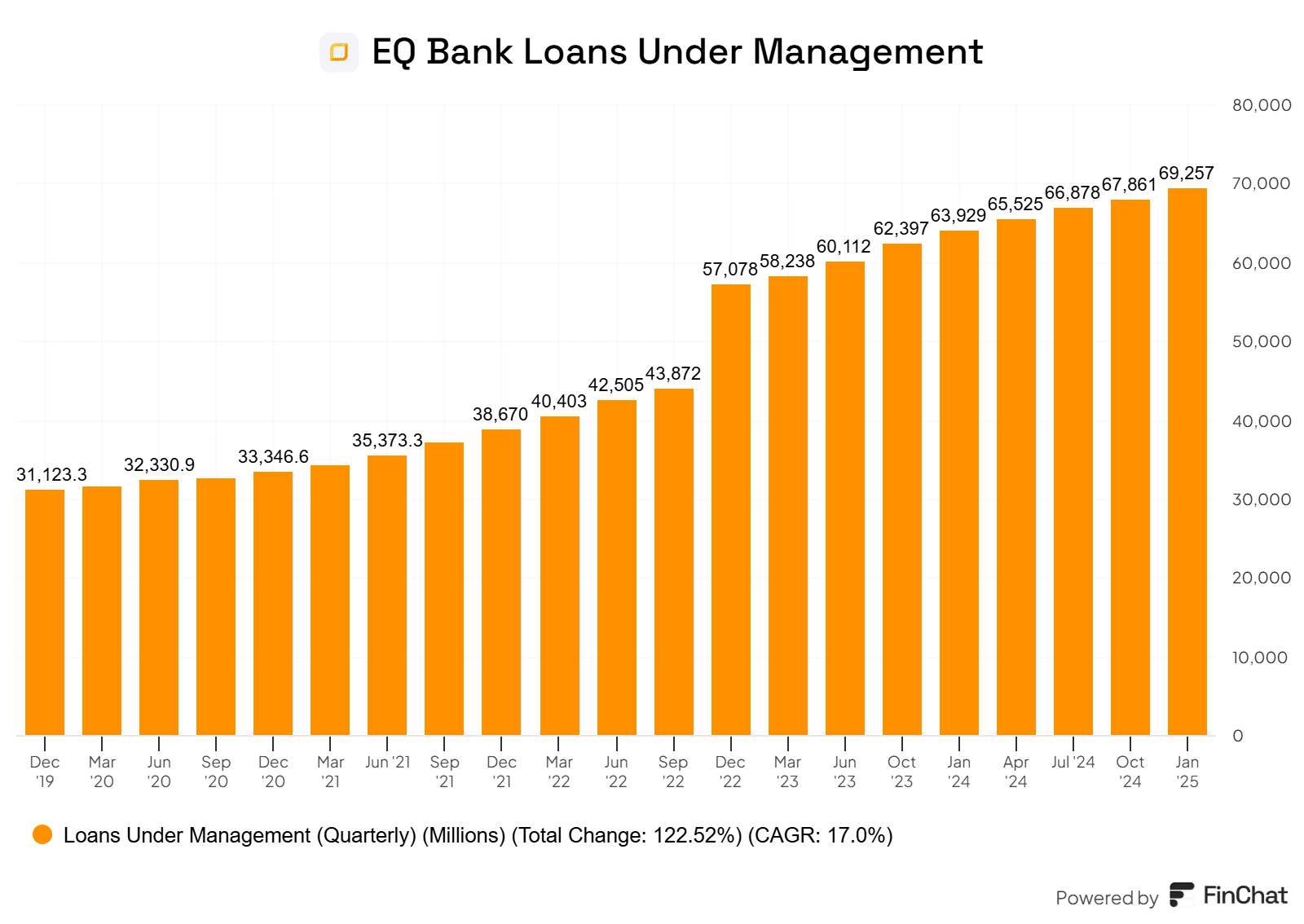
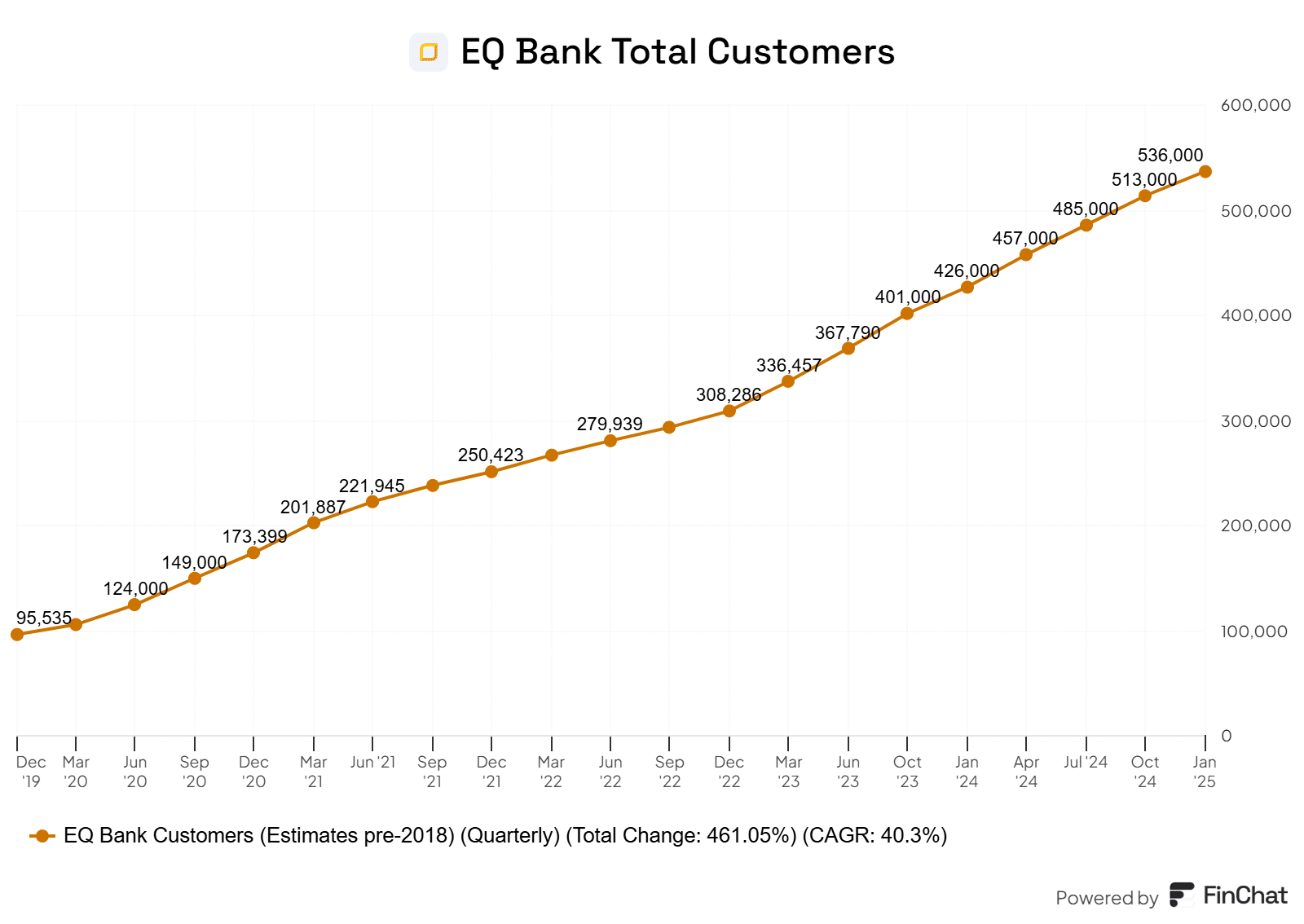
Equitable is quickly becoming a welcomed alternative to the Big Banks. It is adding customers at a rapid pace and continues to expand the breadth of its offerings. It has added products like the EQ Bank Tax-Free Savings Account, EQ Bank RSP Savings Account, and EQ Bank Joint Savings Plus Account – all of which offer much higher interest rates than the big banks.

It has also brought in innovative products like the Notice Savings Account, in which customers can earn a high rate of return on their savings, and the only caveat is they need to give the bank either 7 or 30 day notice they want to withdraw the money. These types of products are one of the core reasons many customers are switching, as major banks simply do not offer them. It also has a reverse mortgage program and a suite of US products.

The more the company adds services/products, the more customers are likely to make the switch, and this is becoming clear over the last few years.

The acquisition of Concentra Bank is helping this company fuel further growth and continue providing exceptional shareholder value. With 20 consecutive years of earnings and revenue growth, few companies have achieved this consistency on the TSX Index. The chronic undervaluation of EQB due to its perceived higher-risk portfolio has disappeared.

However, our thesis of this company being one of the strongest financial growth plays in North America is still well intact and has been reaffirmed numerous times whenever the company makes increases to its guidance.

The main driver of my thesis for Equitable will be the fact that people are fed up with the fees and lack of interest paid on savings by the major institutions. Because of extensive overhead due to physical locations and regulations, it is highly unlikely any of them will be able to match the rates of return offered by Equitable Bank on numerous products, which creates somewhat of a moat surrounding its savings products.

Continued customer additions, accelerated deposits and loans, and strong execution by management should allow this bank to outpace the Big 6 strictly due to more runway for growth and lower operating costs.

Beta

1.5

Best monthly return

31.1%

Worst monthly return

-19.6%

Max drawdown

53%

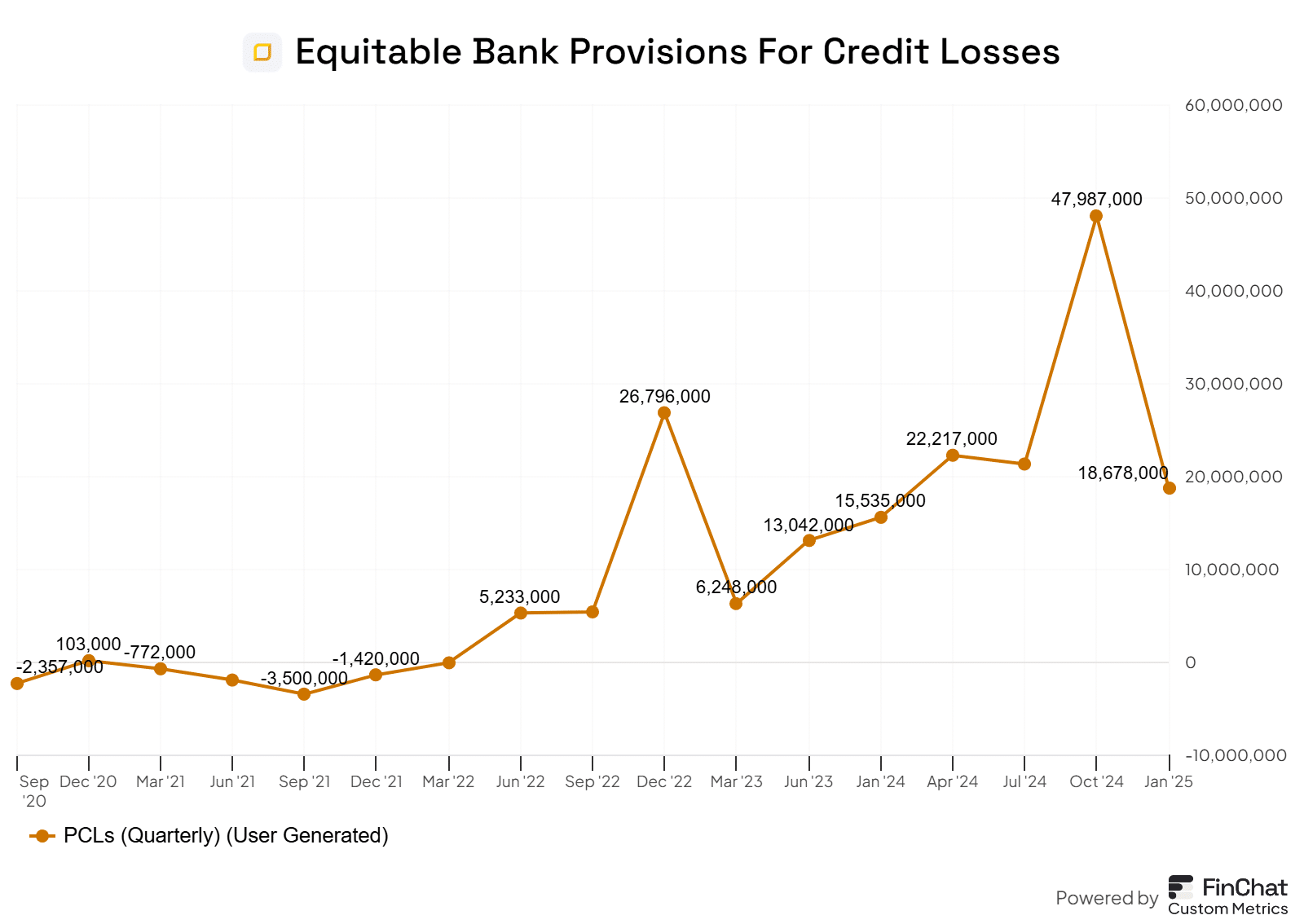
As we’ve seen this past year, financial stocks are vulnerable to a weakening economy. Credit risk is arguably the most considerable risk, which takes the form of provision for credit (or loan) losses. PCLs are a forward-looking estimate in which financials like EQB identify loans that they are unlikely to recover. They write them off as losses and end up taking a hit on earnings.

We have witnessed the company write off a large chunk of loans in the equipment lending segment over the last year, which ultimately hit earnings fairly hard. This not only represents the risks of provisions, but also the added risks that as a smaller bank, its loan book is not as diversified as the larger institutions, making it more susceptible to risks in a particular area of the economy.

The company has ambitious annual objectives in which it expects to grow earnings by double digits annually and grow the dividend by 20-25%. Should it miss on these, investors could expect price weakness.

While not unique to EQB, as a digital bank, cyber security is also a risk. Any hack or adverse cyber security event could have significant, immediate, and long-lasting impacts. In short, depending on the severity of the attack, it could be devastating.

Equitable Bank is positioned to benefit from a thriving economy, with growth opportunities tied to favorable economic conditions. However, if Canada were to experience an economic downturn, the bank’s reliance on mortgages could expose it to certain challenges. In this scenario, its portfolio of mortgages might be perceived as higher risk, particularly because many of its clients turn to Equitable after being declined by major banks. This could influence market sentiment and the bank’s overall performance.

Secondly, the housing market would likely slow in a recession, thus Equitable’s growth. Another notable risk is interest rate risk. Equitable will be exposed to the ebbs and flows of interest rates, which will impact the profitability and attractiveness of its products. And finally, with a large-scale acquisition like Concentra, there is a chance that synergies could take longer to come to fruition, or they could be less than anticipated.

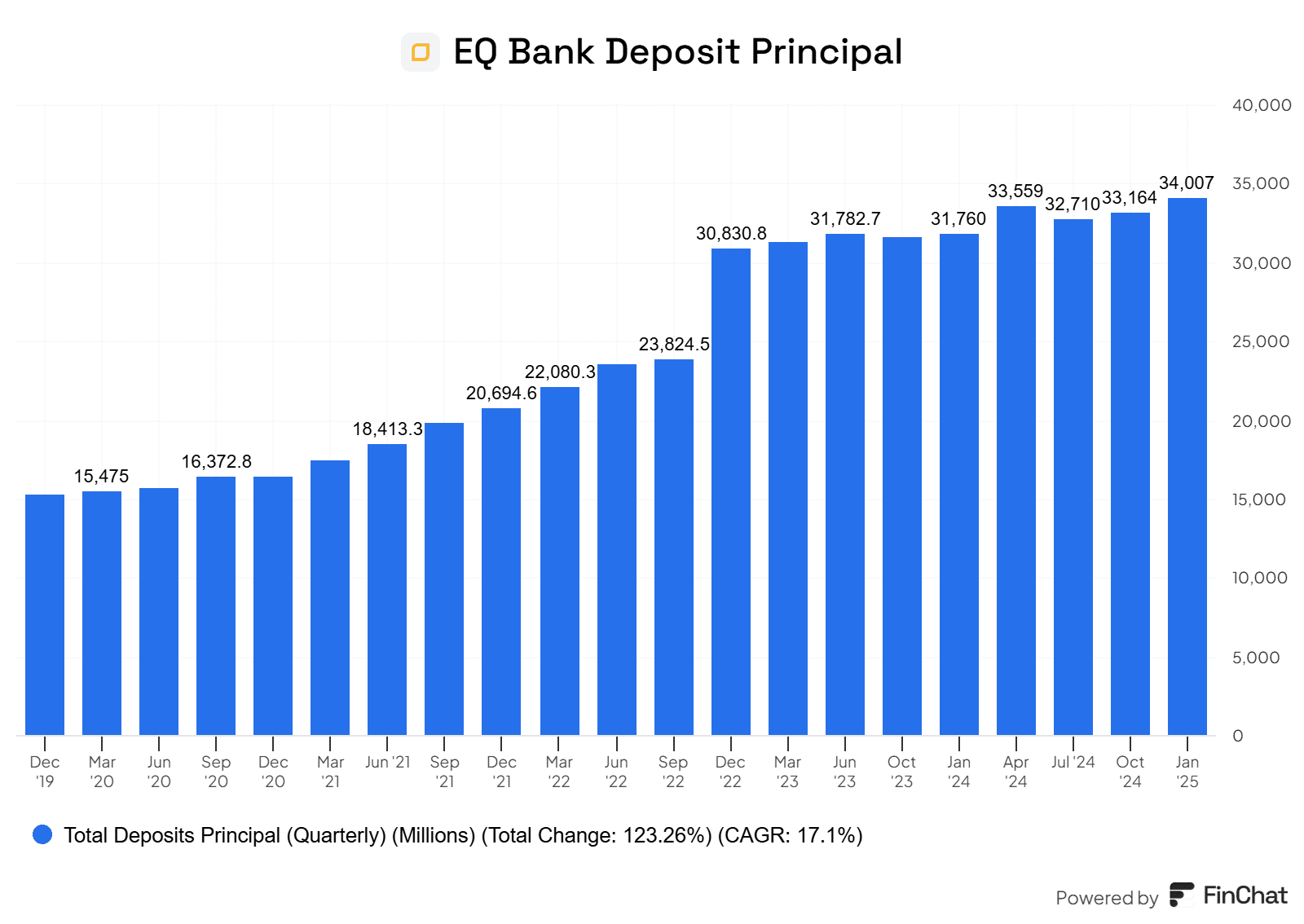
Finally, it is important to understand that Equitable Bank is a deposit-heavy bank. This means they are relying heavily on new customers via deposit methods like GICs, savings accounts, etc. This is why we are seeing the large-scale customer growth right now that they are.

However, if competition were to ramp up in the space, which we already see with Wealthsimple’s lucrative offerings, growth could slow for Equitable. If you go to the KPI’s at the top of this report and look to its deposit activity, we are already seeing this. It needs to continually adapt and offer the best suite of products possible to continue the trajectory of its client growth.

TTM

Historical average

Forward numbers

P/E

9.3

8.4

8.4

P/B

1.1

1.2

Earnings yield

10.7%

P/FCF

PEG ratio

0.7

Since 2018, I have expressed that Equitable Bank was chronically undervalued relative to the other major institutions in Canada. And due to an exceptional streak of strong results, that valuation gap has closed, and Equitable is trading at what I would feel is a fair value. The company is trading at a slight premium to its historical price-to-earnings ratio and a premium to its average price-to-book ratio. In fact, this is the first time, other than a brief stint during its IPO, when the company has traded at a higher book value than some of the other major institutions here in Canada.

This is a notable milestone and a sign that the market is warming up to this challenger bank. In terms of whether or not you should still consider Equitable Bank at what we feel are fair valuations, we go back to the old Buffett saying.

“It’s better to buy a wonderful company at a fair price than a fair company at a wonderful price.”

The company stumbled a bit after missing its annual targets llast year due to some large provisions, but I’m not really all that worried over the long-term.

Looking further out, we can use some basic assumptions to get a projected potential share price. If we assume Equitable hits next year’s guidance, follows that up with 15% earnings growth in the four years after that, and issues 10% more shares, we come to earnings per share of $17~. Using the bank’s current PE ratio, we get a share price of $166.

If the market finally decides to permanently reward Equitable’s growth through a higher PE multiple, share price estimates can get even higher. For example, suppose Equitable Bank were to hit the same growth targets projected above but be rewarded a 11x earnings multiple. In that case, we come to a share price of $187, which would be just under a 90% increase in share price at its current levels.

With a recession arguably already occurring in Canada, tempering expectations is important, even with the string of rock-solid quarters. Considering the current economic uncertainty, we’d be more comfortable taking the lower end of estimates as our targets, especially with the company’s soft close to Fiscal 2024.

Equitable (EQB)

Royal Bank (RY)

Scotiabank (BNS)

Earnings Yield

10.2%

6.5%

7.6%

5-year revenue growth

20.4%

4.7%

2%

5-year EPS growth

11.1%

5.2%

-2.6%

5-year annualized return

12.6%

11.9%

0.9%

ROE

13.3%

13.4%

9.5%

Equitable’s main competition is primarily the big Canadian banks. As such, I have listed what I believe to be the strongest performing Canadian bank in Royal, and what I feel is the weakest Canadian bank in Scotia. As you can see, Equitable is outperforming even the best of the best when it comes to major banks in Royal, as the company has put up more than 4x the annual sales growth over the last 5 years and more than double the average sales growth.

When we look to the weaker performing institution in Scotiabank, it’s not even close. Returns on equity are similar for Royal and Equitable. However, what you may notice is the significant premium Royal trades at in terms of valuation. This will be due to the fact that Royal Bank is a globally diverse bank with a wide variety of loans in its loan book. In addition to this, its underwriting and loan acceptances are very strict, whereas Equitable, as a smaller institution and often a B-grade lender, is a bit more flexible.

As a result, it is highly unlikely we ever see Equitable trade at similar valuations to Royal. Many have this perception that Equitable is “cheap” because it trades at a lower multiple than an institution like Royal. We need to forget about this, and more so focus on what the market has typically valued Equitable at over the years. The discount is appropriate considering the higher risk.

All that said, the trajectory and tailwinds Equitable Bank has make it an attractive option over banking alternatives here in Canada.

Yield

2%

Payout ratio (EPS)

19.3%

5-year dividend growth %

22%

Money Spent/Received on Buybacks and Share Issuances

$-11.7M

Make it thirteen consecutive quarters in which Equitable announced a dividend raise. This past quarter management announced another 4% raise to the dividend. It will now pay $2.12 annually. If we look to when the dividend freeze was lifted in late 2021, Equitable has now more than doubled the dividend since that time.

Before the pandemic, Equitable grew the dividend at one of the fastest paces among all Canadian Dividend Aristocrats. The company is targeting 20-25% annual dividend growth moving forward. In 2023, it hit 24%. In 2024, it sat around 17%. I would imagine the company gets closer to the 17% mark in 2025 rather than the 20-25% mark, but I’m perfectly fine with that. It is still an exceptional dividend growth rate amidst a pretty tough economic environment.

Continue to expect smaller, quarterly increases to the dividend for Equitable Bank. This was the strategy pre-pandemic, and it looks to be one it will continue with moving forward.

When we look to share buybacks, the company has actually issued around $31.3M in shares over the last year. This isn’t really all that concerning. Many bank valuations are high and many banks have slowed share buybacks materially.

Last quarter

EPS

Revenue

Expectations

$2.53

$310M

Reported

$2.31

$316M

Surprise

-8.7%

1.77%

Annual estimates

EPS

Revenue

2025

$10.84

$1.29B

2026

$12.69

$1.38B

2027

$14.56

$1.48B

Equitable had a bit of a soft quarter, and it is clear that the current tariffs and economic uncertainty are starting to weigh on the company. Don’t take this the wrong way. I’m still extremely bullish on the bank over the long term, but there is a potential that we start to see some softer results here in the coming quarters, primarily due to provisions for credit losses.

Earnings overall missed the mark in terms of analyst estimates, and returns on equity of 12% came in well below the target of 15-17%. On the earnings front, they declined on a year-over-year basis, primarily due to higher provisions. Tariffs are making it difficult for banks to predict the direction of the economy, and this is impacting all banks, not just Equitable.

The good news? The company’s core business is still growing strong. The company’s overall customers were up 23% year-over-year, deposits grew by 32% year-over-year, and overall single-family lending increased by 2%. Lending is definitely starting to be scaled back in an environment like this as not only is Equitable likely being a bit more prudent with its lending practices, but also the idea that consumers are simply not looking to borrow all that much in this environment.

The company’s gross impaired loans increased by 8% compared to last quarter and its impairments in equipment financing were up by 23% year-over-year. If you remember, Equitable had a lot of provisions set aside for defaults made in the equipment segment of the business. This is one it has struggled with for a while now, primarily due to the cyclical nature of that side of the business. It has had to book a lot of provisions in this segment.

The bank reported provisions for credit losses of $29M, the bulk of which are impaired loans, which means the borrower has had some sort of default on the loan. Residential mortgages remained strong, as provisions for credit losses only increased by 1.4% from last quarter. However, provisions in its commercial segment increased by 12% and in its leasing segment, 23%. The company attributes most of this to the tariff volatility in the transportation sector. If tariffs are resolved quickly, we could potentially see these provisions added back to earnings.

A final note on provisions: the company says they’re likely to stay elevated for the third quarter but believes this quarter was a “high water mark” for provisions.

The company bought back over $26M in shares on the quarter. However, it has mentioned it will likely pause this buyback activity amidst market volatility, but should resume once things settle.

It reiterated its medium-term outlook, in which it expects 12-15% earnings growth and 15-17% returns on equity. However, it mentioned that 2025 ROE is likely going to come in below these numbers because of the tariff situation and poor ROEs in the first half of the year.

Overall, the company struggled a bit this quarter, but the long-term thesis remains well intact. This is a rock-solid disrupter bank that is accumulating customers at a rapid pace. It just needs a bit of economic improvement and it should start reaping the benefits.

Disclaimer

By utilizing this report, you agree that you are a Stocktrades Premium member, and you agree to our terms and conditions and privacy policy. You acknowledge that any distribution of this report outside of Stocktrades Premium could result in the immediate cancellation of your Premium subscription. You also agree to the following:

This stock report is solely for informative purposes, and does not represent a buy or sell recommendation. The information expressed in this report is the opinion of the analyst about the subject company and our database of stocks in general. The information the analyst used to compile this report comes from sources we believe are reliable. Stocktrades Ltd however makes no warranties of any kind as to the completion or correctness of the information within this document.

All information in this report is accurate as of the date of this report, and all data contained within this report of the subject company is of the analyst’s best judgement at the date of the report. The information contained in this report is subject to change without notice. The information provided in this report is provided for informational purposes by Stocktrades Ltd and Stocktrades Ltd assumes no legal responsibility or liability. Anyone using this report assumes full responsibility for whatever decision is arrived at by using the details of this report.

Stocktrades Ltd. assumes no liability or legal responsibility for the resulting actions and or consequences of using outdated information. No version of this report outside of the original located at www.stocktrades.ca/premium/ is to be considered to contain live, or accurate information. These reports are updated quarterly and it is the users responsibility to insure they have the most recent updated version.

You may not alter or distribute this report in any way without the full consent of Stocktrades Ltd.

The decision to purchase or sell of a security depends on a multitude of individual factors such as but not limited to risk tolerance, financial situation, and investment objectives.