[]
Login Join Premium

Bull List Report – Jamieson Wellness – TSE:JWEL

Jamieson Wellness – JWEL.TO

Jamieson Wellness Inc is engaged in the manufacturing, distributing, and marketing of branded natural health products, including vitamins, minerals, and supplements. The company operates in two segments: The Jamieson brands and The Strategic Partners. The majority of its revenue comes from the Jamieson brand segment. Some of its brands are Jamieson, Progressive, Precision, and Iron Vegan. Geographically, The majority of its revenue is derived from the domestic market.

Focus area

Score

Valuation

76

Profitability

47

Risk

22

Returns

0

Dividend

71

Outlook

95

Debt

50

Growth

81

Overall

62

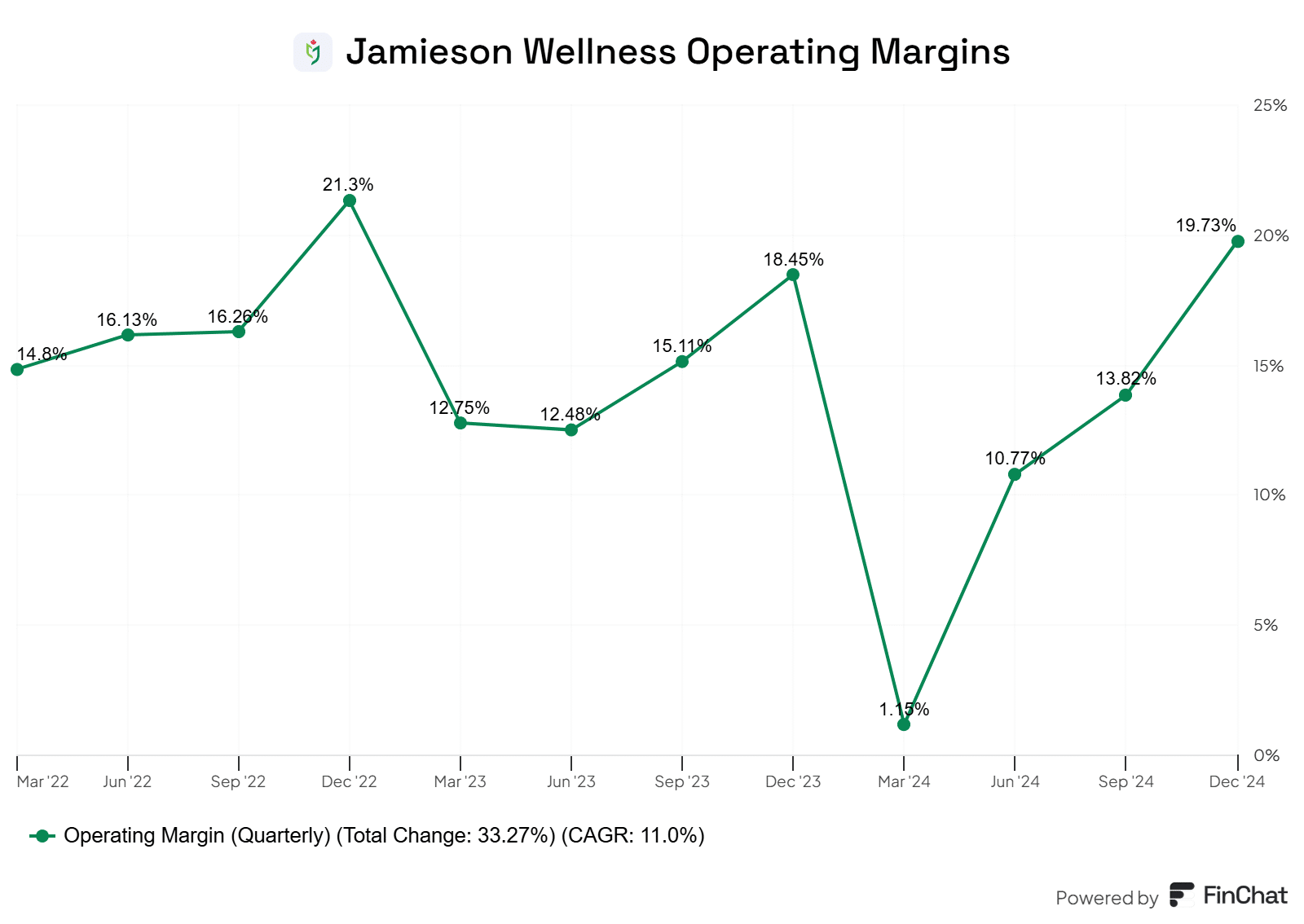
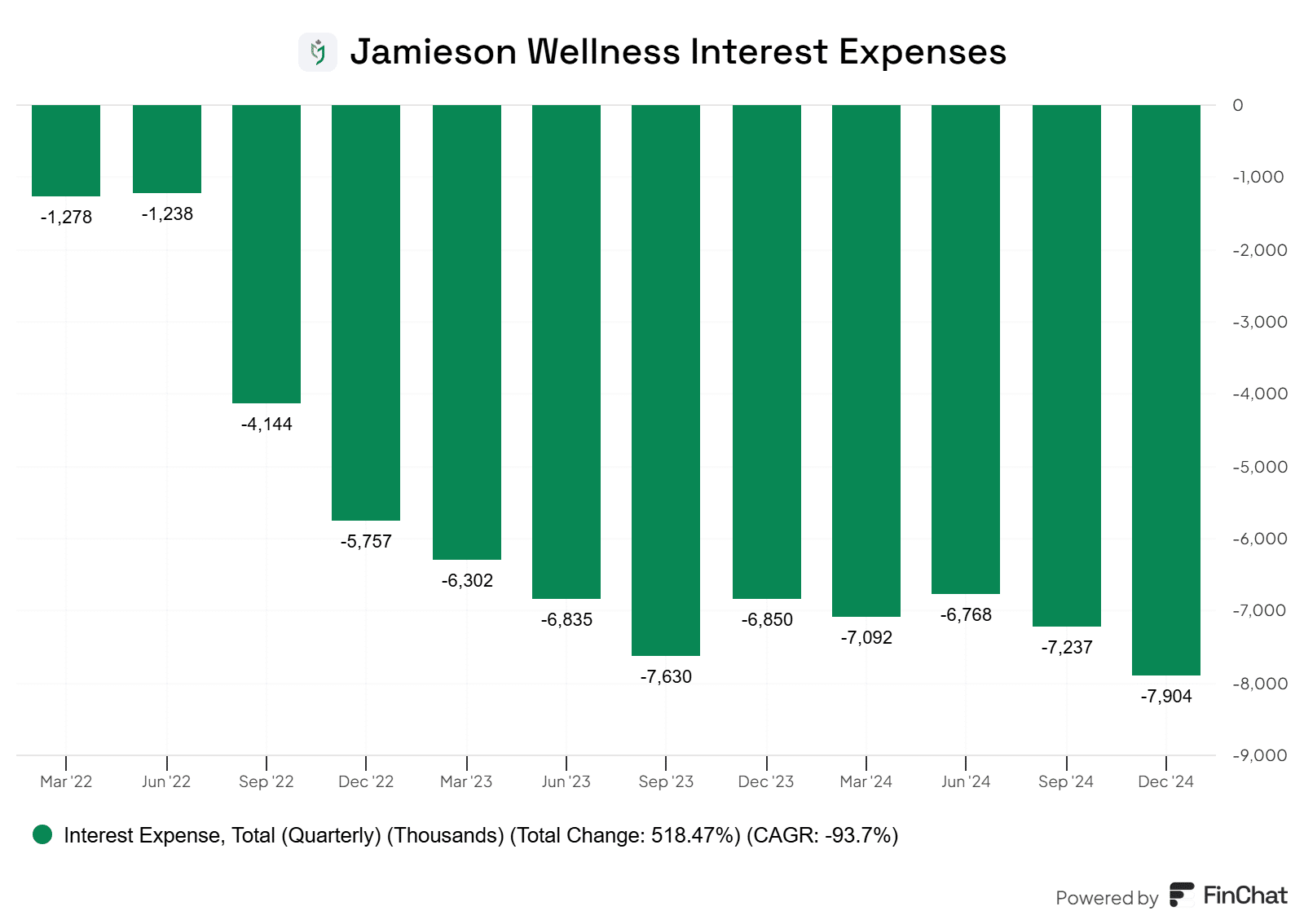
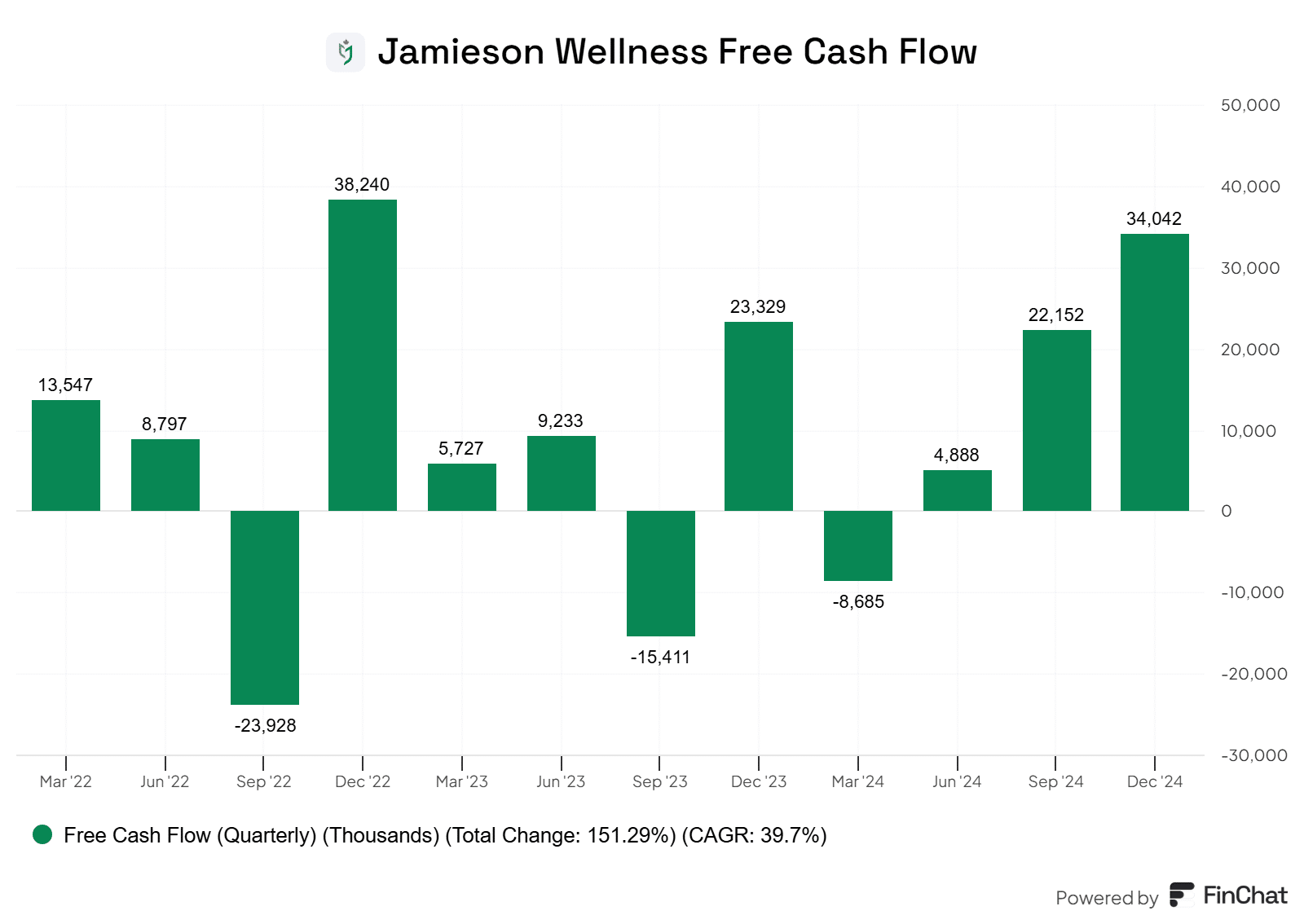
Unfortunately, Finchat does not track KPIs or Segments for Jamieson. However, I’ve placed some key data in the charts below to watch.
Pros

  • The leading VMS company here in Canada
  • The company has multi-bagger potential if international and Chinese expansion works out
  • A Canadian Dividend Aristocrat
  • The company has high, double-digit dividend growth and plenty of room to continue at these rates
  • The company’s products are sticky, and sales are unlikely to have a material impact in a recession
  • Jamieson has a double-digit return on equity and invested capital, and recent numbers are trending above 5-year averages
  • Despite debt being added for acquisitions, the balance sheet is still sound

Cons

  • Brand perception is everything in the space. We witnessed GNC file for bankruptcy in 2020 after the quality of its supplements was questioned
  • Jamieson is already a leader in Canada. Our thesis is based heavily on international growth. If it doesn’t materialize, the company’s valuation would likely be deemed expensive
  • International expansion brings with it higher levels of competition. It will not be as easy for Jamieson to capture international market share as it was in Canada
  • Higher rates are impacting the bottom line. Interest expenses from the youtheory acquisition are still extensive, even with policy rates declining. It needs to prioritize debt reduction

Jamieson Wellness maintains a dominant position in the Canadian market, but the real opportunity lies in its international expansion, particularly in China, which is now the second-largest vitamin, mineral, and supplement (VMS) market globally, worth over $20 billion. That’s the core of the Jamieson thesis: strong domestic leadership combined with outsized growth potential overseas.

International revenue is projected to grow by 20–30% in fiscal 2025, a notable step up from the low double-digit growth seen in 2024. The flagship Jamieson brand segment remains resilient, with total revenue expected to grow between 9–14.5%, just under half of which still comes from Canada. This shows that while the domestic market is steady, the real acceleration is coming from outside of Canada, the core element of this thesis.

Like many companies, Jamieson has faced some macro headwinds from higher interest rates. But underneath that pressure, it’s clearly getting more efficient. Prior to the rate spike, Jamieson was delivering strong double-digit returns on equity and invested capital. As rates normalize, there’s a credible path back to those levels. The company has already restored operating margins to pre-pandemic levels and continues to improve, suggesting that operational leverage is starting to kick in again.

The 2022 acquisition of Nutrawise, the owner of the U.S.-based brand youtheory, gave Jamieson an immediate entry point into U.S. manufacturing and distribution. It was an accretive deal from day one, and the brand is already pulling its weight, growing 17% in 2024. Growth is expected to slow to 5–15% in 2025, but even at the low end, it’s adding meaningful scale and diversification to Jamieson’s core business. The key going forward will be how effectively Jamieson manages the associated debt. Which, while not alarming, still deserves attention.

On that front, the company’s balance sheet remains solid. Working capital sits above $250 million, and its interest coverage ratio is nearly 4x, plenty of room to service debt obligations. In 2024, the company reduced debt by 8.5%, which is decent but slower than the 20% reduction achieved in 2023. Ideally, it would accelerate that deleveraging pace, especially with interest costs still elevated. That said, management may be holding back on repayments in anticipation of rate cuts, preferring to allocate capital toward growth while waiting for cheaper refinancing conditions. It’s a reasonable tradeoff, but worth monitoring.

Overall, Jamieson has a long runway ahead. If its international strategy continues to deliver, and if margins keep trending upward as expected, it’s only a matter of time before broader market attention follows. The current macro backdrop is creating a window for investors to accumulate shares at more attractive valuations, ahead of what still looks like a multi-year global growth story.

Beta

1.2

Best monthly return

32.6%

Worst monthly return

-14.6%

Max drawdown

45.8%

A supplement company is only as good as its reputation with the public. Consumers must believe that the VMS they buy from Jamieson are healthy and high-quality. Any damage to the company’s reputation would significantly impact sales.

Secondly, the debate on using VMS for health has been around forever. While there are strong arguments on either side of the debate, there was no doubt that a statement made by Dr. Fauci during the pandemic about the use cases and benefits of multivitamins caused a surge in sales. The risk is this going the other way, and a person with significant influence discounting the use of supplements, causing a dip in sales. These types of issues tend to occur all the time and are short-lived in nature, but it is always a risk.

The company also presents a risk from an international expansion standpoint. The company’s expansion outside of Canada can provide large-scale growth. However, valuations would likely go south if growth were not to materialize. This growth being focused around China adds another element of risk that investors simply aren’t willing to pay for now, especially considering the Chinese economy isn’t doing as well as many experts forecasted.

Adding to this international expansion, it has had to execute some of this via acquisition. Acquisitions, especially in our current environment, pose more risk, mainly if the company were to take on debt to fund the acquisition. Weaker-than-expected synergies or additional costs related to the acquisition can drag on company performance and, thus, stock price.

The company is also exposed to much more significant and stiffer competition outside of Canada, so its international expansion efforts will likely not come as easy as they did in its home country.

TTM

Historical average

Forward numbers

P/E

25.9

28.5

18.6

EV/EBITDA

16.0

17.4

Free cash flow yield

6.6%

P/FCF

16.0

49.0

PEG ratio

0.3

Jamieson Wellness has undergone a bit of a valuation reset due to some tough macro conditions and the weight of added financing expenses wearing on earnings.

However, the environment is starting to improve, and it is now trading at relatively attractive valuations that are far below its historical averages. The company expects to grow earnings in 2025 by 13% on the bottom end and 20% on the high end. If we make the assumption that the company lands somewhere in the middle, around 16.5%, we get earnings per share of around $1.87. This puts the company at 19x expected earnings, a relatively attractive valuation for a company growing earnings at a double-digit pace.

The company earned $1.20 per share in free cash flow on earnings per share of $1.61 in 2024. If we expect the company to maintain similar free cash flow margins, the company should generate about $1.39 in free cash flow per share in 2025. This puts the company at 26x expected free cash flows, again, a relatively attractive valuation for a company growing at a double-digit pace. Sure, it’s not as good of an opportunity as it was when it was trading at $28/sh, but it’s still attractive.

As interest rates continue to fall and the company prioritizes debt reduction, the market should begin to reward the company with a higher earnings multiple. Maybe not necessarily the 32x multiple it has had over the last 5 years, but even somewhere in the middle would lead to some fairly large upside. If we assume the company will grow earnings by 16%~ each year over the next 2 years, we come to an EPS figure of $2.16 at the end of Fiscal 2026. If we apply a 26x earnings multiple to the company, which is right in the middle of its current valuation and its historical valuation, we would come to a share price of $56.

Of course, this is a relatively optimistic assumption. However, there is a lot of room for error to the downside, where it still presents itself as an attractive opportunity. Growth in China will be key, as without it, the company is a relatively slow-growing business in Canada, and its valuation multiple would contract rather than expand.

Jamieson’s ultimate competition is big box stores. For this reason, I haven’t really added a competition chart because valuation and profitability comparisons will be irrelevant. There aren’t really any companies on the index that specifically focus on vitamins, so Jamieson is in a league of its own.

Although there are other supplement companies, the threat of cheaper alternatives is one that investors must acknowledge if they’re investing in Jamieson. There needs to be a brand perception that the company’s products are of higher quality, or there is a chance that consumers could choose alternative discount-name products at stores like Walmart. However, as mentioned, it isn’t fair to compare Jamieson directly to Walmart valuations, as Walmart is not a pure-play supplement store.

Another significant competitor for the company was the Franchise Group (NYSE:FRG). Franchise Group owns Vitamin Shoppe, a large U.S.-based VMS store. However, back in 2023, the company was taken private.

Yield

2.5%

Payout ratio (EPS)

67.0%

5-year dividend growth %

16.1%

Money Spent/Received on Buybacks and Share Issuances

$101M

One thing I love about Jamieson is that the company presents a unique blend of growth via share appreciation and dividends. In the company’s short publicly-traded life, it has become a Canadian Dividend Aristocrat. It has grown the dividend by more than 80% over those 8 years.

Despite a challenging environment and a reduction in guidance, the company came through with an 11% increase to the dividend in the middle of 2024. This can be viewed in two ways. For one, it shows the company’s commitment to returning capital to shareholders.

However, with payout ratios becoming tight (65% of earnings), it was also seen as a somewhat risky bet on policy rates coming down. They ended up being right, thankfully.

The bulk of Jamieson’s struggles earnings-wise have been financing expenses. If rates continue to decline, it will provide more relief on the financing end and, ultimately, the payout ratio will improve, even with this raise. We’ve witnessed this over the last few quarters, as the payout ratio has declined from 85% to under 60% today.

On the other hand, many investors would prefer the company utilize that money to pay down debt levels. In this environment, investors want to see the company prioritize debt levels at all costs, as it is one of the driving factors impacting the company’s reduction in guidance and slower growth.

Last quarter

EPS

Revenue

Expectations

$0.39

$187.36M

Reported

$0.41

$199.32M

Surprise

5.13%

6.39%

Annual estimates

EPS

Revenue

2025

$1.87

$820.28M

2026

$2.28

$904.65M

2027

$2.66

$990.90M

Jamieson Wellness turned in another impressive quarter. Revenue increased 13%, with branded sales up 16.5%, outpacing expectations thanks to standout momentum in China, double-digit international gains, and as always, steady performance in Canada.

Gross margins expanded 350 basis points company-wide, driven by strong execution in high-margin regions, kind of highlighting how the company has the potential to grow at scale internationally.

China remains the star of the portfolio, and the core of my thesis. Sales were up more than 60% in the quarter, fueled by smart digital marketing, influencer partnerships, and traction both online and at physical stores. Management’s shift toward higher-ROI campaigns and micro-influencer strategies is clearly paying off, and Jamieson’s recent recognition as VMS Store of the Year in China highlights how well the brand is resonating with Chinese consumers.

Youtheory is also building momentum, with revenue up nearly 17% in the quarter. A lot of investors were initially upset with Jamieson’s decision to buy the company. However, synergies are going well, and the price Jamieson paid may really not be all that bad after all.

Meanwhile, international markets were another highlight, up 19%. The Middle East has become a quiet growth engine for the brand, as regulatory shifts open up new opportunities in the region. It is still a small portion of the business, but one to keep an eye on for sure.

As always, Canada continues to perform. This is the “moaty” side of the business, where Jamieson has a stranglehold on market share. Revenue grew 4%, largely driven by consumption rather than Jamieson increasing prices. This is a good sign considering how tight consumers are right now.

With a strong quarter in the books, Jamieson narrowed its full-year revenue and EBITDA guidance. Full-year revenue is now expected between $810 million and $830 million (10–13% growth), with EBITDA of $158–162 million and EPS of $1.82–1.88.

If the company can hit these numbers in terms of guidance, the stock is trading at attractive valuations, there is little doubt.

Jamieson is hitting its stride. The branded business is growing across every region. China and the Middle East are scaling faster than expected, Youth Theory is gaining relevance in digital U.S. channels, and Canada remains a stable base. Margins are moving in the right direction, and capital is being deployed wisely. The company repurchased $8.8 million of shares in Q3 and continues to pay a sustainable dividend.

Disclaimer

By utilizing this report, you agree that you are a Stocktrades Premium member, and you agree to our terms and conditions and privacy policy. You acknowledge that any distribution of this report outside of Stocktrades Premium could result in the immediate cancellation of your Premium subscription. You also agree to the following:

This stock report is solely for informative purposes, and does not represent a buy or sell recommendation. The information expressed in this report is the opinion of the analyst about the subject company and our database of stocks in general. The information the analyst used to compile this report comes from sources we believe are reliable. Stocktrades Ltd however makes no warranties of any kind as to the completion or correctness of the information within this document.

All information in this report is accurate as of the date of this report, and all data contained within this report of the subject company is of the analyst’s best judgement at the date of the report. The information contained in this report is subject to change without notice. The information provided in this report is provided for informational purposes by Stocktrades Ltd and Stocktrades Ltd assumes no legal responsibility or liability. Anyone using this report assumes full responsibility for whatever decision is arrived at by using the details of this report.

Stocktrades Ltd. assumes no liability or legal responsibility for the resulting actions and or consequences of using outdated information. No version of this report outside of the original located at www.stocktrades.ca/premium/ is to be considered to contain live, or accurate information. These reports are updated quarterly and it is the users responsibility to insure they have the most recent updated version.

You may not alter or distribute this report in any way without the full consent of Stocktrades Ltd.

The decision to purchase or sell of a security depends on a multitude of individual factors such as but not limited to risk tolerance, financial situation, and investment objectives.