[]
Login Join Premium

Bull List Report – National Bank – TSE:NA

National Bank – NA.TO

National Bank of Canada is the sixth-largest Canadian bank. The bank offers integrated financial services, primarily in the province of Quebec as well as the city of Toronto. Operational segments include personal and commercial banking, wealth management, and a financial markets group.

Focus area

Score

Valuation

68

Profitability

46

Risk

96

Returns

100

Dividend

98

Outlook

20

Debt

33

Growth

55

Overall

57

Click the KPI images to expand them if needed!
Pros

  • Best-performing Big Six bank over the past 3, 5, and 10-year periods
  • Owns a 14-year dividend growth streak and one of the lowest payout ratios in the industry
  • Highest 5YR dividend growth rate among the Big Six banks
  • Consistently has among the highest returns on equity
  • The most Canadian-focused of the Big Six and, as such, the least exposed to less regulated environments
  • Has one of the lowest exposures to hot Canadian housing markets
  • Acquisition of Canadian Western will give it large exposure to Western Canada

Cons

  • Lower-than-average yield compared to its peers
  • The most Canadian-focused of the Big Six and, as such, is highly reliant on the state of the Canadian macro-environment
  • Highly concentrated in Quebec (~55% of the business)
  • The company is trading at a premium to historical averages due to exceptional results
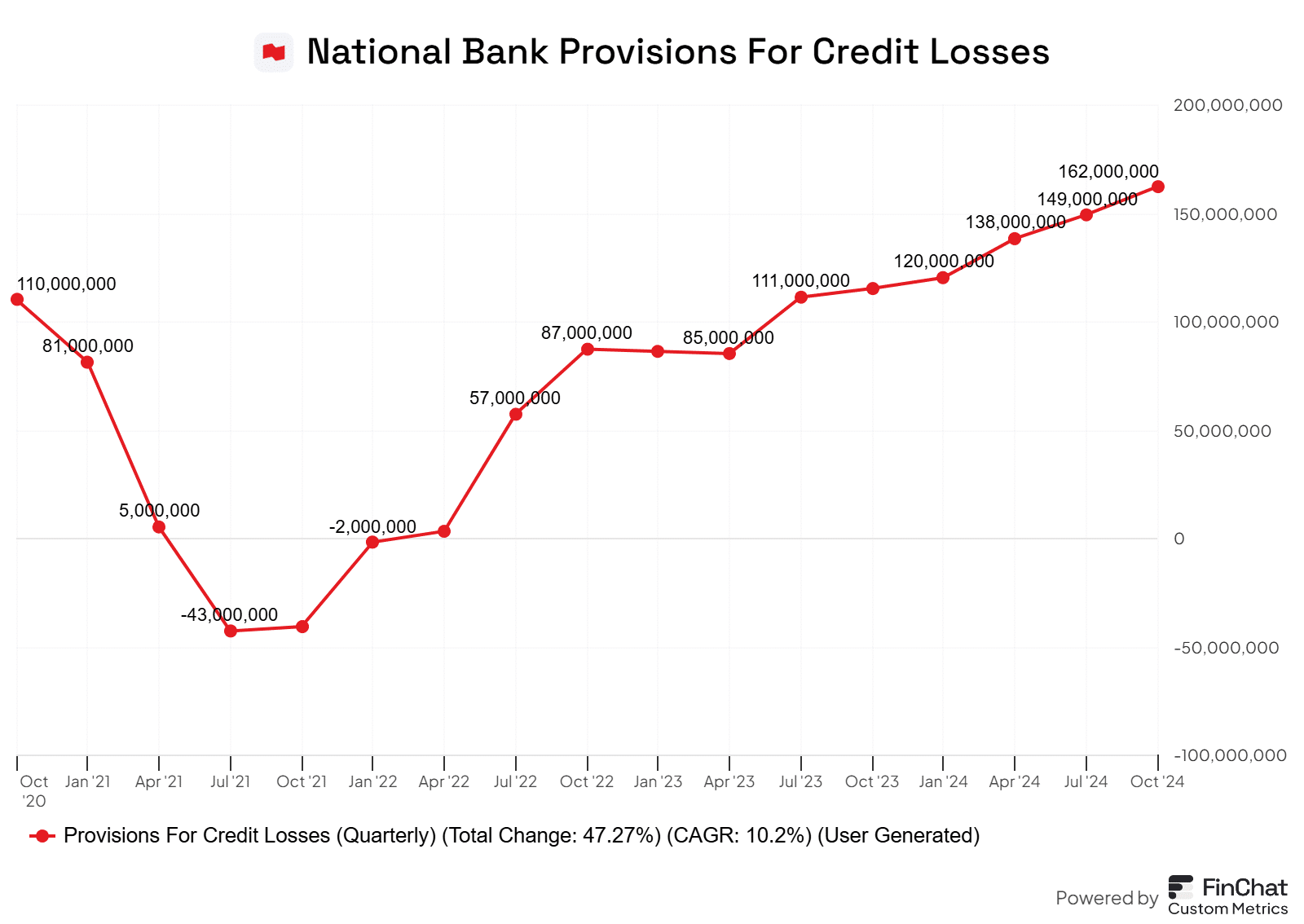
  • Provisions are starting to creep up as credit quality deteriorates. This is a sign that Canadian banks are not out of the woods yet

My overall thesis with Canadian banks, mainly the “Big Six” banks, has been simple: I identify the cheapest bank, and I buy that bank. That said, the environment for banks during this period of high rates and continued macro-uncertainty is making me shift my strategy somewhat.

Instead of looking to the cheapest bank today, I am shifting focus and presenting the best-performing banks to members. I already had one as a Foundational, Royal Bank of Canada. The other one that doesn’t get near enough credit is National Bank. It often gets left out of the Big 5 conversation since it is the smallest of the bigger banks and because of its regionality.

Approximately 85% of income comes from Canada (55% from Quebec); depending on your viewpoint, this can be a good or bad characteristic. On the one side, it has the least exposure to higher-growth international and US markets.

Its acquisition of Canadian Western Bank should allow it to expand into Western Canada and offer a better suite of products to CWB customers. The company’s focus in Eastern Canada hasn’t necessarily been a drag on the business, but it could certainly do with a little country-wide diversification, and I feel it got just that with the purchase of CWB. Yes, it paid a pretty hefty price tag, but I believe it will be a profitable endeavour over the mid to long term.

On the other hand, Canada’s banks are among the best in the world because of the regulated nature of our industry. They are successful because of, not despite, our system, and as the most exposed domestic bank of the Big 6, National Bank has outperformed all the others in recent years. Why? Because those high-growth markets are proving to be more volatile and are undergoing their own geo-political and macro events. Think of the US regional banking crisis in 2023 and even the borderline failure of NYCB in 2024.

It also benefits from higher returns because it is Canadian-focused and has one of the lowest exposures to hot mortgage markets. Royal and National were also the only banks to report YoY earnings gains in Fiscal 2024. My shift here is simple: go for one of the best-performing banks in the country amidst the current macro-uncertainty.

Beta

1.1

Best monthly return

13.5%

Worst monthly return

-12%

Max drawdown

22.6%

Although inflation has settled and rates are starting to come down, there is still the question of continued credit quality among Canadian buyers. Many pandemic-level mortgages have now come due or are coming due soon. Although policy rates are much lower, mortgage rates are relatively sticky at this point in time. Higher than average rates will continue to put pressure on Canadian consumers and thus National Bank’s loan book. We’re starting to see this now even in 2025.

This adds much uncertainty to the banks’ projected earnings, as provisions for credit losses (PCLs) have been highly volatile. Throughout 2023 and 2024, the banks ramped up PCLs. Although we are now in a cycle of multiple rate cuts, and often ones of sizable amounts, we’re still seeing provisions rise as more and more Canadians are under a crunch financially.

Credit risk is also a real threat to banks, especially mortgages. Higher rates put pressure on the ability of borrowers to make payments, notably borrowers with variable-rate mortgages or for whom the mortgage term is up for renewal.

Additionally, there is always a market risk with banks. Poor capital markets will not only continue to put pressure on customer trading activity and inflows to their products, but they will also continue to reduce the value of the bank’s assets.

Finally, while the bank’s exposure to Canada is one of the main reasons for its outperformance, it can also be a threat to the company, especially due to its high exposure to Quebec. As I mentioned, it has low exposure to hot mortgage markets like Toronto and Vancouver. On the flip side, it has the highest exposure to Quebec. So, National Bank would be the most impacted if there is a significant downturn in that province.

TTM

Historical average

Forward numbers

P/E

14.3

11.1

13.6

P/B

2.0

1.8

Earnings yield

10.6%

P/FCF

9.5

PEG ratio

4.3

Canadian banks, and any bank for that matter, are relatively easy to evaluate. The company’s price-to-earnings ratio and its price-to-book ratio give a good idea of how cheap or expensive a bank is. Ultimately, we want a bank producing the best earnings for the lowest price possible and one that is attractively valued relative to its loan book. Canadian banks usually revert to their historical price-to-earnings ratios when trading at a discount almost 100% of the time.

At the time of writing, National Bank is trading above historical averages. There are a couple of main reasons for this. First, higher provisions for credit losses (PCLs) have negatively impacted recent earnings. Still, the company’s share price has held up quite well.

Why is that? As mentioned, National Bank generates some of the highest returns in the industry thanks to its greater exposure to Canada’s highly regulated banking environment. Other Big Six banks are dealing with macroeconomic environments that National Bank has somewhat avoided. In terms of P/B, the company is also at a slight premium, but nothing to be concerned with.

From my perspective, National Bank is fully valued here. That said, my strategy this time around is different. Instead of going for the cheapest bank, I wanted to highlight the most reliable and consistent performer.

We also need to consider that Canada dropped interest rates before the US. Why is this a benefit? As mentioned, National Bank has more exposure to the Canadian economy as a percentage of its total loan book.

Mortgage interest payments have doubled since 2022, and there is ~$352 billion in mortgages up for renewal this year. If rates remain high, Canadian consumers will be feeling considerable pain, which is a position the Bank of Canada likely wants to try to avoid.

For this reason, rates dropping in Canada before the US is likely a tailwind for National at this time. Its higher valuation multiple on a trailing basis is likely because analysts expect more growth moving forward from the company. However, as we’ve witnessed in recent quarters, this won’t exactly be a “smooth” transition, as provisions continue to accelerate.

National (NA)

Royal Bank (RY)

CIBC (CM)

P/E

14.3

15.2

12.7

P/B

2

2.2

1.7

ROE

14.4%

14.3%

13.3%

5-year EPS growth

11%

5.1%

5.4%

5-year annualized return

17.7%

14.3%

15.6%

For the competitors, we’ve decided to add the banks with the largest Canadian exposure in Royal and CIBC. The Canadian Imperial Bank of Commerce is heavily exposed to Canadian real estate and, as a result, tends to trade at discounted valuations relative to the other major Banks.

Royal, on the other hand, is often considered the premiere blue-chip bank. As a result, it tends to trade at a heavy premium to the other institutions. Relative to Royal Bank, National is attractive on a price-to-earnings and book basis, primarily because it should be able to continue to grow faster than Royal due to its smaller nature. In fact, it is positioned to grow faster than any of the Big 6 Banks moving forward.

At this point in time, it is hard not to view National Bank as one of the most attractive opportunities in the Canadian banking space. I do believe valuations are being discounted here due to its overall Canadian exposure plus its rising provisions as of late. However, the underlying operations are doing fine, and despite rising provisions, the bank is still able to grow its earnings at a high single-digit pace. If it can get PCLs under control and stabilized, which it should be able to do when the Bank of Canada inevitably continues to reduce interest rates, it should be able to return to double-digit growth.

Yield

3%

Payout ratio (EPS)

-45.6%

5-year dividend growth %

10.2%

Money Spent/Received on Buybacks and Share Issuances

$258

I always like to have at least one of Canada’s banks on the Dividend Bull List because they have been among the best dividend stocks in the country. Despite some challenging environments over the past couple of decades, these stocks just keep on paying out reliably, year after year.

At 14 years, National Bank has the longest dividend growth streak among the Big 6 banks, and at 10.2%, it has the highest five-year dividend growth rate. It remains well positioned to out-raise its peers as its payout ratio of 43% is among the lowest in the industry.

National Bank raised the dividend by 3.7% in its second quarter 2024 results. It seems like National Bank is going to be turning to a bi-annual raise schedule, providing smaller, more frequent dividend raises.

The one thing we will mention is that their double-digit dividend growth rate is likely to be unsustainable in this current environment. This isn’t unique to National but to all major banks, as the tough macro-environment is impacting earnings, and you will likely see banks being more cautious moving forward until the situation improves. When it does, I fully expect National to revert back to its trend of double-digit annual dividend growth.

You will also notice that the company has issued about $53M in shares over the last year. This isn’t all that surprising. Valuations are above historical averages, and National Bank has not been known to ever be a company that buys back a lot of shares. Its last aggressive buyback campaign was back in 2017, and even then, it reduced share counts by low single-digit amounts.

National reported a much-needed beat and raise quarter to start 2026, looking significantly better than the performance they turned in during the back half of last year. If you’ll remember, I was getting a bit concerned with National’s results and provisions over the last few quarters of 2025. This quarter alleviated my concerns.

While the 11% earnings growth was the headline, the real story is how quickly they are extracting value from the Canadian Western Bank acquisition. They’ve already hit $176 million in synergies, which is well ahead of their initial pace and suggests that management might have been sandbagging their original targets. I would not be shocked if this is the case. By sandbagging, I simply mean projecting the acquisition would add less value than they knew it would, so that investors are surprised when larger results occur.

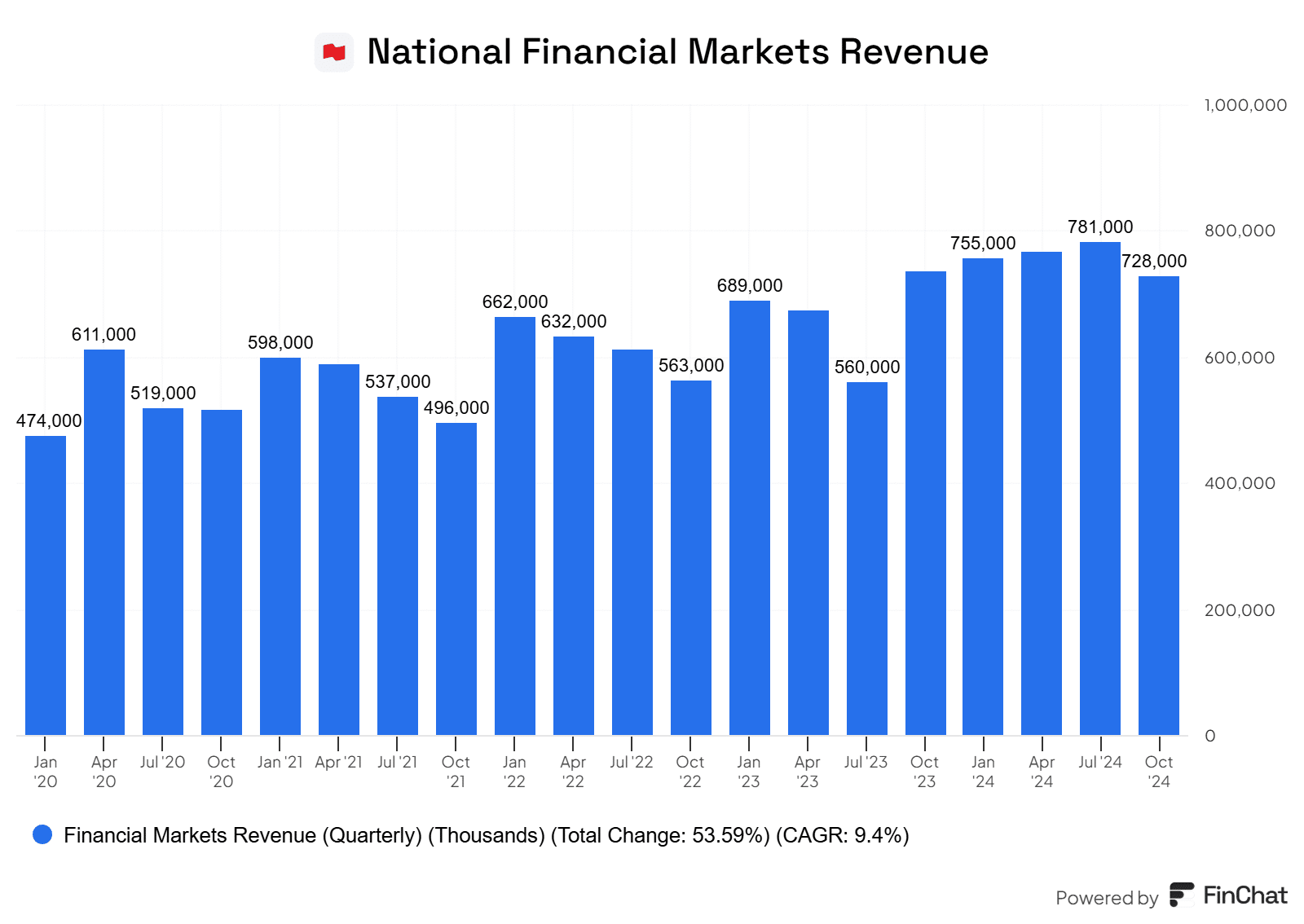
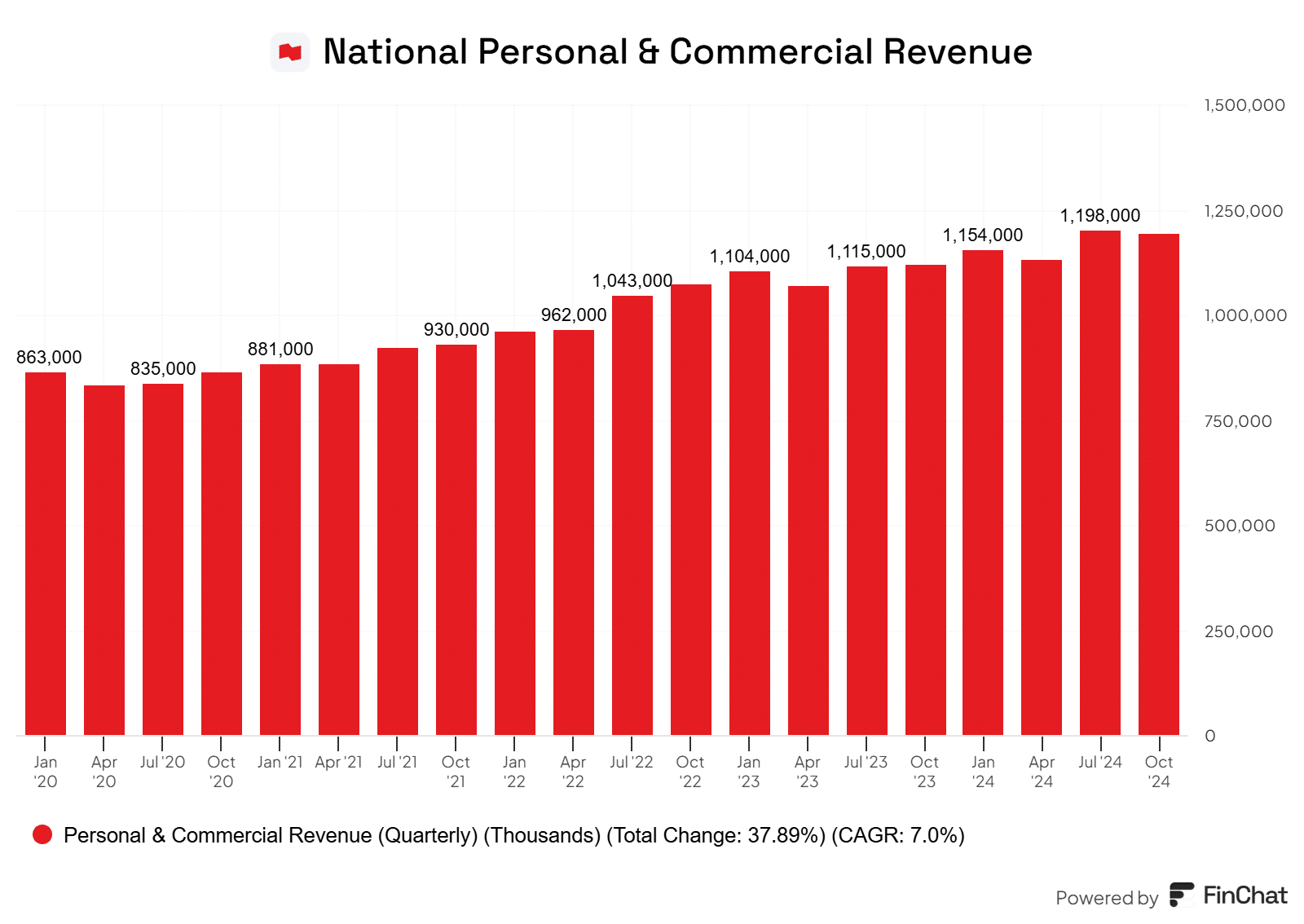
Personal and Commercial banking was actually a highlight this time around, with personal loans up 11% and, more importantly, net interest margins finally showing signs of life with a two-basis-point expansion. National’s NIMs had been sliding for a while, so it’s nice to see this.

What I take from their personal mortgage loan growth is that they are taking market share from the other Big 6, likely due to their dominant position in Quebec. Wealth Management and Capital Markets are riding the same stock market euphoria as everyone else, but National is being particularly aggressive with their capital, nearly doubling their buyback program.

I found it interesting that despite the macro headwinds that exist and what management is constantly speaking on, they were confident enough to increase their ROE target to 16% for the year. PCLs are still hovering around 32 basis points, which isn’t the rock-bottom level we became accustomed to a few years ago, but it’s well within their guidance and suggests they have the credit side of the business under control. This is relieving, as National did experience a bit of a short-term spike in provisions.

Compared to the rotation we saw out of the stock last year when it lagged peers like Royal and Scotia, this quarter feels like a return to form for National. It wasn’t just a “not bad” quarter, it was a legitimately strong one that justifies why this bank usually trades at a premium.

As a shareholder, the company’s path to a long-term ROE of 17% by 2027 looks a lot more credible today than it did three months ago, and I’m happy to see them being more aggressive with the buybacks now that the integration risks are fading with Canadian Western. Great quarter from Canada’s best bank, in my opinion.

Disclaimer

By utilizing this report, you agree that you are a Stocktrades Premium member, and you agree to our terms and conditions and privacy policy. You acknowledge that any distribution of this report outside of Stocktrades Premium could result in the immediate cancellation of your Premium subscription. You also agree to the following:

This stock report is solely for informative purposes, and does not represent a buy or sell recommendation. The information expressed in this report is the opinion of the analyst about the subject company and our database of stocks in general. The information the analyst used to compile this report comes from sources we believe are reliable. Stocktrades Ltd however makes no warranties of any kind as to the completion or correctness of the information within this document.

All information in this report is accurate as of the date of this report, and all data contained within this report of the subject company is of the analyst’s best judgement at the date of the report. The information contained in this report is subject to change without notice. The information provided in this report is provided for informational purposes by Stocktrades Ltd and Stocktrades Ltd assumes no legal responsibility or liability. Anyone using this report assumes full responsibility for whatever decision is arrived at by using the details of this report.

Stocktrades Ltd. assumes no liability or legal responsibility for the resulting actions and or consequences of using outdated information. No version of this report outside of the original located at www.stocktrades.ca/premium/ is to be considered to contain live, or accurate information. These reports are updated quarterly and it is the users responsibility to insure they have the most recent updated version.

You may not alter or distribute this report in any way without the full consent of Stocktrades Ltd.

The decision to purchase or sell of a security depends on a multitude of individual factors such as but not limited to risk tolerance, financial situation, and investment objectives.