[]
Login Join Premium

Bull List Report – Taiwan Semiconductor – TSM

Taiwan Semiconductor – TSM

Taiwan Semiconductor Manufacturing Co., Ltd. engages in the manufacture and sale of integrated circuits and wafer semiconductor devices. Its chips are used in personal computers and peripheral products, information applications, wired and wireless communications systems products, and automotive and industrial equipment, including consumer electronics such as digital video compact disc players, digital televisions, game consoles, and digital cameras. The company was founded by Chung Mou Chang on February 21, 1987 and is headquartered in Hsinchu, Taiwan.

Focus area

Score

Valuation

21

Profitability

91

Risk

58

Returns

100

Dividend

95

Outlook

100

Debt

83

Growth

85

Overall

76

Click the KPI images to expand them if needed!
Pros

  • TSMC is the world’s largest contract chipmaker with a near-monopoly in its manufacturing process. It has a market share of about 70–71% of the global pure-play foundry market in 2025
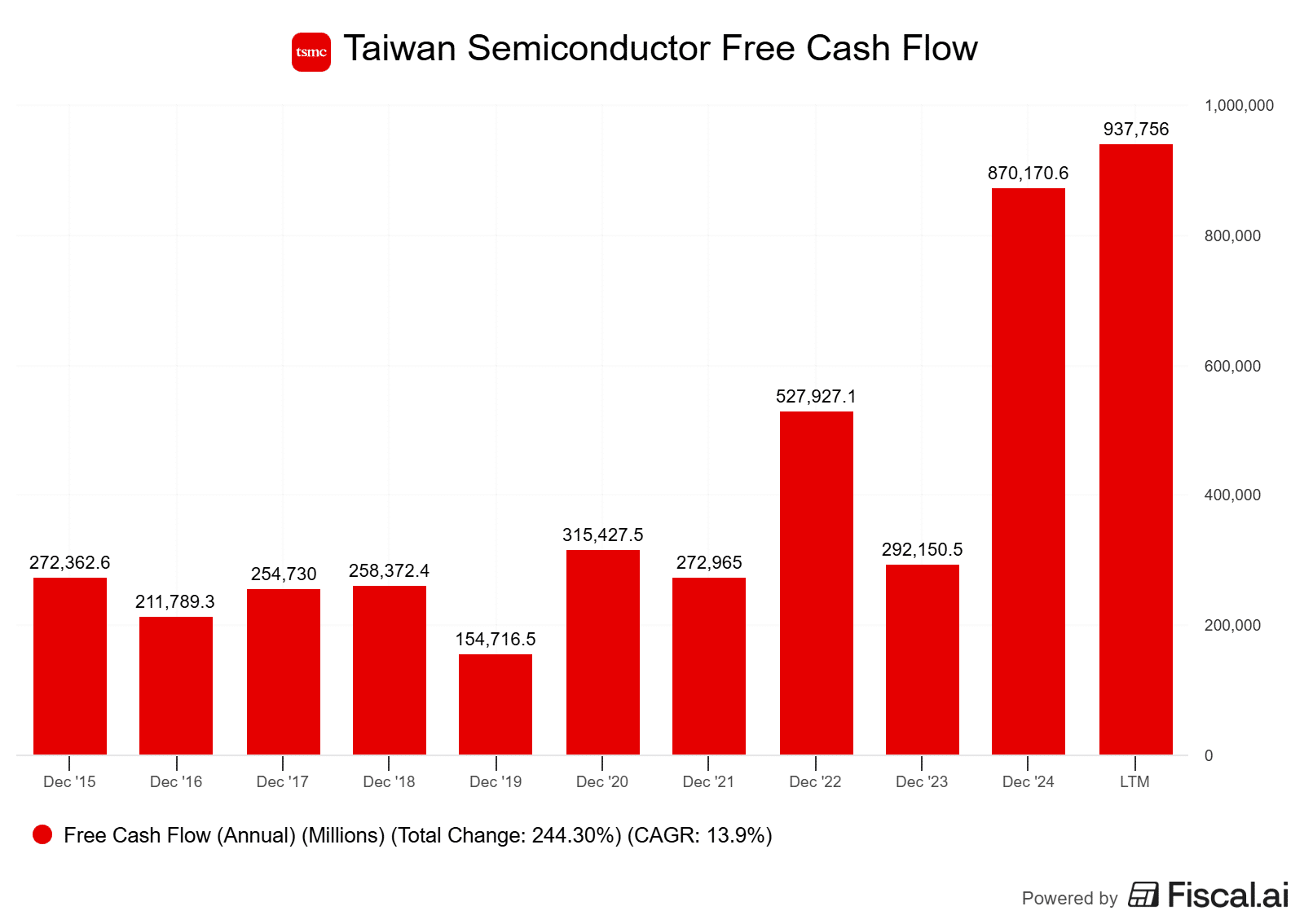
  • For a manufacturing company, its margins are exceptional, which drives strong free cash flow
  • TSMC is positioned to benefit from long-term semiconductor demand. Many believe it to be just AI, but the rise of cloud computing, 5G, IoT, and automotive electronics all require the exact chips TSMC makes
  • The company carries only $34B in debt on the balance sheet. It could eliminate its entire debt load with just a year of free cash flow, highlighting the company’s balance sheet strength
  • TSMC’s process know-how, extensive patent portfolio, and economies of scale form its economic moat. This position is hard for new entrants to disrupt, which supports its long-term competitive advantage
  • The growth and overall outlook of a company this size is simply outstanding. 30%+ top and bottom line growth for a $1.5T company is one of the best growth rates out of all mega cap stocks
  • It trades at a large discount to other semiconductor companies, primarily because of geopolitical tensions
  • No matter how profitable AI systems or pieces of software are, TSMC is a true “picks and shovels” play of AI. Even if companies down the line lose money on AI innovation, TSMC makes money off the chips

Cons

  • TSMC is headquartered in Taiwan, which faces significant geopolitical tension due to China’s claims on the territory. Any conflict or political instability in the Taiwan Strait could severely disrupt TSMC’s operations. Make no mistake about it, this is the largest risk of this company
  • An AI/smartphone/PC slump or global recession could reduce chip orders and hurt TSMC over the short term. The industry is capital-intensive, and TSMC must keep investing through cycles. This can make short-term earnings volatile in cyclical lows
  • Although the company’s earnings aren’t “priced to perfection” like many AI names, they’re certainly not cheap either. There is a lot of forward-looking AI demand that needs to be satisfied to justify the premium
  • Although the company is one of the cheaper options in the semiconductor space, valuations are still at the point where double-digit growth will be needed to justify them
  • A sizable portion of TSMC’s revenue comes from a few large customers. A prime example of this would be Apple, which accounted for 24%~ of revenue in 2024. Although they are diversifying because of the AI boom, this is still a risk

The core investment thesis here is that TSMC is the indispensable backbone of semiconductor production.

Some investors are buying TSM due to the bullish outlook regarding AI. And don’t get me wrong, it needs AI to continue advancing to justify its valuation. However, virtually every major technology trend (cloud computing, mobile connectivity, electric and autonomous vehicles, IoT, etc.) relies on more complex chips. TSMC is the primary manufacturer of the best of the best in this regard.

TSMC has some considerable competitive advantages: scale, technological lead, loyal customer base, and deep expertise. Ultimately, this is what creates their moat. And make no mistake about it, the moat is priced into the stock today. However, the company has showcased it can flex that moat at a substantial rate. This company has developed deep, trusted relationships with most of its top-end clients.

The company continues to invest heavily in future nodes (2nm, 1.4nm) and in expanding capacity globally. Because TSMC has such high margins and free cash flow generation, it can continually invest in new technology and advancements, all while putting next to no strain on the balance sheet. This is what forms most of the fortress around this company.

The pace of AI model scaling, large language models, and generative AI is relentless. Regardless of profitability on the end-user side of the spectrum, Taiwan Semiconductor gets paid for the production of the chips. As I mentioned above, it is a true “picks and shovels” play in the realm of artificial intelligence. The “picks and shovels” saying originates from the typical gold rushes, and the fact that the only companies to ever really make money over the long-term were those who sold the equipment for the miners to get the gold out of the ground. The miners, on the other hand, experienced numerous boom and bust cycles, and few of them were ever successful.

The company is in what I would call a constant feedback loop. The more successful TSMC becomes, the more it can reinvest in R&D, fabs, yield improvements, and recruiting top human talent. This creates a compounding edge: scale leads to better margins, more money becomes available for investments, which in turn leads to processing improvements, and ultimately, more customers. As this continues, TSMC pushes itself farther and farther ahead of major competitors.

Overall, the investment thesis is that TSMC’s role in the semiconductor ecosystem will translate into sustained revenue and earnings growth over the next decade, justifying its premium valuation. Yes, we might get some volatility if AI capex scales back. However, it is difficult to imagine a world without Taiwan Semiconductors at the forefront of a lot of up-and-coming technology. Thus, I believe it is worthy of its current valuations, despite it running up quite a bit over the last few years.

Beta

1.9

Best monthly return

29.1%

Worst monthly return

-19.1%

Max drawdown

56.5%

The only reason Taiwan Semiconductor trades at steep discounts to the likes of AMD and NVIDIA is the geopolitical tensions and sovereign risk. With the company’s operations being in Taiwan, there is a delicate balance here. Any escalation from China in regards to Taiwan could impact the company materially. In the most extreme cases, military conflict could disrupt or even destroy TSMC’s fabs. The difficulty here is navigating how much these tensions really deserve to weigh down on the company’s valuations.

We can look back to Warren Buffett selling his stake in TSMC back in 2023. He called the company one of the best-managed and most important companies on the planet. However, he needed to sell it because of the potential geopolitical issues. The difference here is we are managing retail portfolios and not hundreds of billions of dollars. So, we can mitigate that risk to a certain extent with allocations, but we cannot outright eliminate the risk.

The semiconductor industry has boom-bust cycles. TSMC’s business can fluctuate with the end market of devices. Even something as simple as an economic downturn in terms of cellular devices can impact results. We saw a mild version of this in recent years when smartphone and PC demand cooled.

A more severe global recession or potentially the cooling off of AI data center buildouts could reduce demand for high-end chips and result in lower utilization at TSMC. TSMC does have some cushion with long-term customer agreements and its broad product mix, but don’t make the mistake of believing it is immune to macroeconomic slowdowns. Although the long-term trend is upwards, the short-term trend based on overall results is bound to be lumpy.

If a competitor advances TSMC in technology, the moat could erode. Intel and Samsung are the two most significant rivals in this regard, and two investors need to pay attention to. At this point in time, both of them are well behind, but that is not to say they will stay well behind in the future.

And finally, as TSMC expands to new sites (Arizona, Japan, Europe), it faces execution risk in constructing and staffing these countries to its standard. New facilities will no doubt have somewhat of a learning curve, and there is the potential that higher cost of materials and higher costs of labor in these regions could impact overall margins in those segments of the business.

TTM

Historical average

Forward numbers

P/E

33.8

42.4

29.2

EV/EBITDA

22

25.1

Free cash flow yield

3.2%

P/FCF

31.3

PEG ratio

0.9

Taiwan Semiconductor is one of the cheapest mega-cap plays in the sector. However, the company is currently trading at more than double its historical valuations due to the current AI boom. As a picks-and-shovels play, it likely has less cyclicality in its earnings based on AI demand. Still, if end-user products don’t end up being as profitable, it will eventually trickle back into smaller orders for TSMC and ultimately valuations.

However, if we are willing to accept the current geopolitical risk, TSMC is a bargain compared to many of its major AI-related competitors. When we look to a competitor like Samsung, which routinely trades for around half the valuation TSMC does, it does look like TSMC on the surface is expensive. However, it has a much more dominant position than Samsung, and in my opinion, the premium is justified.

If we look to expected growth rates of 25% or greater over the next half-decade, there is still plenty of upside here from a share price perspective. Yes, you can find cheaper companies operating in the same sector, but TSMC’s valuation carries a significant premium vs. those peers. This is primarily due to its accelerated growth and dominant market position.

I would argue that at this point, you are paying a fair price for TSM. Which, in this area of the market, is a rare find. Could the stock fall 20%, 30%, or even 40% on geopolitical tensions or a potential slowdown in AI-related spend? Yes. But could it also go that much higher, potentially even more, on continued AI and technological expansions? Absolutely. If we look to this investment as a minimum 10+ year hold and ignore the short-term potential volatility that could come with it, it starts to look more attractive.

TSMC (TSM)

Samsung (SSNLF)

Intel (INTC)

Gross margins

52%

47%

48%

P/FCF

31.3

27.8

30

5-year EPS growth

24.8%

24.7%

16.2%

5-year annualized return

18.3%

21.8%

24%

ROIC

42%

26%

34.4%

TSMC’s most relevant competitors are Samsung Electronics and Intel, along with smaller pure-play foundries like GlobalFoundries (US-based), UMC (Taiwan), and SMIC (China).

Samsung is the second-largest player in contract chip fabrication by revenue, but it remains a distant second. In fact, last year it ended up losing market share, while TSMC gained share. Samsung’s main advantage is that it is both an IDM (integrated device manufacturer for its own chips) and a producer. So, it can satisfy demand to some extent using its own devices. Overall, Samsung faces an uphill battle to win third-party customers from TSMC. Many high-end chip designers simply go straight to TSMC, and I really don’t think this is going to change anytime soon.

Historically, Intel was a leader in semiconductor manufacturing, but this was primarily for in-house chips. In recent times, Intel has launched services to open up its production to external customers, and it does have lofty expectations of becoming the number 2 player by the end of the decade. But at this point in time, there is no meaningful movement in this regard, and TSMC remains the core player.

If I were to sum it all up in a few sentences, TSMC has competitors, yes. But its dominant market share, in excess of 65%~, dwarfs that of something like Samsung, which holds around 8%. What this massive lead does is allow TSMC to continue to expand and innovate over and above what competitors can keep up with.

Yield

1%

Payout ratio (EPS)

28.5%

5-year dividend growth %

14%

Money Spent/Received on Buybacks and Share Issuances

$4.2B

TSMC does pay a dividend, and one that is routinely growing. Some large runups in share price don’t really make it all that attractive from a yield standpoint. However, the company is committed to both paying the dividend and raising it, and with a payout ratio of ~30%, it has plenty of room to do so.

One thing you might notice, however, is a fluctuation in the dividend. This is likely due to the fact that TSMC’s dividend is in Taiwan Dollars, and any sort of currency fluctuations in the USD could lead to a higher/lower dividend quarterly.

In terms of buybacks, you won’t see much from the company right now. It is highly likely that it will continue to aggressively expand production capacity in both Taiwan and external countries to keep up with the demand it is seeing. It would not make sense to allocate capital to buybacks at this point in time.

Last quarter

EPS

Revenue

Expectations

$2.62

$31.49B

Reported

$2.92

$33.10B

Surprise

11%

5.1%

Annual estimates

EPS

Revenue

2025

$9.82

$120.8B

2026

$11.49

$142B

2027

$14.13

$170B

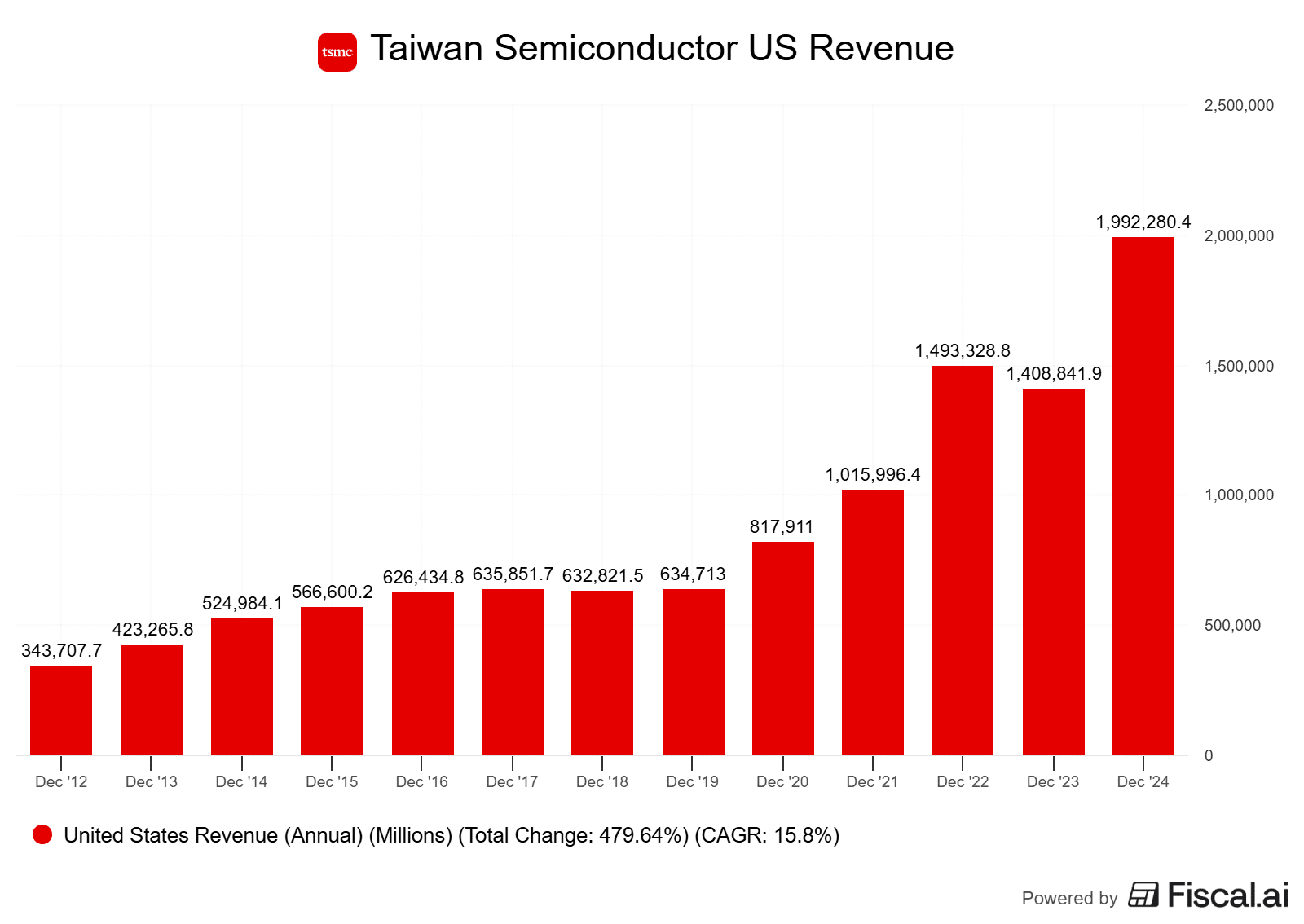
TSMC delivered a strong quarter, with revenue of $33.1B, not only up 10% sequentially but also ahead of guidance. Gross margin expanded 90bps to 59.5% and operating margins increased to 50.6%. The company raised its full-year revenue growth outlook to the mid-30% range in USD terms, primarily pointing to AI and smartphone demand.

Despite all this, the stock dipped in share price on the day of earnings. A lot of this likely had to do with the slide in all major indexes that day. However, I was definitely impressed with the earnings, which were one of the catalysts to place it on the Bull List.

High-performance computing remained the core of the business at 57% of revenue. Smartphone revenue rebounded, up 19% QoQ and is now 30% of the overall mix. Automotive and IoT each grew ~20%, while digital consumer electronics continued to shrink. This is not really that surprising, considering the economic environment.

Management raised its CAPEX range to $40–42 billion for 2025, which could have caused a bit of the selloff as well. Previous CAPEX was to be around $38B-$40B. The good news out of this is that the company mentioned the bulk of this CAPEX is going directly to future growth, driven by clear signals from their customers, particularly in AI.

The company’s global expansion is accelerating relatively quickly. In Arizona, management is accelerating efforts to build a gigafab cluster and expand advanced packaging. In Japan, the first Kumamoto fab is in motion, and a second is under construction.

The N2 node is entering volume production now, with an aggressive ramp expected in 2026. TSMC introduced N2P (an enhanced version) and A16 (for dense HPC workloads), both scheduled for the second half of 2026. While N2 will dilute margins in 2026, N3 is expected to catch up to corporate average margins during the same period, which should offset most of the impact. Currency is always a big factor here, as swings between the Taiwan Dollar and the US dollar, even as small as 1%, can swing margins by 40 basis points.

Overall, this was a high-conviction quarter, and one that I am surprised the market didn’t react positively to. TSMC is not necessarily building for the current chip cycle, but more so the future cycle in regards to AI. Their moves in capacity, packaging, global scale, and roadmap all reflect a company preparing for a sustained boom.

Disclaimer

By utilizing this report, you agree that you are a Stocktrades Premium member, and you agree to our terms and conditions and privacy policy. You acknowledge that any distribution of this report outside of Stocktrades Premium could result in the immediate cancellation of your Premium subscription. You also agree to the following:

This stock report is solely for informative purposes, and does not represent a buy or sell recommendation. The information expressed in this report is the opinion of the analyst about the subject company and our database of stocks in general. The information the analyst used to compile this report comes from sources we believe are reliable. Stocktrades Ltd however makes no warranties of any kind as to the completion or correctness of the information within this document.

All information in this report is accurate as of the date of this report, and all data contained within this report of the subject company is of the analyst’s best judgement at the date of the report. The information contained in this report is subject to change without notice. The information provided in this report is provided for informational purposes by Stocktrades Ltd and Stocktrades Ltd assumes no legal responsibility or liability. Anyone using this report assumes full responsibility for whatever decision is arrived at by using the details of this report.

Stocktrades Ltd. assumes no liability or legal responsibility for the resulting actions and or consequences of using outdated information. No version of this report outside of the original located at www.stocktrades.ca/premium/ is to be considered to contain live, or accurate information. These reports are updated quarterly and it is the users responsibility to insure they have the most recent updated version.

You may not alter or distribute this report in any way without the full consent of Stocktrades Ltd.

The decision to purchase or sell of a security depends on a multitude of individual factors such as but not limited to risk tolerance, financial situation, and investment objectives.