[]
Login Join Premium

Bull List Report – TELUS – TSE:T

TELUS – T.TO

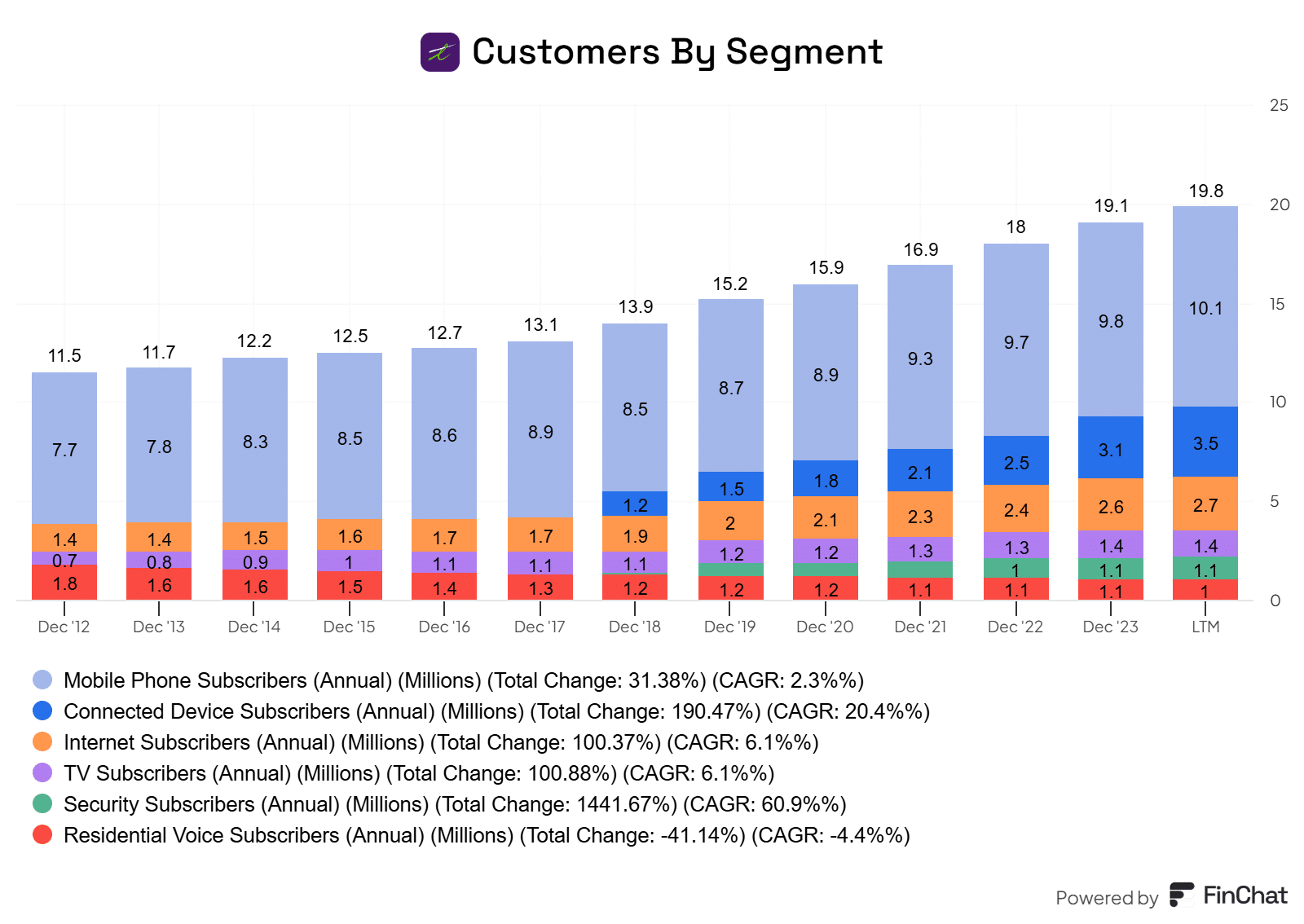
Telus is one of the Big Three wireless service providers in Canada, with over 10 million mobile phone subscribers nationwide constituting about 30% of the total market. It is the incumbent local exchange carrier in the western Canadian provinces of British Columbia and Alberta, where it provides internet, television, and landline phone services. It also has a small wireline presence in eastern Quebec. Mostly because of recent acquisitions, more than 20% of Telus’ sales now come from nontelecom businesses, most notably in the international business services, health, security, and agriculture industries. The firm has a 55% economic stake in Telus International.

Focus area

Score

Valuation

70

Profitability

46

Risk

54

Returns

0

Dividend

49

Outlook

50

Debt

12

Growth

49

Overall

45

Click the KPI images to expand them if needed!
Pros

  • The company holds a dominant share in the telecom market here in Canada
  • Free cash flows are expected to cover the dividend in Fiscal 2025
  • Despite a lagging stock price, the company is one of the fastest-growing telecoms in Canada
  • Although the dividend is not the main focus, a starting yield north of 6% is no doubt attractive at current valuations
  • The company’s issued guidance is some of the fastest-growing among telecoms in Canada
  • While BCE cut the dividend, it is looking like Telus will be able to sustain it

Cons

  • Regulatory issues loom for Canadian telecom players
  • A reduction in immigration policy could stunt growth, as birthrates among Canadians are declining
  • The company is caught up in a multi-year downtrend on higher interest rates
  • Platforms like Starlink pose a risk to future business

In 2025, TELUS was removed from the Canadian Foundational Stocks List. For many, the confusion surrounding the removal was primarily related to me still holding a position in the company. However, the main thesis behind my decision is that TELUS is still a strong company from a valuation perspective but does not quite fit the criteria for a core foundational holding in my portfolio anymore.

Telecoms have faced many hurdles over the last 2-3 years. Before having some large-scale success on the back of lower interest rates for the better part of a decade, they have struggled in a post-COVID environment due to ballooning interest expenses. For this reason, my holding of TELUS has moved from a long-term hold to a holding I plan to keep until valuations reach more attractive levels, at which time I will sell.

I believe the company is deeply discounted from a valuation perspective relative to the cash flows it can generate in a “normal” environment. A “normal” environment being one that sees rates stabilize, capital expenditures normalize and free cash flows increase. I will speak more on this in the valuation section of the report.

Overall, although I am less bullish on the telecom industry in general, I believe that TELUS can grow at an outsized pace relative to the other telecoms simply due to the diversity of its business. Whether it be TELUS Health, TELUS Agriculture, TELUS Security, or potentially even a rebound in TELUS Digital, the company should have more levers to pull in terms of overall growth than its major competition in an environment that is facing stiff competition and regulatory uncertainty.


My core thesis in holding TELUS is valuation expansion on the back of improving cashflows and returning sentiment to the sector overall on declining interest rates.

Beta

1

Best monthly return

10%

Worst monthly return

-10.4%

Max drawdown

34%

TELUS is a company that relies heavily on immigration into the country to fuel new customers. This is not a strategy that the company intentionally deploys. This connection to immigration is due to a declining birth rate among Canadians who are in the midst of a cost-of-living crisis and are either choosing to have fewer children or no children at all. As a result, new government policies regarding immigration have the potential to impact the company’s ability to grow now and in the future.

Interest rates are also an important topic for a company like TELUS. The company relies heavily on debt and equity financing to build out new infrastructure. The industry is capital intensive, and while that typically thwarts new players from entering the industry, it also requires the companies to lay out significant upfront costs to develop the infrastructure needed to deliver their services. It doesn’t make sense to lay out these large amounts of cash at once, so the company typically finances much of the costs.

As a result, when interest rates rise, the company will not only be forced to pay more to finance its infrastructure expansions, but it will also incur higher renewal rates on debt and higher interest payments on floating-rate debt.

Another risk would be the element of increased competition. Although three players dominate the market, governments are attempting to introduce more competition into the space to give Canadians some much-needed relief regarding day-to-day expenses. As a result, new regulations that impact the company’s economic moat could come into play.

Finally, the risk of disruptive products exists, such as Starlink, which offers internet services to numerous customers at much lower prices than the telecoms, simply due to the service’s lower capital-intensive nature. Although I don’t view Starlink as a short-term threat, it is certainly a threat over the long term.

TTM

Historical average

Forward numbers

P/E

33.3

27.6

20.2

EV/EBITDA

9.2

9.6

Free cash flow yield

5.8%

P/FCF

17.3

PEG ratio

0.4

If you look to historical averages on a price-to-earnings basis, TELUS does look expensive here. However, these ratios are a bit misleading as the company was hit materially by higher rates and large interest expenses in 2024 prior to the Bank of Canada lowering rates. It is likely the company’s situation in this regard improves in 2025 which should lead to higher earnings. When we look to valuations on an EV/EBITDA basis, the company is trading at a slight discount to historical averages.

The more interesting element here is the company’s free cash flow yield of 5.8%. I typically view free cash flow yields north of 7% as relatively attractive. So why do I feel TELUS is attractive at 5.8%? Primarily because these are trailing numbers. TELUS’s free cash flow generation was strong in 2024 but will likely improve heading in 2025, so this free cash flow yield is likely underrepresented.

Of course, there is the chance the company runs into difficulties or continues to spend and free cash flows don’t improve. Still, from the commentary made by management over the last few quarters regarding spending in 2025, they’re looking to scale that back to generate more cash flows and ultimately cover the dividend.

The company announced its Fiscal 2025 guidance in which it expects to generate free cash flows of at least $2.15B. This puts the company trading at 14.8x expected free cash flows. This is a double-digit discount to what the company typically has traded at over the last decade, which is what I am looking to take advantage of.

Do I believe valuations will get back to pre-pandemic levels? Unfortunately not, as I believe regulatory issues and the scaling back of immigration levels in Canada will likely result in slower growth overall. However, it doesn’t really need to get back to pre-pandemic levels of valuation to justify the value thesis. Even double-digit annual upside in terms of share price appreciation plus the 7.5%+ dividend would likely (but not guaranteed) work out to be market-beating returns over the short term.

TELUS (T)

BCE (BCE)

Rogers (RCI.B)

Price to free cash flow

18.4

12.3

10.3

Free cash flow yield

5.4%

9.7%

8.1%

5-year revenue growth

7.3%

1%

5%

5-year EBITDA growth

4.9%

5.6%

3.4%

Free cash flow payout ratio

93%

128%

42.5%

When we look to the company’s competitors, we can see that TELUS is the most expensive on a price-to-earnings basis, along with having the lowest free cash flow yield. This may lead to people thinking Bell and Rogers are more attractive. In my opinion, the valuations are appropriate considering the overall quality of the company. If we look to revenue growth rates, TELUS is over and above the two by a sizable margin, particularly BCE.

When we look to EBITDA growth, although BCE has grown EBITDA at a faster rate, the company’s forward EBITDA projections are well below TELUS’s.

From a payout ratio standpoint, although Roger’s looks to be the best here, we do need to understand that the company suspended all dividend growth pre-pandemic in an attempt to utilize cash flows to try and fuel more growth in other ways. We can look no further than the Shaw acquisition and the acquisition of Bell’s portion of Maple Leaf Sports and Entertainment. Growth of the dividend is certainly not a priority with Rogers, and as such, its payout ratio should be expected to be low.

Overall, I feel TELUS, despite being more expensive than the other two telecoms, is worth the added price tag due to the company’s projected growth.

Yield

7.5%

Payout ratio (FCF)

85%

5-year dividend growth %

6.7%

Money Spent/Received on Buybacks and Share Issuances

TELUS offers a high yield for those who are seeking a high yield. However, it is safe to say that the dividend is bordering on unsustainable if free cash flows were to remain at this level. However, as I’ve mentioned numerous times in this report, free cash flows should show improvements in 2025, which should allow the dividend to not only be sustainable but grow at a mid-single-digit pace.

TELUS is well known for making 2 dividend increases on an annual basis. So, if free cash flows do improve next year, expect them to follow through with a 3%-3.5% raise at multiple points throughout the year. If cash flows are stagnant, it will be interesting to see what the company will do. We may see lower levels of dividend growth as it continues to try and navigate its way through the current environment.

Although I am not one to chase yields, yields are certainly a part of total returns. With a 7.5%~ dividend yield and the potential for double-digit annual upside in terms of share price, it is an attractive proposition.

Last quarter

EPS

Revenue

Expectations

$0.23

$5.02B

Reported

$0.22

$5.08B

Surprise

-7%

1%

Annual estimates

EPS

Revenue

2025

$1.019

$20.68B

2026

$1.11

$21.33B

2027

$1.21

$22.2B

TELUS posted another solid quarter, despite missing estimates on earnings. The company added 198,000 new customer additions amidst a pretty tough environment right now in the telecom space in terms of competition.

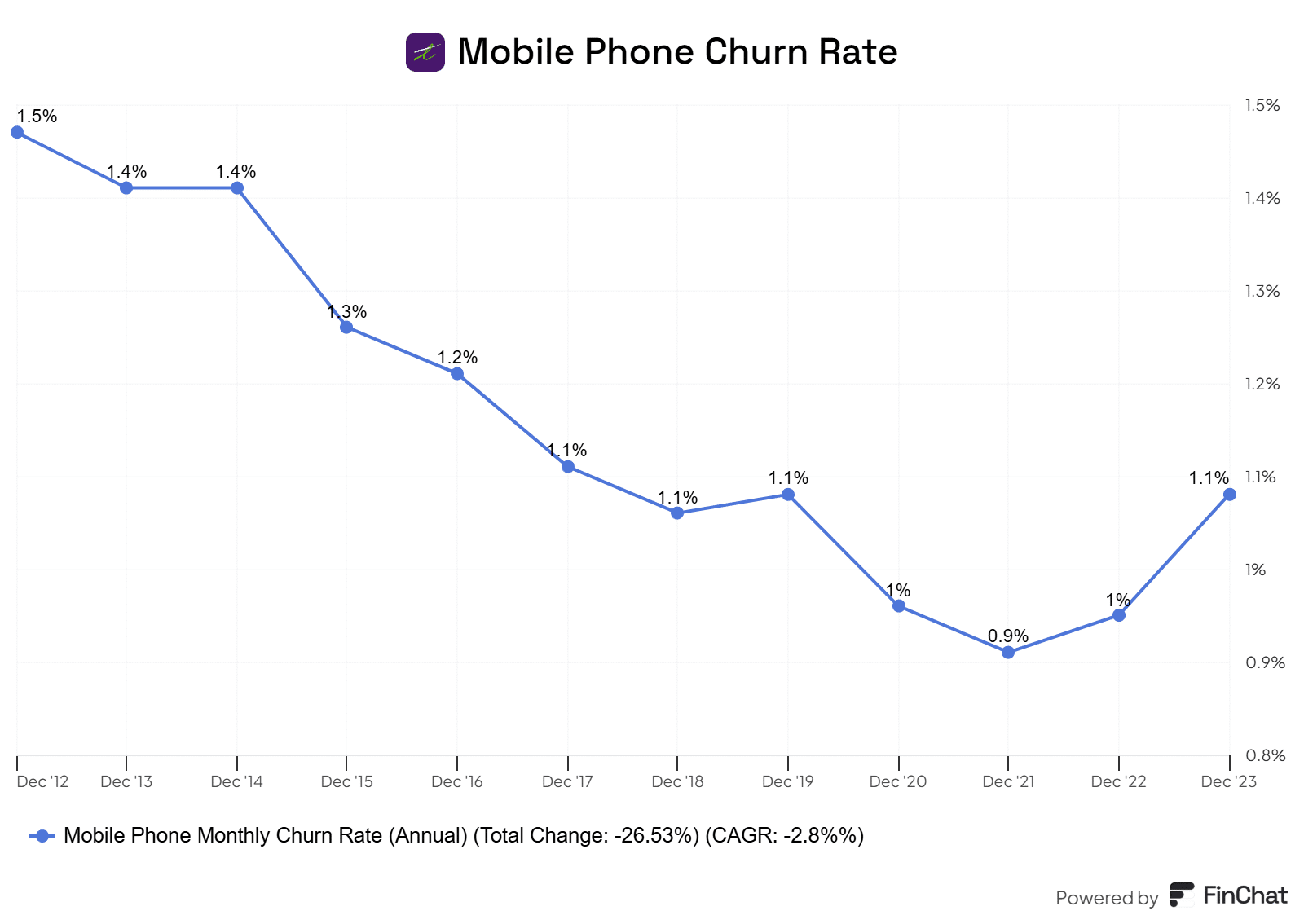
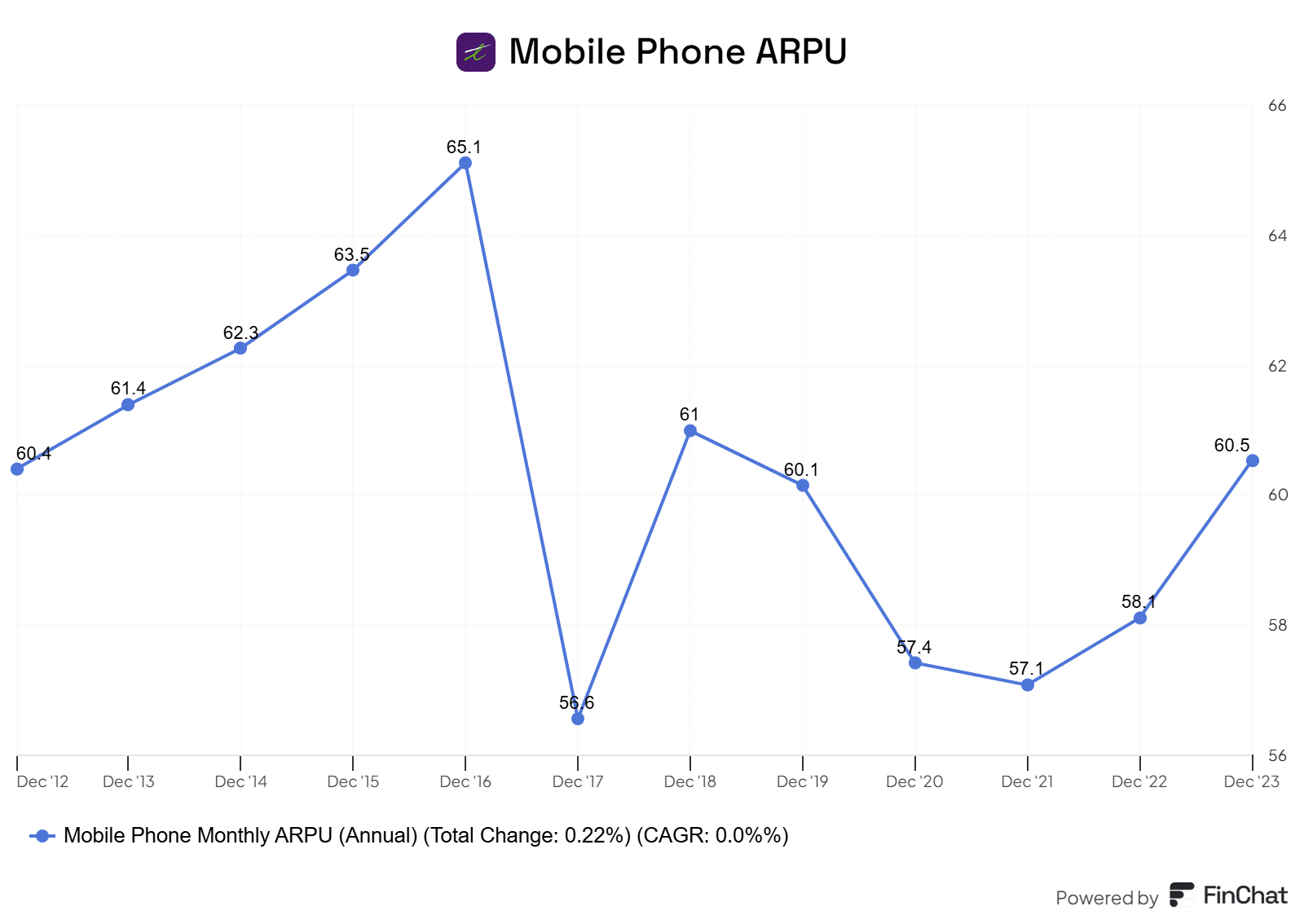
They added 167,000 mobile subs (55k phones, 112k connected devices) and 31,000 fixed-line connections. Churn rates came in at 0.9%, which is best in class among the major telecoms here in Canada. The only added difficulty here is ARPU, or average revenue per customer, declined by 3.3%. It is fairly clear the company is having to offer more attractive prices to keep customers. On a positive note, this is happening to every telecom player, not just TELUS.

TELUS Health had another standout quarter, with revenue up 16% and adjusted EBITDA up 29%. Lives covered rose to 157 million globally. Synergies from LifeWorks are now well above $400M, which is above their initial targets. The one interesting thing in this regard is TELUS has wanted to spin off its Health division for some time now. But I do believe with the difficulties they had with the TELUS International spinoff, they’ll be holding off. There likely isn’t much trust here in regards to making this spinoff a success.

Speaking of TELUS International (now TELUS Digital), operating revenue came inline, but EBITDA saw margin compression tied to pricing pressure. This led to a $500M impairment charge, which caused earnings to fall to effectively break even. TELUS Digital is struggling mightily, and it has been for a couple of years now.

Back to TELUS. Free cash flow rose 11% to $535M. The bulk of this is due to lower capital expenditures, but also some relief on the rates it pays on its debt which caused interest expenses to decline. TELUS confirmed it still intends to hit its full-year free cash flow target of $2.15B.

On the debt front, net debt/EBITDA fell to 3.7x and is on track for 3.55x by year-end. The medium-term target remains 3.0x, which would be one of the better leverage ratios out of the major telecom plays.

Arguably the biggest news on the quarter was the announcement of the partial monetization of its tower assets through a new entity, Terrion, in which La Caisse will take a 49.9% stake. The transaction will give TELUS $1.26B~, which will help reduce its leverage ratio.

This was a quarter where TELUS quietly executed. In fact, they have been for numerous quarters now, however sentiment has not returned to the industry. Its core business added subscribers and managed to maintain margins. Health continued to grow at a double digit pace, and it managed to find a partner for its towers, which allows it to take that capital, reduce its debt, and ultimately improve the balance sheet.

This is in stark contrast to a company like BCE, which sold its MLSE asset off, said it would pay down debt, and then a month later spent it on a $5B~ US Fiber acquisition. The worst part is BCE then realized it didn’t have the funding to grow it, and had to sell off some of the growth.

TELUS is positioning itself as a resilient, diversified telco with a management team that stands above the other Big 3 players.

Disclaimer

By utilizing this report, you agree that you are a Stocktrades Premium member, and you agree to our terms and conditions and privacy policy. You acknowledge that any distribution of this report outside of Stocktrades Premium could result in the immediate cancellation of your Premium subscription. You also agree to the following:

This stock report is solely for informative purposes, and does not represent a buy or sell recommendation. The information expressed in this report is the opinion of the analyst about the subject company and our database of stocks in general. The information the analyst used to compile this report comes from sources we believe are reliable. Stocktrades Ltd however makes no warranties of any kind as to the completion or correctness of the information within this document.

All information in this report is accurate as of the date of this report, and all data contained within this report of the subject company is of the analyst’s best judgement at the date of the report. The information contained in this report is subject to change without notice. The information provided in this report is provided for informational purposes by Stocktrades Ltd and Stocktrades Ltd assumes no legal responsibility or liability. Anyone using this report assumes full responsibility for whatever decision is arrived at by using the details of this report.

Stocktrades Ltd. assumes no liability or legal responsibility for the resulting actions and or consequences of using outdated information. No version of this report outside of the original located at www.stocktrades.ca/premium/ is to be considered to contain live, or accurate information. These reports are updated quarterly and it is the users responsibility to insure they have the most recent updated version.

You may not alter or distribute this report in any way without the full consent of Stocktrades Ltd.

The decision to purchase or sell of a security depends on a multitude of individual factors such as but not limited to risk tolerance, financial situation, and investment objectives.