[]
Login Join Premium

Bull List Report – Uber Technologies – UBER

Uber TechnologiesUBER

Uber Technologies is a technology provider that matches riders with drivers, hungry people with restaurants and food couriers, and shippers with carriers. The firm’s on-demand technology platform is currently utilized by traditional cars as well as autonomous vehicles, but could eventually be used for additional products and services, such as delivery via drones or electronic vehicle take-off and landing (eVTOL) technology. Uber operates in over 70 countries, with over 171 million users who order rides or food at least once a month.

Focus area

Score

Valuation

35

Profitability

78

Risk

36

Returns

49

Dividend

Outlook

75

Debt

63

Growth

99

Overall

66

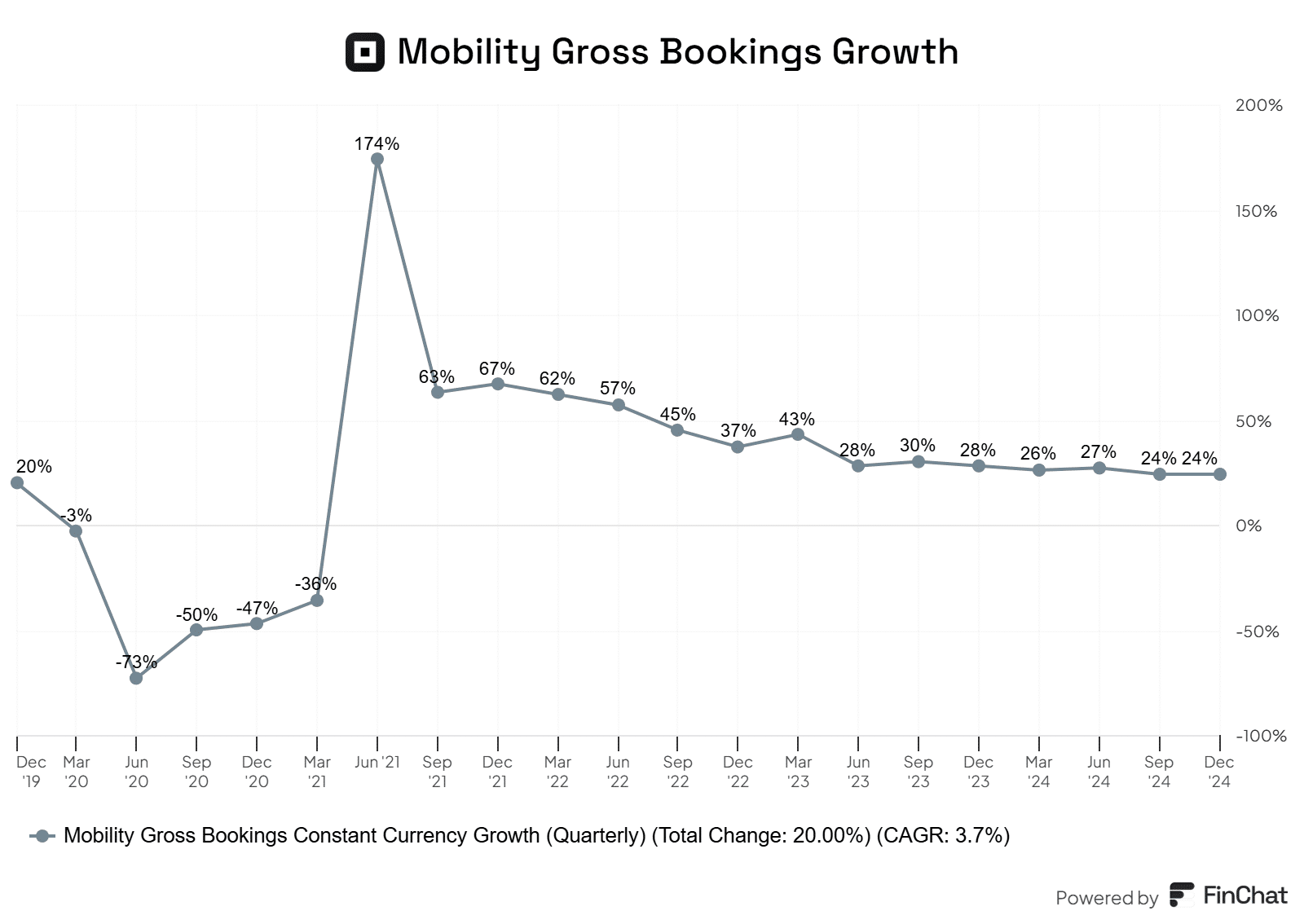
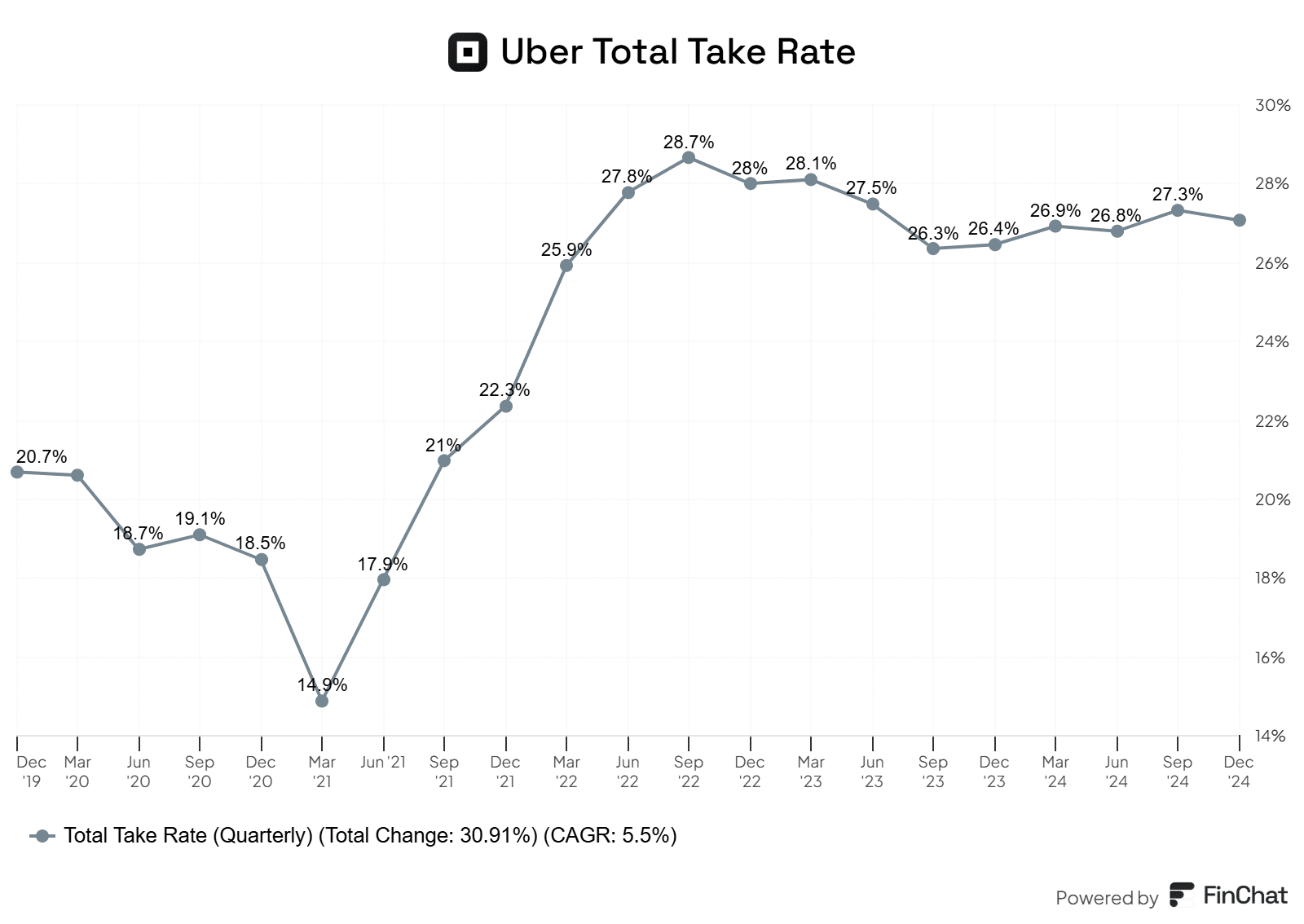
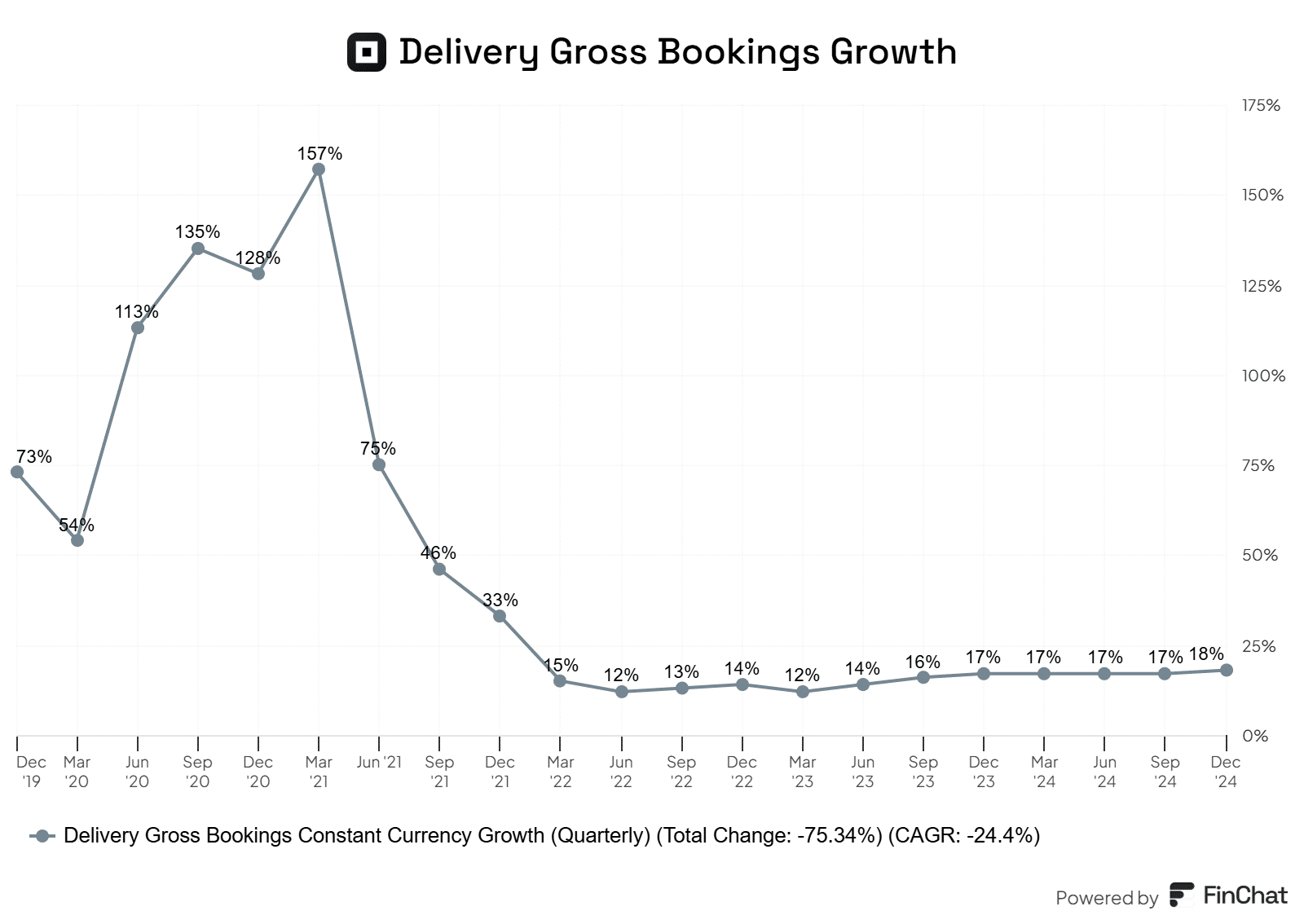
Click the KPI images to expand them if needed!
Pros

  • The company’s network effect is gigantic, operating in over 70 countries and completing over 11.3 billion trips in 2024
  • Although the company’s bread and butter is rideshare (55%~ of revenue), its delivery (35%) and freight (10%) segments provide some diversity in its business model
  • The company’s balance sheet is sound, and the company is well beyond the cash-burning stage, generating nearly $7B in free cash flow last year
  • The company doesn’t own the assets utilized to generate revenue. This leads to extremely low capital expenditures relative to its revenue, which ultimately fuels free cash flow generation
  • The company has abandoned the idea of making its own autonomous vehicles and is now utilizing its scale and leverage to partner with AV companies like Waymo (Google)
  • Because the company is asset-light, it can grow revenue by double digits without spending a ton of money or requiring debt/equity issuances, which fuels free cash flow growth
  • Its established market position is a large deterrent for new companies to enter the space attempting to take market share

Cons

  • Regulatory risks are notable. (I’ll get into this more in the potential risks section) Thus, Uber’s profitability can be significantly impacted by something as simple as their drivers being classified as contractors or employees
  • Although its rideshare segment is expected to see demand regardless of the economic environment (to a certain degree), the delivery side of the business is certainly dependent on consumers’ willingness to spend. The economic exposure impact is also extended to its freight business but is a relatively small portion of revenue overall
  • Operating in 70 different countries creates a confusing situation in terms of currencies and regulatory requirements

It has been interesting to watch Uber transition from a cash-burning startup to a cash-flowing, dominant rideshare company. Investments into growing the company’s market share and dominant position are now paying off, and it certainly has my attention. I believe regulatory issues and some fears in terms of autonomous vehicles are keeping this company’s stock price flat. However, I believe long-term accumulators who can sift through the noise here will be rewarded, as the growth is substantial.

When we are in need of personal transport, especially in urban areas, and we don’t happen to have a vehicle at that moment in time, Uber is often the first thing we think of. You could arguably put the commonly used phrase, “take an Uber,” right up there with “Google it.” Obviously, these are two different situations (one being getting somewhere you need to go and the other being finding information), but when people need a ride and they need it immediately, they often think of Uber. This type of brand recognition certainly shouldn’t be undervalued.

As extensive brand recognition takes hold, the company needs to spend less on marketing as it becomes a household name. As this continues and more and more people ride with Uber, it can lower trip costs while maintaining profitability, add more drivers to the platform, and continue its business flywheel.

Although the company is dominant in the rideshare industry, it does have some diversity in its business in the form of Uber Eats and its Freight segment. Although its Uber Eats segment certainly has more competition and Uber is not the direct market leader (Doordash would have that title), that segment of the business is still growing well and expanding margins. And while Doordash is solely a food delivery company, Uber is multi-faceted, allowing it to capitalize on platforms like its Uber One system, where loyal customers can gain access to both rideshare and food delivery.

As I had mentioned, the company is beyond the cash-burning stage and is now a substantial generator of free cash flow. It can do this because its business model is asset-light. It does not own the vehicles; it simply has a take rate it extracts from each transaction (see the KPI chart above). On $44B in revenue in 2024, the company spent $242M in capital expenditures or around 0.55% of revenue. If we compare this to an asset-heavy business like BCE, for example, they generated $24B in revenue on $4.5B in capital expenditures, or around 19% of revenue.

The company’s balance sheet is in outstanding shape, with nearly $7B in cash and long-term debt of $9.4B. And because the company’s brand is now scaling organically, the company will likely take on substantially lower debt and equity issuances in the future. In fact, it has even started to buy back shares.

For investors with a 5–10+ year horizon, Uber offers exposure to a dominant, high-utility consumer platform. The main difference between now and a few years ago is it has changed from a promising vision to a cash-flowing machine. Organic growth will now continue to scale as the company’s brand is growing, which should allow it to benefit from organic, cost-free growth of market share. And the dominant market share is a deterrent for new players to enter the industry. We’ve witnessed this with Lyft recently, which is stalling out.

Beta

1.8

Best monthly return

48.6%

Worst monthly return

-26.3%

Max drawdown

67.6%

The main risk for Uber, without question, is the regulatory situation. The company primarily benefits from not having to pay its drivers as employees. Drivers simply collect a portion of their fee from the ride-share, and Uber takes their cut. The difficulty here is this model has attracted the eyes of regulators and government bodies, some of which are attempting to make Uber reclassify its situation and instead make their drivers employees.

Contractors are a lot less capital intensive than employees, as they do not have to pay them a minimum wage or benefits. The more countries that force Uber to restructure how it compensates its drivers, the more impacted it would be. Although Uber has absorbed a lot of costs in the UK due to the restructuring of their worker status, it is an environment they must continue to navigate if more countries continue to change.

Last year, the company won a decision in the Supreme Court of California to allow them to keep their drivers on as contractors. But, it is important to keep an eye on the landscape moving forward, as anything can change.

The other potential headwind is autonomous vehicles. These are driverless vehicles that get people from point A to point B. In this situation, take rates would effectively improve to 100%, as the AV company would not have to pay a driver a commission for a particular trip. At this point in time, Uber is partnering with these companies (like Waymo), but if one of these AV companies decides to take on the task of developing a network themselves, it could erode market share.

I feel this is unlikely, as the costs to create a network similar to Uber’s size (remember, Uber doesn’t own the vehicles, Waymo would have to) would be astronomical. However, it is no doubt a risk.

There is also some macro-economic risk here. Although its mobility segment is relatively sheltered from economic conditions because it could be seen as a staple item to get people from point A to point B, it would still likely see an impact in terms of discretionary rides. In addition to this, its Uber Eats platform could easily be something consumers cut out in a recession. To some extent, this segment remains relatively defensive as well in terms of grocery deliveries etc. from people who don’t have vehicles, but discretionary spending in terms of food delivery would no doubt drop.

And finally, currency risk is always something people should consider when a company has exposure to a lot of countries. In Uber’s case, this is 70+. Earnings can vary as currencies fluctuate.

TTM

Historical average

Forward numbers

P/E

16.4

26.3

P/B

8.9

8.6

Earnings yield

6.1%

P/FCF

24.1

PEG ratio

-1.4

Valuations for Uber at this point in time are extremely misleading. When you see a forward P/E that is higher than trailing, you often think of declining earnings. Yes, earnings are expected to decline, but this is because the company realized a large one-time accounting gain in terms of tax carryforwards that boosted earnings. I won’t go into it in detail, but just know that Uber’s 2024 earnings were an anomaly due to some tinkering when it comes to accounting.

Uber is certainly not “cheap” by any stretch of the imagination. However, when you have a capital-light business model growing at 25-30% a year, the market is going to take notice and is going to pay a premium for the company. Uber is certainly a “Growth at a Reasonable Price” play, which is the foundation for most of the investments inside my own portfolio.

It is difficult to compare Uber on a valuation basis to its competitors (I get into that in the tab below), primarily because the company is far superior in scale, business model, and profitability than a company like Lyft. And because ride-sharing companies, at least on the publicly traded side of things, are few and far between, there isn’t much peer comparables you can do.

The company is also a bit difficult to value because of its wide variety of business models. For example, despite its freight segment generating $5B in revenue, it will be valued much lower than the delivery or ride share segments of the business because of the margin profiles.

If we take out the tax benefits the company realized in 2024, Uber would be trading at nearly 100x trailing earnings, which might bring up a ton of red flags for investors. However, this makes the forward P/E multiple of 25x even more attractive, as it highlights the extent the company is expected to grow moving forward.

At this point in time, I believe there is a reasonable margin of safety on Uber’s stock price, around 28%~, based on some assumptions of 15%~ revenue growth, margins expansion, and 3% terminal growth. Obviously, execution is key here, but if the company can execute, I believe it is discounted at the moment.

Uber (UBER)

Lyft (LYFT)

Doordash (DASH)

Earnings Yield

6.1%

1.1%

0.7%

5-year revenue growth

27.6%

9.9%

64.7%

ROIC

39.7%

4.9%

8.6%

Operating Margins

10.7%

0.3%

4.9%

Forward P/E

26.3

16.8

51.7

The one thing I want to highlight before I begin is that I have included Doordash on this competitor chart, but in reality it is only a competitor to Uber Eats. LYFT is the more appropriate competitor, and as you can see in the chart above, Uber has been the superior company.

Why the success while Lyft has struggled? Uber’s platform is better on almost all levels. The company has been good at encouraging user retention, including subscription services, while Lyft has not. This has led to Uber turning out large-scale profits while Lyft is barely cash flow positive. As we can see in the chart above, its operating margins are break-even, at best. This will likely result in Lyft having to take on more debt or equity issuances in the future in an attempt to grow its network.

We then have the difficulty of analyzing whether or not the capital spent will be worthwhile for Lyft, as it will have to be taking market share from Uber, which is in a much more dominant position and runs a better platform overall. So, debt or equity could easily be ill-spent.

Lyft is seen as smaller, niche, and increasingly stuck — it is a regional competitor, while Uber is a global force.

Last quarter

EPS

Revenue

Expectations

$0.86

$13.2B

Reported

$3.56

$13.4B

Surprise

311%

1.55%

Annual estimates

EPS

Revenue

2025

$6.2

$51.9B

2026

$4.34

$59.9B

2027

$5.22

$68.5B

Uber reported exceptional results. Some might be shocked because the price didn’t move all that much. However, this is mostly related to forward fears. The results at this point in time are outstanding.

Gross bookings grew 22% year-over-year, the fifth consecutive year of growth exceeding 20%. That was primarily driven by an acceleration in trips, which now exceeds 15B on an annual run rate, and its overall customer base now exceeds a whopping 200 million active visitors a month.

The most eye-catching metric, however, is the cash generation: Uber generated $8.7 billion in adjusted EBITDA and $9.8 billion in free cash flow, up 42% year-over-year. It is rare to see free cash flow exceed EBITDA by such a wide margin in a capital-light business. This cash cow status allows Uber to aggressively buy back its own stock, which management called “really cheap”, all while investing capital back into the business as well. Over the long-term, companies in this position tend to provide compounded growth.

One of the most important aspects of this quarter was the commentary on autonomous vehicles. Why? Well, this is what has been dragging Uber down. Khosrowshahi argued that autonomous vehicles will not replace Uber. In fact, he said it will “supercharge” it. His core thesis is that AVs suffer from low utilization when operated as standalone fleets, but when plugged into Uber’s hybrid network, utilization jumps significantly. Again, I have said time and time again, Uber’s value is not in the actual vehicles, it is in the network.

Uber claims AVs on its platform see 30% higher trips per vehicle per day than first-party fleets. If Uber can generate more revenue per car than Waymo or Tesla can on their own, the hardware makers will be incentivized to partner with Uber rather than fight it. Building out Uber’s network without extensive cash flows re-invested is a difficult task.

Uber is assembling a coalition of partners, including Waymo, NVIDIA, Waabi, Avride, Nuro, and Lucid. What this is doing is positioning itself as the demand layer. The company has mentioned they are seeing an accelerated amount of AV bookings in cities where it is popular, suggesting that the network effect is in full display.

Management mentioned that 70% of the U.S. is outside its top markets, yet these areas are growing 1.5 to 2 times faster than the core cities. The growth is simply untapped there.

Uber’s delivery business is performing excellent as well. The segment is accelerating, driven by a massive push from Uber into grocery and retail, where Uber has now partnered with five of the top ten U.S. grocers. The trend is undeniable. People either do not want to leave their houses because they find it more convenient to simply order groceries to their door, or they do not have a means to get to the grocery store. Either way, Uber benefits.

This diversification is critical because it increases the stickiness of the platform. Users who order groceries and rides are far less likely to churn. Advertising has also become a huge driver. This is pure profits falling to the bottom line. People are ad-blind these days, and showing ads is likely to result in zero churn. We have witnessed this from major platforms like Amazon and Netflix. And the thing is, those ads are a direct impact to your viewing experience, and they still have very little churn.

The glue holding all of this together is the Uber One membership program. 46 million members that account for nearly 50% of total gross bookings. This membership base provides a predictable, recurring revenue stream that acts as a buffer against a rocky economy. Uber used to be extremely cyclical and prone to fluctuations in demand. This membership removes some of that.

In terms of guidance, the company is projecting continued acceleration in the U.S., fueled by insurance leverage and growth in the suburbs, like I mentioned earlier. The company’s strategy from a spending perspective is clear: reinvest in organic growth and return the rest to shareholders through aggressive buybacks.

Disclaimer

By utilizing this report, you agree that you are a Stocktrades Premium member, and you agree to our terms and conditions and privacy policy. You acknowledge that any distribution of this report outside of Stocktrades Premium could result in the immediate cancellation of your Premium subscription. You also agree to the following:

This stock report is solely for informative purposes, and does not represent a buy or sell recommendation. The information expressed in this report is the opinion of the analyst about the subject company and our database of stocks in general. The information the analyst used to compile this report comes from sources we believe are reliable. Stocktrades Ltd however makes no warranties of any kind as to the completion or correctness of the information within this document.

All information in this report is accurate as of the date of this report, and all data contained within this report of the subject company is of the analyst’s best judgement at the date of the report. The information contained in this report is subject to change without notice. The information provided in this report is provided for informational purposes by Stocktrades Ltd and Stocktrades Ltd assumes no legal responsibility or liability. Anyone using this report assumes full responsibility for whatever decision is arrived at by using the details of this report.

Stocktrades Ltd. assumes no liability or legal responsibility for the resulting actions and or consequences of using outdated information. No version of this report outside of the original located at www.stocktrades.ca/premium/ is to be considered to contain live, or accurate information. These reports are updated quarterly and it is the users responsibility to insure they have the most recent updated version.

You may not alter or distribute this report in any way without the full consent of Stocktrades Ltd.

The decision to purchase or sell of a security depends on a multitude of individual factors such as but not limited to risk tolerance, financial situation, and investment objectives.