[]
Login Join Premium

Bull List Report – Well Health Technologies – TSE:WELL

WELL Health Technologies – WELL.TO

WELL Health Technologies Corp is a practitioner-focused digital healthcare company. It has seven reportable segments that are grouped into three key business units: Canadian Patient Services that includes Primary and Specialized MyHealth. WELL Health USA Patient Services includes Primary Circle Medica, Primary WISP, Specialized CRH Medical, and Specialized Provider Staffing and SaaS and Technology Services. It generates the majority of its revenue from Well Health USA Patient and Provider Services unit.

Focus area

Score

Valuation

52

Profitability

13

Risk

36

Returns

71

Dividend

NA

Outlook

100

Debt

46

Growth

82

Overall

46

Click the KPI images to expand them if needed!
Pros

  • Covid-19 pandemic accelerated the shift to virtual medicine
  • Diversified base, including physical clinics, virtual health care, and EMR
  • Third-largest electronic medical record (EMR) provider in Canada
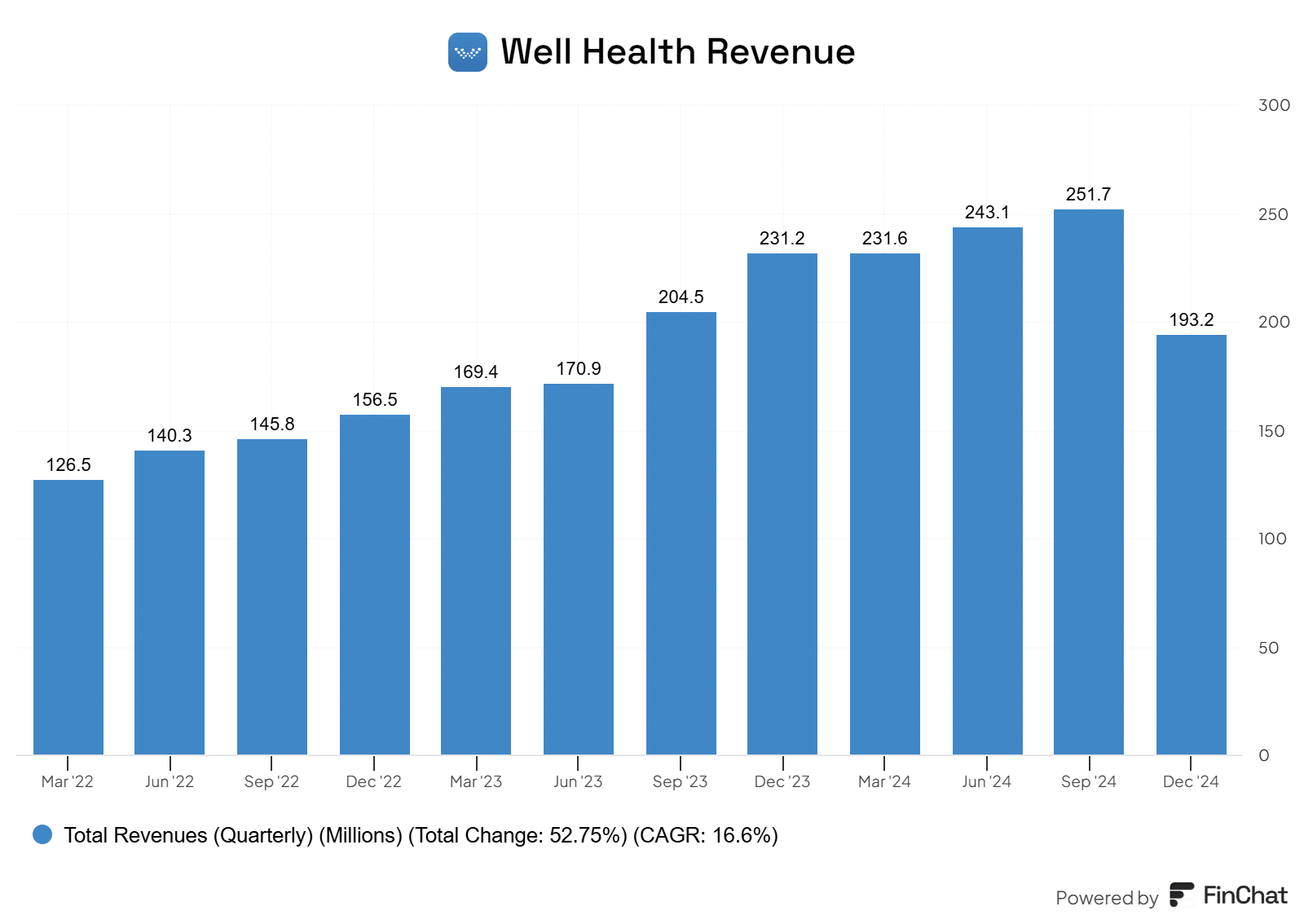
  • A fast-growing company with impressive growth rates
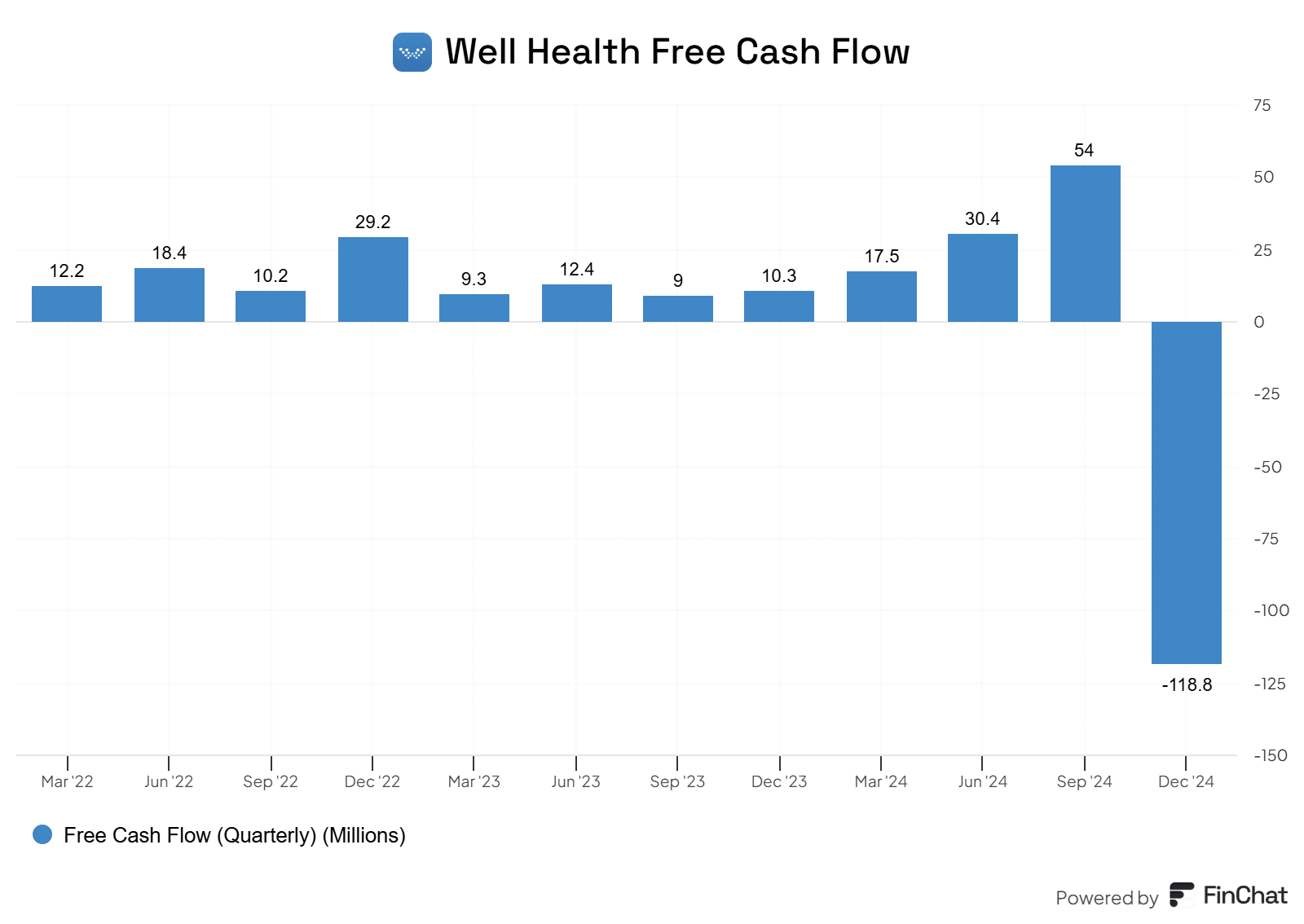
  • Starting to generate positive cash flow and EBITDA
  • Strong revenue growth (+25%) in FY ’25 expected
  • Company is continually revamping its guidance upwards
  • Insiders bought large chunks of shares in 2024

Cons

  • Earnings are still volatile
  • At risk of potentially growing too fast
  • Slowing virtual health adoption as the pandemic has resided
  • Growth through acquisition strategy could become more expensive as competition increases
  • Circle Medical billing situation resulted in the company pulling back 8%~ of revenue in 2024
  • The company is struggling with overall profitability, leading to some hesitancy that its acquisition model is working

What still separates WELL from most digital-health peers is its hybrid model: the company owns the largest outpatient clinic network in Canada while simultaneously running one of the country’s most widely used practice-management and virtual-care software ecosystems. Virtual health isn’t replacing in-person care, and in-person care isn’t replacing virtual. WELL’s strategy is built on the understanding that the winning model integrates both, and that strategy is now showing meaningful operating leverage.

What makes WELL compelling today is the shift from a “growth at any price” roll-up to a business that is increasingly generating consistent cash flow, expanding margins, and leaning into higher-quality recurring revenue. The company’s 2025 outlook remains one of the strongest among small-cap Canadian tech names, with management guiding to mid-20% revenue and EBITDA growth.

That guidance is backed by clearer visibility than in prior years. Primary care demand remains high, virtual visits are stabilizing at post-pandemic levels, and software revenues continue to scale with attractive margins. WELL’s recurring and reoccurring revenue base is now large enough that incremental growth is translating to improved operating cash flow instead of share dilution or higher debt.

The company’s position in outpatient care provides a stable foundation that many digital-health names simply don’t have. These clinics continue to produce steady, predictable cash flows, which WELL uses to fund smaller, accretive acquisitions rather than outsized bets.

What’s flown under the radar is WELL’s organic growth. Even without acquisitions, the company has been expanding at a pace north of 30%, driven by software utilization, higher patient throughput at clinics, and operational efficiencies from AI-enabled workflow tools. Most small-cap healthcare tech players sacrifice profitability to achieve similar growth rates, but WELL continues to deliver positive free cash flow and improving margins, reflecting a business that is maturing from a capital-heavy roll-up into a scalable operating platform.

From an industry standpoint, WELL remains one of the very few ways Canadians can gain public-market exposure to healthcare in Canada, an area that is under-represented on the TSX. Demand for accessible primary care, digital triage, and integrated hybrid care is only rising, and the market is projected to grow at double-digit rates for years.

WELL Health today is no longer just an acquisition story. It is a profitable, diversified healthcare operator with improving cash generation and a long runway for both organic and M&A-driven growth.

Beta

1.0

Best monthly return

32.3%

Worst monthly return

-27.7%

Max drawdown

71.5%

WELL Health’s business model relies on growth by acquisition. Although it can be a successful and rewarding strategy, there are potential pitfalls. The most common is a lack of synergies. Typically, serial acquirers pick up companies and integrate them into the fold, reducing duplication and achieving synergies. However, this doesn’t always go smoothly and can lead to write-downs and negative or lower-than-expected financial benefits.

A second risk most applicable to Well Health is the increased competition for assets. Several virtual health companies have a similar growth-through-acquisition strategy. Although there is room for multiple players, increased competition for assets will result in higher acquisition prices. A disciplined approach is needed, as turbulence in acquisitions or synergies can lead companies to overpay for assets.

A significant near-term risk is the ongoing regulatory investigation in the United States concerning its subsidiary, Circle Medical. This investigation by the US Attorney’s Office for the Northern District of California into Circle Medical’s billing practices led to Well Health not being able to file its fourth-quarter results and annual report. Although it looks like things are resolved at this point in time, the investigation is not over, and there could be more issues under the surface.

With the company operating primarily in a public healthcare system, there are also added regulatory risks. A change in government policy here in Canada or even an insurance policy south of the border where healthcare is private could impact its overall revenue streams. An example of this would be if insurers or governments change their reimbursement policy for digital healthcare services.

In addition to this, the rapid development of artificial intelligence could prove to be both a headwind and a tailwind for the company. The development of artificial intelligence could render some of Well Health’s services no longer needed. However, on the flip side, if Well Health can integrate some AI services into its business, it could end up generating more revenue in a higher-margin environment.

TTM

Historical average

Forward numbers

P/E

15.2

EV/EBITDA

25.8

Earnings yield

-9.9%

P/FCF

PEG ratio

0.1

WELL’s valuation today reflects a business that the market still views with caution, despite a materially improved underlying profile. In fact, this is arguably one of the more frustrating stocks on the Toronto Stock Exchange, as the market truly seems to have no idea what to value this company at.

Shares trade at a forward earnings multiple of 10.5x. To me, this level suggests investors are pricing in execution risk rather than the growth and margin expansion the company is now delivering. In most situations, companies that are growing at a 20-30% pace do no trade at only 10x those expected earnings. Often, it is more than double that valuation.

This disconnect is what creates the opportunity. WELL’s recurring and reoccurring revenue base is growing, margins are expanding, and cash flow generation is stabilizing.

For a company guiding to mid-20% growth in both revenue and EBITDA, these multiples are unusually low, particularly when compared with private-market valuations for outpatient clinics or software-enabled healthcare platforms, which often command far higher EBITDA and revenue multiples.

As the company continues to demonstrate cleaner financial reporting, consistent free cash flow, and disciplined M&A with accretive clinic multiples, the market should begin to re-rate the stock toward peers. Even modest multiple expansion paired with WELL’s underlying growth offers compelling upside.

Profitability and trust has always been an issue with WELL Health, but I do believe at some point it will move out of the penalty box in terms of valuations and the market will reward it.

Well Health (WELL)

Hims & Hers (HIMS)

Teladoc (TDOC)

Gross margins

31.6%

67.1%

55.6%

Operating Margins

-0.5%

6.8%

-7.1%

5-year Revenue Growth

94.8%

-%

35.9%

5-year annualized return

-6.5%

34.8%

-46.5%

ROIC

-9.2%

27.4%

-7.9%

WELL Health has plenty of competition in both the virtual health and clinic industries. In Canada, the company lists Babylon (Telus), Medeo (Loblaw), Doxy.me, and Maple as key competitors in the telehealth space. As you can see, there are some big names.

Not surprisingly, Teledoc (TDOC) in the US has been identified as its main competition, along with Hims & Hers and OneMedical. All this to say, the industry is still highly fragmented, with many players in the space. This is why WELL’s acquisition strategy is sustainable over the long term, as plenty of small-to-mid-sized businesses could be integrated into WELL’s ecosystem.

The only difficulty here is the business models are vastly different, which is why the comparison chart above should be taken with a grain of salt. If we look at WELL Health’s gross margins, we see they are notably lower than something like HIMS and TDOC. However, WELL Health does operate a lot of physical clinics and electronic medical records, whereas Hims & Hers primarily provides consultations and prescription medications for a variety of health concerns.

The same can be said for TDOC, which primarily focuses on digital health. Another aspect of this is HIMS and TDOC operate in the United States, where the healthcare system is private and has higher levels of profitability, whereas WELL Health’s business is in the US, but primarily located in Canada, which is a much heavier-regulated environment because of the public healthcare system.

Last quarter

EPS

Revenue

Expectations

$0.09

$368.13M

Reported

$0.16

$364.60M

Surprise

67.29%

-0.96%

Annual estimates

EPS

Revenue

2025

$0.38

$1.40B

2026

$0.39

$1.55B

2027

$-

$1.68B

WELL Health Technologies posted a strong Q3 from a headline standpoint. Revenue hit $364.6M, up 56% year over year, and adjusted EBITDA came in at $59.9M, nearly quadruple last year’s figure. That said, a chunk of the EBITDA gain came from deferred revenue recognition at Circle Medical.

Excluding that, adjusted EBITDA would have been $42.3 million, still a solid 180% jump. The real story is what’s happening under the hood: Canadian operations are surging, technology segments are maturing into high-margin contributors, and management is pushing hard to redeploy capital toward its most efficient assets.

In Canada, the clinic network continues to grow at a strong pace, with 1.08 million patient visits in Q3 alone. This is a 38% increase from last year, along with 17% growth in billable providers and a 19% bump in visits per provider.

WELL’s acquisition machine hasn’t slowed down either, with five clinic deals in Q3 totaling $27.5M in annual revenue, and a massive $235M in clinic revenue now under signed LOIs.

Beyond clinics, WELL Star, which is their SaaS platform aimed at outpatient providers, is emerging as a core value driver. The segment posted 67% year-over-year revenue growth and 35% EBITDA margins. WELL Star also closed a $62M million equity raise and is on track for a 2026 IPO, with a goal of scaling to over $100M in run-rate revenue.

The business has been expanding both organically and through acquisitions, including the purchase of Neutro (an AI scribe platform) and a pending billing company deal. This adds more firepower to a three-pronged growth approach: EMR, billing, and physician productivity tools. Meanwhile, HealWell, WELL’s enterprise-facing AI arm, delivered $30.4M in revenue and hit positive EBITDA for the first time.

On the U.S. side, the divestiture process continues to unfold. I do believe this is one of the main things holding the company’s share price back right now, as there are a lot of questions in regards to this side of the business.

Wisp, Circle Medical, and CRH Healthcare are all up for sale, with management reiterating its goal of completing at least one transaction by year-end. CRH, in particular, seems closest to the finish line after a partial divestment this quarter. Despite the regulatory challenges, Circle Medical showed signs of stabilization with Q3 revenue up 32% and EBITDA up 14%.

Management emphasized that capital unlocked from these sales would likely be cycled back into Canadian acquisitions, where ROIC is highest and integration has been proven.

Importantly, the company reaffirmed its full-year guidance of $1.4–1.45B in revenue and expects to land toward the upper end of its $190–210M adjusted EBITDA target.

Overall, WELL is entering 2026 with significant momentum. The Canadian engine is firing on all cylinders, the tech arms are scaling, and the company should be able to move on from a lot of US businesses, which should give it the cash to expand more in Canada.

The stock has gotten no love for a few years now, but I do believe it is only a matter of time.

Disclaimer

By utilizing this report, you agree that you are a Stocktrades Premium member, and you agree to our terms and conditions and privacy policy. You acknowledge that any distribution of this report outside of Stocktrades Premium could result in the immediate cancellation of your Premium subscription. You also agree to the following:

This stock report is solely for informative purposes, and does not represent a buy or sell recommendation. The information expressed in this report is the opinion of the analyst about the subject company and our database of stocks in general. The information the analyst used to compile this report comes from sources we believe are reliable. Stocktrades Ltd however makes no warranties of any kind as to the completion or correctness of the information within this document.

All information in this report is accurate as of the date of this report, and all data contained within this report of the subject company is of the analyst’s best judgement at the date of the report. The information contained in this report is subject to change without notice. The information provided in this report is provided for informational purposes by Stocktrades Ltd and Stocktrades Ltd assumes no legal responsibility or liability. Anyone using this report assumes full responsibility for whatever decision is arrived at by using the details of this report.

Stocktrades Ltd. assumes no liability or legal responsibility for the resulting actions and or consequences of using outdated information. No version of this report outside of the original located at www.stocktrades.ca/premium/ is to be considered to contain live, or accurate information. These reports are updated quarterly and it is the users responsibility to insure they have the most recent updated version.

You may not alter or distribute this report in any way without the full consent of Stocktrades Ltd.

The decision to purchase or sell of a security depends on a multitude of individual factors such as but not limited to risk tolerance, financial situation, and investment objectives.